Facts
The petitioner was employed as a conductor with the Delhi Transport Corporation (DTC) from 29 April 1983.
Source reference: pp. 1–3; paras. 1–4During an inspection on 6 October 1994, eleven passengers were allegedly found travelling without tickets, despite having paid ₹124 as fare to the petitioner.
Source reference: pp. 1–3; paras. 1–4Eleven unpunched tickets of corresponding denominations were allegedly recovered and surrendered.
Source reference: pp. 1–3; paras. 1–4Following a departmental enquiry, the petitioner was removed from service with effect from 27 April 1998.
Source reference: pp. 1–3; paras. 1–4The Labour Court upheld the fairness of the enquiry and the punishment of removal, holding that non-counting of cash and non-examination of passengers did not vitiate the proceedings.
Source reference: pp. 1–3; paras. 1–4The petitioner challenged the Labour Court’s order and award under Article 226 of the Constitution.
Source reference: pp. 1–3; paras. 1–4Issues
1. Whether the departmental enquiry and the finding of misconduct were vitiated because DTC did not verify the petitioner’s cash at the time of inspection as contemplated by the departmental instructions.
Source reference: pp. 5–7, 9–12; paras. 16–222. Whether the non-recording or non-examination of independent and ticketless passengers rendered the enquiry unfair or insufficient to establish the charge of non-issuance of tickets.
Source reference: pp. 6–9; paras. 17–203. Whether the Labour Court’s findings and the punishment of removal warranted interference under the High Court’s supervisory jurisdiction under Article 226.
Source reference: p. 5; paras. 14–15, 23–24Law Applied
The High Court applied the principle that judicial review under Article 226 is supervisory and not appellate; a writ court should not reappreciate evidence or substitute its view for that of the Labour Court unless the findings are arbitrary or perverse.
Source reference: para. 14In departmental proceedings, strict rules of evidence do not apply, and misconduct is established on the preponderance-of-probabilities standard, provided there is some material supporting the finding.
Source reference: para. 15Relying on State of Haryana v. Rattan Singh, (1977) 2 SCC 491, the Court held that non-recording or non-examination of passengers and reliance on the evidence of checking staff do not automatically invalidate a disciplinary proceeding.
Source reference: paras. 16–20The departmental circulars and Office Order dated 28/30 June 1967 were treated as rules of prudence and administrative instructions, rather than mandatory statutory requirements; their breach would matter only where it caused prejudice or left the charge unsupported.
Source reference: paras. 16–20The Court further relied on UPSRTC v. Suresh Chand Sharma, (2010) 6 SCC 555, DTC v. Anup Singh, 2006 SCC OnLine Del 1065, Delhi Transport Corporation v. Shyam Singh, 2012:DHC:2113-DB, DTC v. Ram Avtar Sharma, 2026 SCC OnLine Del 3929, and Nathi Ram v. Delhi Transport Corporation, 2018 SCC OnLine Del 12099, to hold that cash verification is not an indispensable precondition for proving non-issuance of tickets; its absence assumes significance only when the remaining evidence is substantially deficient.
Source reference: paras. 21.1–21.6Reasoning
The Court held that the departmental instructions requiring cash verification and recording of passenger statements were intended to standardise procedure and did not prescribe mandatory conditions whose breach would automatically nullify the enquiry.
Source reference: paras. 16–19Although the petitioner’s cash had not been counted and independent passengers had not been examined, the ticketless passengers’ statements had been recorded and signed by the petitioner, while the checking officials consistently testified that eleven passengers were travelling without tickets and that the petitioner had collected the fare.
Source reference: para. 20DTC had also attempted to secure the passengers’ attendance by issuing notices, but some notices were not served and some passengers did not appear despite service.
Source reference: para. 20Unlike cases where the evidence was materially inconsistent or substantially deficient, the present record contained corroborative material and no significant contradiction in the management witnesses’ testimony.
Source reference: paras. 15, 20–22Therefore, the absence of cash verification did not displace the finding of guilt, particularly since departmental proceedings are governed by preponderance of probabilities and not proof beyond reasonable doubt.
Source reference: paras. 15, 20–22Given the petitioner’s repeated past misconduct, the Court found no basis to interfere with the punishment of removal.
Source reference: para. 23Holding
The Court answered the issues against the petitioner.
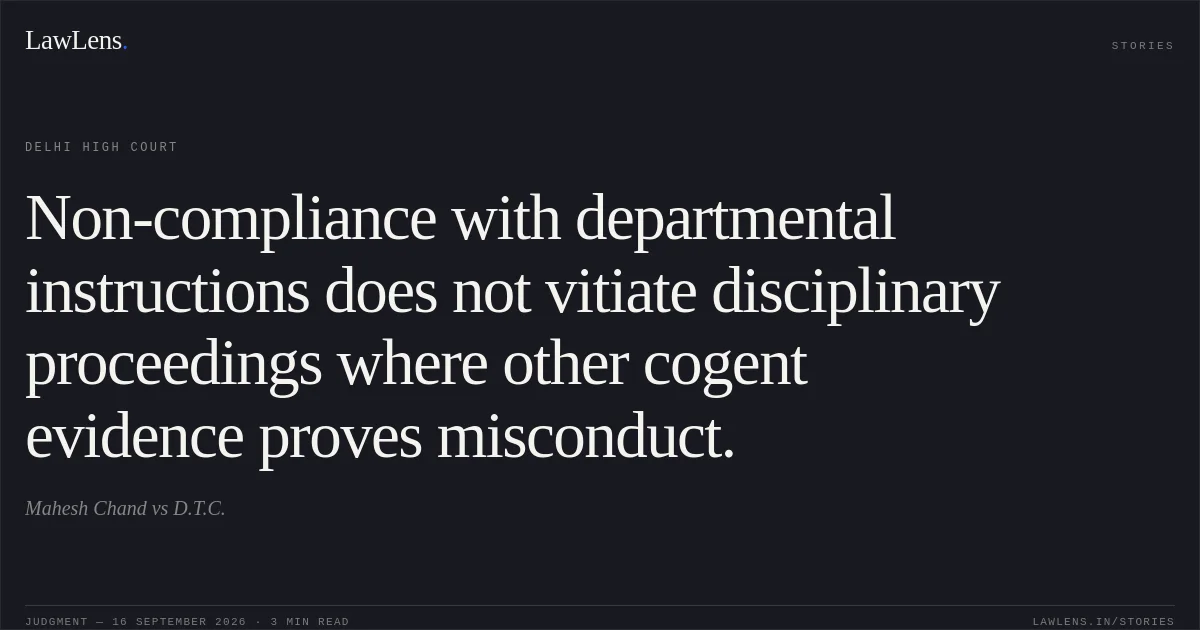
It held that non-compliance with the departmental instructions regarding cash verification and passenger examination did not, in the circumstances, vitiate the enquiry or render the misconduct unproved.
Source reference: paras. 22–24The Labour Court’s concurrent findings were neither perverse nor arbitrary, and the punishment of removal was not disproportionate in view of the petitioner’s past conduct.
Source reference: paras. 22–24The writ petition was accordingly dismissed.
Source reference: paras. 22–24Original Court PDF
Mahesh ChandvsD.T.C.
Click to open original judgment
Original judgment, available to read, download and summarize on LawLens.in