Facts
The Ahmedabad Municipal Corporation’s Food Inspector visited the respondent’s food stall on 19 December 2008 and purchased a sample of butter allegedly used in preparing sandwiches and dabeli.
Source reference: p.2, para.12The Public Analyst reported that the sample did not conform to the prescribed standards for butter and was adulterated.
Source reference: p.1, paras.1–2.2After sanction for prosecution, the Corporation filed Criminal Case No.1345 of 2009 for offences under Section 7(1), punishable under Section 16(1)(a)(l) of the Prevention of Food Adulteration Act, 1954.
Source reference: p.1, paras.1–2.2At the accused’s request, the sample was forwarded to the Central Food Laboratory, Mysore under Rule 4(4) of the Prevention of Food Adulteration Rules, 1955; the report stated that the sample was fit for analysis and that the seals were intact, but the trial court found non-compliance with the mandatory requirements concerning verification/comparison of the seal impressions.
Source reference: p.2, para.2.2; p.8, para.13The Metropolitan Magistrate acquitted the accused on 10 October 2012.
Source reference: p.1, para.1The Ahmedabad Municipal Corporation challenged the acquittal under Section 378 of the Code of Criminal Procedure, 1973.
Source reference: p.1, para.1Issues
1. Whether the trial court was justified in acquitting the accused on the basis of the evidence and alleged non-compliance with Rule 4(4) of the Prevention of Food Adulteration Rules, 1955.
Source reference: p.6, para.112. Whether the trial court correctly appreciated the prosecution evidence and whether its findings suffered from illegality, irregularity, or perversity warranting appellate interference.
Source reference: p.6, para.113. Whether the Central Food Laboratory report could be relied upon despite the omission to record comparison of the seal impressions.
Source reference: p.5, para.9.1Law Applied
The Court applied Section 378 CrPC governing appeals against acquittal, and Sections 7(1) and 16(1)(a)(l) of the Prevention of Food Adulteration Act, 1954 concerning prohibition and punishment of adulterated food.
Source reference: p.1, para.1It considered Section 13(2) of the Act, under which the accused is entitled to have the sample analysed by the Central Food Laboratory, and Rule 4(4) of the Prevention of Food Adulteration Rules, 1955, requiring proper verification of the condition and seal impressions of the sample forwarded for analysis.
Source reference: p.7, para.12; p.8, para.13On appellate review of acquittal, the Court relied principally on Chandrappa v. State of Karnataka, reaffirmed in Rajesh Prasad v. State of Bihar, Babu Sahebagouda Rudragoudar v. State of Karnataka, and Ramesh v. State of Karnataka: although an appellate court may fully reappreciate the evidence, an acquittal carries a double presumption of innocence and should not be disturbed where two reasonable views are possible; interference is justified only where the trial court’s conclusion is manifestly illegal or perverse.
Source reference: pp.10–12, paras.16–19Reasoning
The Court found that the trial court had properly considered the oral and documentary evidence, including the Public Analyst’s report, the Central Food Laboratory report, and the evidence of the Food Inspector and accompanying peon.
Source reference: pp.3–4, paras.3–4; p.7, para.12Although the Central Food Laboratory reported that the butter was adulterated and that the seals were intact, the trial court had held that the failure to record comparison of the seal impressions constituted breach of the mandatory safeguards under Rule 4(4).
Source reference: pp.2, 5, paras.2.2, 9.1; p.8, para.13The High Court agreed with that reasoning and with the line of Gujarat High Court authorities treating similar omissions in the Central Food Laboratory procedure as material.
Source reference: pp.8–10, paras.13–18It further held that the prosecution evidence did not establish the accused’s guilt beyond reasonable doubt and that the trial court’s view was a reasonably possible view.
Source reference: pp.8–10, 12–13, paras.13–18, 20–21Applying the heightened restraint applicable to appeals against acquittal, the Court found no perversity, manifest error, or illegality justifying reversal.
Source reference: pp.8–10, 12–13, paras.13–18, 20–21Holding
The High Court answered the issues against the appellant.
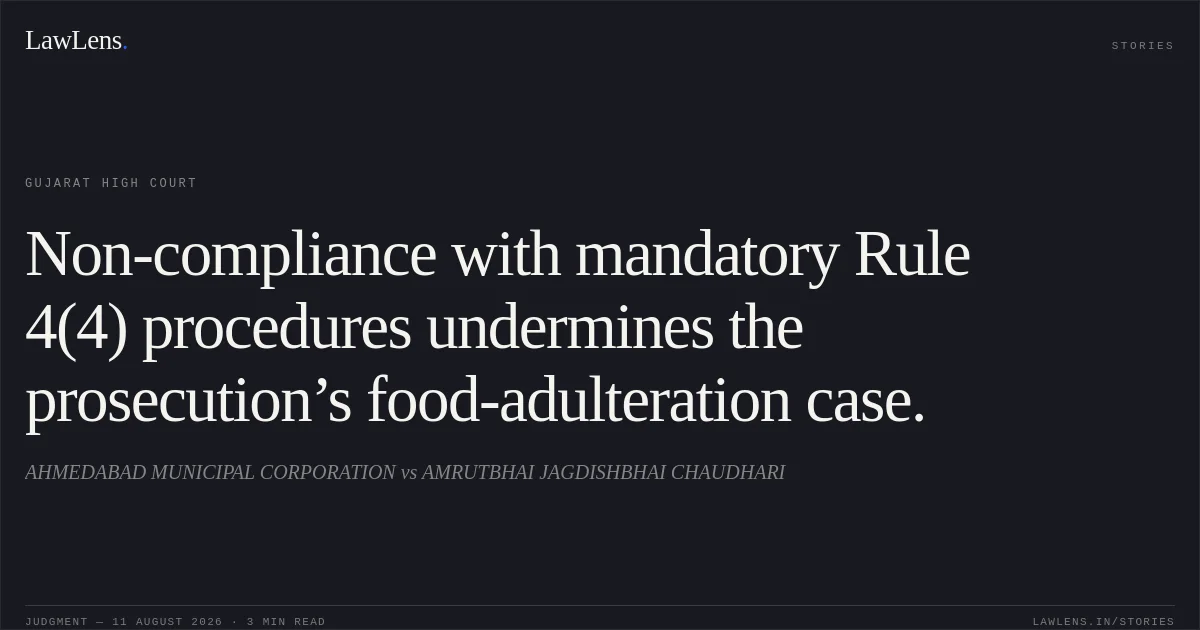
It held that the trial court had rightly acquitted the accused because the prosecution failed to prove the charge beyond reasonable doubt and the defect in compliance with Rule 4(4) materially undermined reliance on the Central Food Laboratory analysis.
Source reference: pp.12–13, paras.20–22The appeal was dismissed, the judgment and order of acquittal dated 10 October 2012 were confirmed, the bail bond was cancelled, and the record and proceedings were directed to be returned to the trial court.
Source reference: p.13, para.22Acts & Sections Cited
2 provisions across 1 statute referred to in this judgment. Each provision opens on LawLens.
Code of Criminal Procedure, 19732
Original Court PDF
AHMEDABAD MUNICIPAL CORPORATIONvsAMRUTBHAI JAGDISHBHAI CHAUDHARI
Click to open original judgment
Original judgment, available to read, download and summarize on LawLens.in