Facts
The borrower (S. Murugesan) availed a loan from Indian Bank in 1984, with G. Ramanujam (guarantor/appellant’s father) mortgaging his property as security
Source reference: para. 4aFollowing a default, a preliminary decree was passed in 1997
Source reference: para. 4bAfter the guarantor's death in 2001 and failed settlement attempts, the bank initiated recovery under the SARFAESI Act in 2009—nearly 12 years after the decree
Source reference: para. 4c, 4dA public auction held on 11.03.2010 saw Respondent 2 emerge as the successful bidder for Rs. 2.11 crore
Source reference: para. 4eThe appellant challenged the sale, alleging that the auction purchaser failed to deposit the mandatory 25% "immediately" and the remaining 75% within the statutory 15-day period (paid on 31.03.2010), and that no written agreement for extension existed
Source reference: para. 4e, 13The DRT, DRAT, and High Court concurrently dismissed the appellant's challenges on grounds of delay and lack of bona fides
Source reference: paras. 6-10Issues
1. Whether the proceedings under the SARFAESI Act initiated nearly 12 years after the preliminary decree stand vitiated on the ground of limitation?
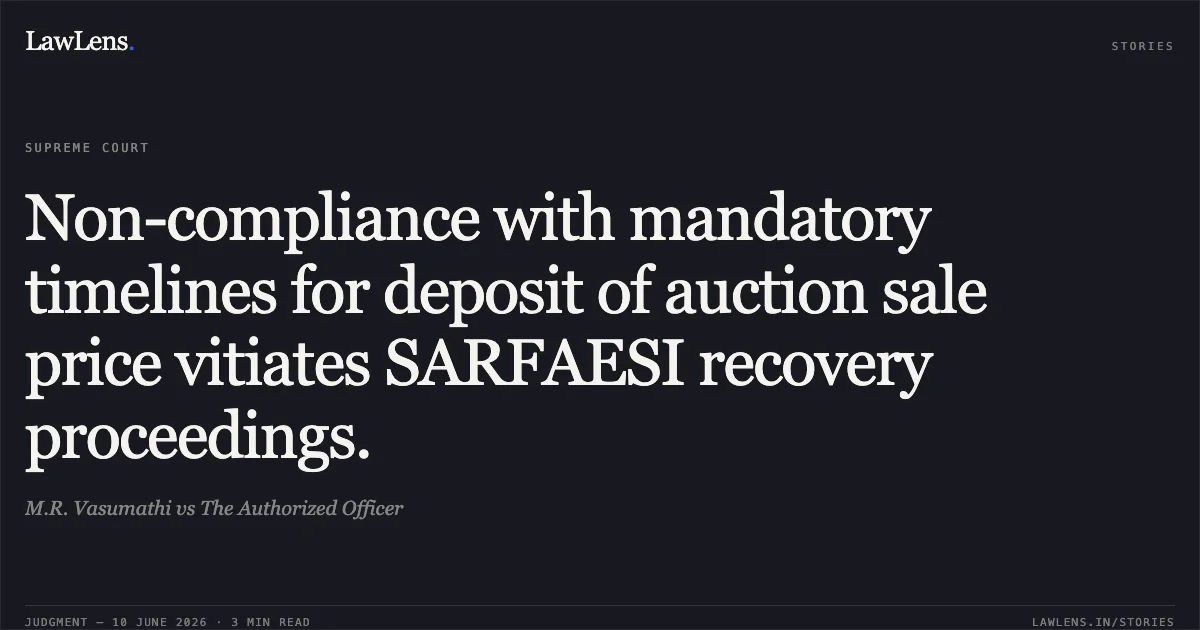
Source reference: para. 22a2. Whether the auction sale of the secured asset stands vitiated due to non-compliance with the mandatory timelines for payment under Rule 9 of the SARFAESI Rules?
Source reference: para. 22bLaw Applied
Rule 9 of the Security Interest (Enforcement) Rules, 2002 (unamended), which mandates that the purchaser must "immediately" deposit 25% of the sale price
Source reference: para. 25, 26Under Rule 9(4), the balance 75% must be paid within 15 days of confirmation or such extended period "as may be agreed upon in writing between the parties"
Source reference: para. 25The Court relied on Sri Siddeshwara Cooperative Bank Ltd. v. Ikbal, established that while these rules are mandatory, they are for the benefit of the parties and can be waived only by "manifestation of mutual assent in writing"
Source reference: para. 27Failure to comply with these timelines, absent a written agreement, renders the sale a nullity
Source reference: para. 28Reasoning
The Court observed that the auction took place on 11.03.2010, meaning the 15-day window for the 75% balance payment expired on 26.03.2010
Source reference: para. 29, 30However, the purchaser admittedly paid the balance only on 31.03.2010
Source reference: para. 31The Court found no evidence of a written request for extension by the purchaser or any written agreement by the Bank before the deadline
Source reference: para. 33The Court rejected the lower courts' reliance on "equities" or the "indolent conduct" of the borrower to validate the sale, holding that statutory non-compliance with Rule 9 is a material irregularity that goes to the root of the sale's validity
Source reference: para. 36It emphasized that even if the appellant had not made a formal tender for redemption, her multiple applications before the DRT manifested a clear intent to protect her interest in the property
Source reference: para. 37Since the mandatory procedure was bypassed, the sale could not be sanctified
Source reference: para. 38, 39Holding
The Supreme Court allowed the appeal in part, setting aside the orders of the High Court, DRAT, and DRT, and quashing the auction sale
Secured Creditor must refund the auction purchaser's deposit with 7% interest per annum within six weeks; Appellant is granted a one-time opportunity under Article 142 to redeem the mortgage by paying Rs. 95,42,372.52 with 5% interest per annum from the date of the Section 13(2) notice; if the appellant fails to pay within the stipulated time, the bank may conduct a fresh auction. The issue of limitation was left open.
Source reference: para. 42, 43, 44, 45, 46, 47Acts & Sections Cited
5 provisions across 2 statutes referred to in this judgment. Each provision opens on LawLens.
Securitisation and Reconstruction of Financial Assets and Enforcement of Security Interest Act, 20024
Limitation Act, 19631
Original Court PDF
M.R. VasumathivsThe Authorized Officer
Click to open original judgment
Original judgment, available to read, download and summarize on LawLens.in