Facts
The petitioner sought regular bail in FIR No. 9 of 2025, registered at Women Police Station Chowari, District Chamba, for offences under Sections 64(2), 77, 123, 137(2) and 351(2) of the Bharatiya Nyaya Sanhita, 2023, and Sections 4, 6 and 15 of the Protection of Children from Sexual Offences Act, 2012 (“POCSO Act”).
Source reference: para. 1The prosecution alleged that the petitioner recorded the minor victim while she was bathing, compelled her to undress during a video call by threatening to circulate the recording, screen-recorded the call, circulated the videos on Instagram, and thereafter entered into a sexual relationship with her under threat.
Source reference: paras. 3, 11The victim was born on 16 October 2006 and was a minor at the time of the alleged incident.
Source reference: para. 11Investigation was complete, the charge-sheet had been filed, and the prosecution had cited 39 witnesses, of whom two had been examined.
Source reference: paras. 2, 3, 15The petitioner relied on the alleged delay in trial and Section 35(2) of the POCSO Act, which contemplates completion of trial, as far as possible, within one year of cognisance.
Source reference: para. 5The State opposed bail on the grounds of the seriousness of the allegations and the possibility of witness intimidation.
Source reference: para. 6Issues
Whether the petitioner was entitled to regular bail considering the prima facie material indicating his involvement in offences involving sexual exploitation and circulation of videos of a minor, and the apprehension of witness intimidation?
Source reference: paras. 8–11, 17–18Whether non-completion of the trial within the period contemplated under Section 35(2) of the POCSO Act created a right in favour of the accused to be released on bail?
Source reference: paras. 5, 12–14Whether the petitioner could claim benefit of the decision in Manoj Kumar @ Manu v. State of H.P. on account of delay in trial?
Source reference: para. 16Law Applied
The Court applied the established principles governing bail, including consideration of the nature and gravity of the accusation, the prima facie evidence, the severity of punishment, the likelihood of absconding, the possibility of repetition of the offence, witness intimidation, and obstruction of justice, as stated in Gudikanti Narasimhulu v. High Court of A.P., Prahlad Singh Bhati v. State (NCT of Delhi), Ram Govind Upadhyay v. Sudarshan Singh, Kalyan Chandra Sarkar v. Rajesh Ranjan, Prasanta Kumar Sarkar v. Ashis Chatterjee, and Brijmani Devi v. Pappu Kumar.
Source reference: para. 8Although “bail, not jail” is the normal rule, the principle is subject to exceptions arising from the gravity of the offence, risk of witness intimidation, and the possibility of thwarting justice, as held in State of Rajasthan v. Balchand.
Source reference: para. 9Section 35 of the POCSO Act requires recording of the child’s evidence within 30 days and completion of the trial, as far as possible, within one year of cognisance; however, the provision is directory and intended for the benefit of the child victim, not as an independent statutory right to bail for the accused, as held in Alakh Alok Srivastava v. Union of India, Mohiddin v. State of Karnataka, and Hanumantha Mogaveera v. State of Karnataka.
Source reference: paras. 12–14The Court also held that Manoj Kumar @ Manu v. State of H.P. was distinguishable because that case involved delay coupled with the accused’s serious illness.
Source reference: para. 16Reasoning
The Court found prima facie material connecting the petitioner with the alleged offences: the forensic analysis confirmed the presence of the video recording on the petitioner’s mobile phone, and the allegations indicated that the petitioner used the recording to threaten and sexually exploit the minor victim.
Source reference: para. 11Applying the settled bail principles, the Court treated the allegations as serious and noted that most prosecution witnesses had yet to be examined.
Source reference: para. 17Consequently, the apprehension that the petitioner could influence or intimidate witnesses if released was considered substantial.
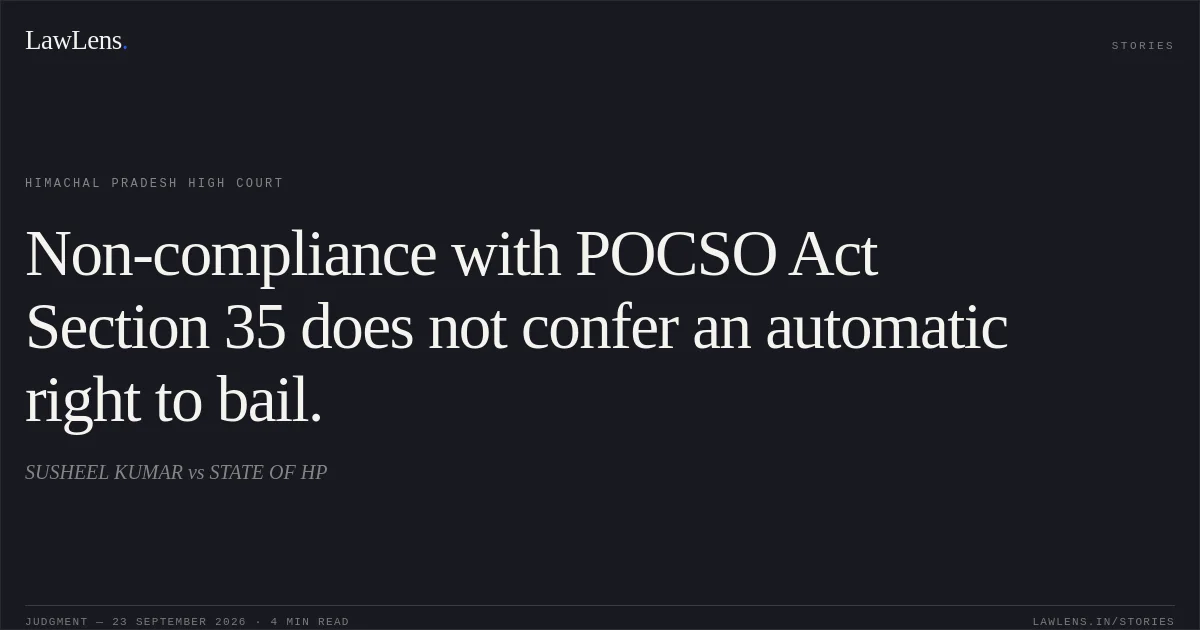
Source reference: para. 17The Court rejected the argument based on Section 35(2) of the POCSO Act, holding that the statutory timeline is directory and that its non-compliance does not automatically confer a right to bail upon the accused.
Source reference: paras. 12–14The Court also noted that the trial court had listed the matter on consecutive dates, demonstrating an attempt to expedite the proceedings.
Source reference: para. 15The precedent relied upon by the petitioner was held inapplicable because it involved the additional circumstance of serious illness, which was absent in the present case.
Source reference: para. 16Holding
The Court held that the petitioner was not entitled to bail at that stage, given the prima facie allegations, the serious nature of the offences, and the risk of intimidation or influence over witnesses whose evidence remained to be recorded.
The petition for regular bail was accordingly dismissed.
Source reference: para. 19However, the petitioner was granted liberty to file a fresh bail application if the trial was not concluded expeditiously despite his cooperation.
Source reference: para. 19The observations were confined to disposal of the bail petition and were declared not to affect the merits of the criminal case.
Source reference: para. 20Acts & Sections Cited
13 provisions across 4 statutes referred to in this judgment. Each provision opens on LawLens.
Bharatiya Nyaya Sanhita, 20235
Protection of Children from Sexual Offences Act, 20125
Code of Criminal Procedure, 19732
Indian Penal Code, 18601
Original Court PDF
SUSHEEL KUMARvsSTATE OF HP
Click to open original judgment
Original judgment, available to read, download and summarize on LawLens.in