01Facts
The respondent (plaintiff) filed a suit on January 7, 2019, for the eviction of the appellant (defendant) from a property used as office space
¶ 12, 15The subject matter of the suit was valued above the "specified value" under the Commercial Courts Act, 2015
¶ 12While there was no formal written agreement, rent receipts were issued by the respondent to the appellant
¶ 13The appellant challenged an order by the learned Single Judge dated December 3, 2025, which allowed the plaintiff’s application to transfer the suit from the non-commercial division to the Commercial Division
¶ 6-7The appellant contended that the dispute was not "commercial" due to the lack of a written agreement and that the suit should have been dismissed for non-compliance with the Commercial Courts Act rather than transferred or returned
¶ 8-902Issues
i.1. Whether a dispute involving immovable property used in trade or commerce requires a written agreement to qualify as a "commercial dispute" under Section 2(1)(c)(vii) of the Commercial Courts Act, 2015.
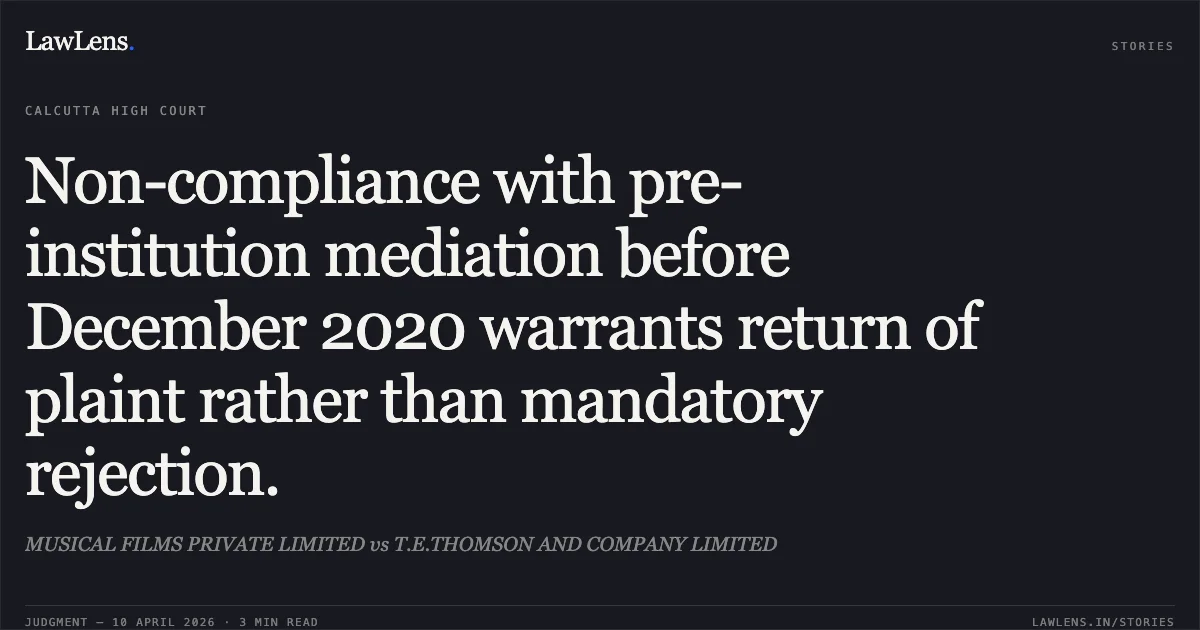
¶ 10, 14ii.2. Whether a suit involving a commercial dispute filed in a non-commercial division after the 2018 notification, but within the transition period defined by precedent, should be rejected or returned for presentation before the appropriate forum.
¶ 17-2203Law Applied
The court applied Section 2(1)(c)(vii) of the Commercial Courts Act, 2015, which defines commercial disputes involving agreements relating to immovable property used exclusively in trade or commerce, noting the statute does not distinguish between oral and written agreements
¶ 10It relied on Laxmi Polyfab Pvt. Ltd v. Eden Realty Ventures Pvt. Ltd. (AIR 2021 CAL 190), which established a "grace period" (January 1, 2016, to December 11, 2020) where plaintiffs are not faulted for failing to undertake pre-institution mediation under Section 12A due to lack of infrastructure
¶ 17-18The court further considered Patil Automation Private Limited v. Rakheja Engineers Private Limited [(2022) 10 SCC 1], which affirmed that the mandatory nature of Section 12A applies based on the timeline set by respective High Courts
¶ 11, 19Provisions in the judgment · 1 · Linked ones open on LawLens
Commercial Courts Act, 2015 Section 2
04Reasoning
The Court first addressed the nature of the dispute, holding that Section 2(1)(c)(vii) of the Act of 2015 does not specify that an agreement must be written; thus, rent receipts themselves constitute a valid tenancy agreement for commercial purposes
¶ 10, 13-14Regarding the procedural validity of the suit, the Court distinguished this case from Auto Fuel & Services v. Amalgamated Fuels Limited, where a suit was rejected because it was filed in 2022, well after Section 12A became strictly mandatory
¶ 20Since the present suit was filed on January 7, 2019, it fell within the protected window identified in Laxmi Polyfab, during which the absence of pre-institution mediation did not warrant outright dismissal
¶ 18, 21Therefore, the Trial Judge's decision to return the plaint for presentation before the Commercial Division, rather than dismissing the suit, was legally sound
¶ 2205Holding
The Court dismissed the appeal and affirmed the order of the learned Single Judge
¶ 24It held that the dispute is a "commercial dispute" under the Act of 2015 as the property is used for trade and the rent receipts qualify as an agreement
¶ 14Furthermore, because the suit was filed during the period where Section 12A compliance was not strictly enforced due to infrastructural deficits, the direction to return the plaint for proper presentation was correct
¶ 22-23No costs were awarded
¶ 24Original Court PDF
MUSICAL FILMS PRIVATE LIMITEDvsT.E.THOMSON AND COMPANY LIMITED
Click to open original judgment
Original judgment, available to read, download and summarize on LawLens.in