Facts
The appellants challenged their conviction under Section 20(b)(ii)(C) of the N.D.P.S. Act, for which they were sentenced to ten years of R.I. and a fine of Rs. 1,00,000.
Source reference: p. 2On January 29, 2021, acting on reliable information, the police intercepted a private Ford Endeavour vehicle.
Source reference: p. 3Upon search, 37.240 kgs of contraband ganja was recovered from two poly gunny bags in the vehicle's backside.
Source reference: p. 4-5The trial court held that since the vehicle was intercepted in a public place, Section 43 of the Act applied instead of Section 42, thereby excusing the rigors of recording and communicating information.
Source reference: p. 10-11Issues
1. Whether the recovery of contraband from a private vehicle in a public place necessitates compliance with the mandatory procedural safeguards under Section 42 of the N.D.P.S. Act.
Source reference: p. 122. Whether the prosecution successfully proved compliance with Section 42(1) and 42(2) regarding the recording and transmission of information to superior officers.
Source reference: p. 14Law Applied
The court applied the mandatory procedural requirements of Section 42 of the N.D.P.S. Act, which requires an officer to reduce information to writing and send a copy to a superior within 72 hours.
Source reference: p. 8-9The court relied on the Supreme Court precedents of Boota Singh v. State of Haryana and State of Rajasthan v. Jag Raj Singh @ Hansa, which established that a private vehicle does not fall under the definition of a "public place" under Section 43, thus making Section 42 applicable even if the vehicle is intercepted on a public road.
Source reference: p. 12, p. 13The court cited the Constitution Bench in Karnail Singh v. State of Haryana and State of Punjab v. Balbir Singh, affirming that non-compliance with Section 42 vitiates the trial.
Source reference: p. 21, p. 18Reasoning
The High Court found the trial court’s reliance on Section 43 erroneous because the contraband was seized from a private vehicle, which attracts Section 42.
Source reference: p. 13-14Upon examining the evidence, the court noted that P.W. 17 (the informant) admitted he did not reduce the information to writing at the time of receipt or after arriving at the police station.
Source reference: p. 15While the prosecution claimed a General Diary (G.D.) entry was made, this entry was never marked as an exhibit or proved in court.
Source reference: p. 16P.W. 18 (the I.O.) admitted he did not seize the relevant G.D. entry, failed to examine the IIC who reportedly received the info, and did not examine any staff from superior offices to verify receipt of the mandatory reports.
Source reference: p. 16-17This total lack of documentary proof regarding the recording and transmission of information was held to be a fatal breach of statutory safeguards.
Source reference: p. 20-21Holding
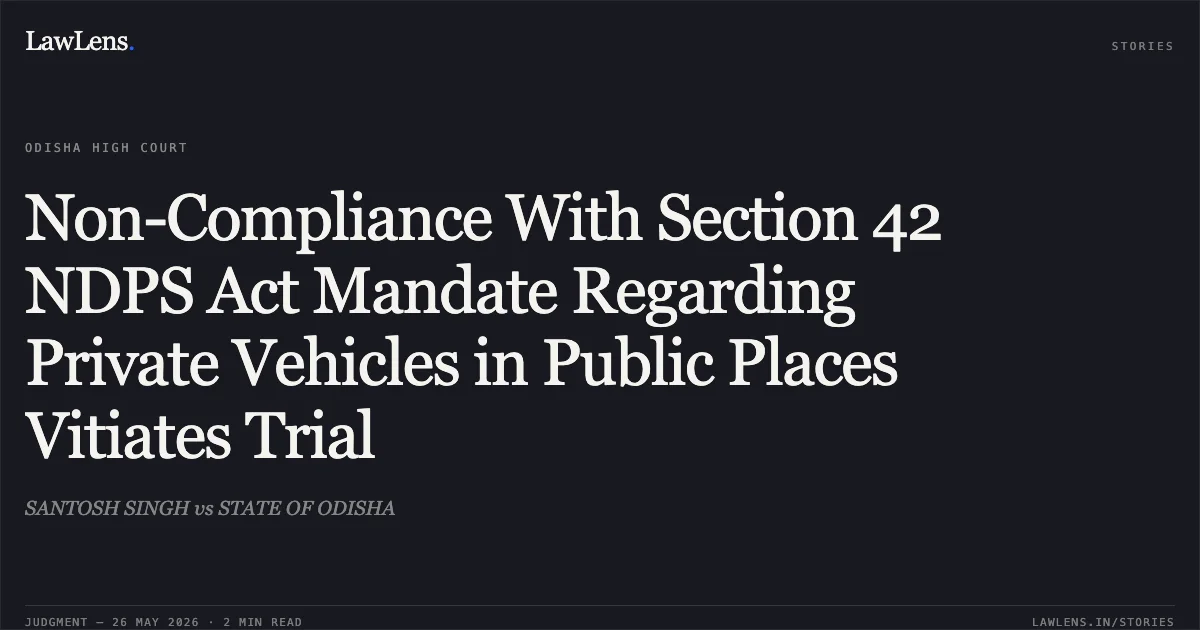
The Court answered the first issue in the affirmative and the second in the negative, holding that the mandatory requirements of Section 42 were not complied with in letter or spirit, which caused prejudice to the accused and vitiated the trial.
The High Court allowed both appeals, set aside the common judgment of conviction and sentence dated February 29, 2024, acquitted the appellants, and ordered all bail bonds discharged.
Source reference: p. 21-22Acts & Sections Cited
7 provisions across 2 statutes referred to in this judgment. Each provision opens on LawLens.
Code of Criminal Procedure, 19731
Narcotic Drugs and Psychotropic Substances Act, 19856
Original Court PDF
SANTOSH SINGHvsSTATE OF ODISHA
Click to open original judgment
Original judgment, available to read, download and summarize on LawLens.in