Facts
On May 4, 2024, the Investigating Officer (PW-8) received secret information regarding a person carrying contraband under the Kashiram Nagar overbridge
Source reference: para. 6A search was conducted, leading to the recovery of a black bag from the appellant containing 600 capsules of "Spasmo Proxyvon Plus" (300 grams), containing Dicyclomine, Tramadol, and Acetaminophen
Source reference: paras. 8-10The Trial Court convicted the appellant under Section 22(c) of the NDPS Act, sentencing him to 15 years of rigorous imprisonment and a fine of Rs. 1,50,000
Source reference: para. 5The appellant challenged the conviction on grounds of procedural non-compliance with Sections 42, 50, 52A, and 55 of the NDPS Act
Source reference: para. 17Issues
1. Whether the Investigating Officer was duly authorized and competent in law to conduct the investigation under the NDPS Act
Source reference: para. 32(i)2. Whether the appellant was found in conscious and unlawful possession of the contraband in contravention of the NDPS Act
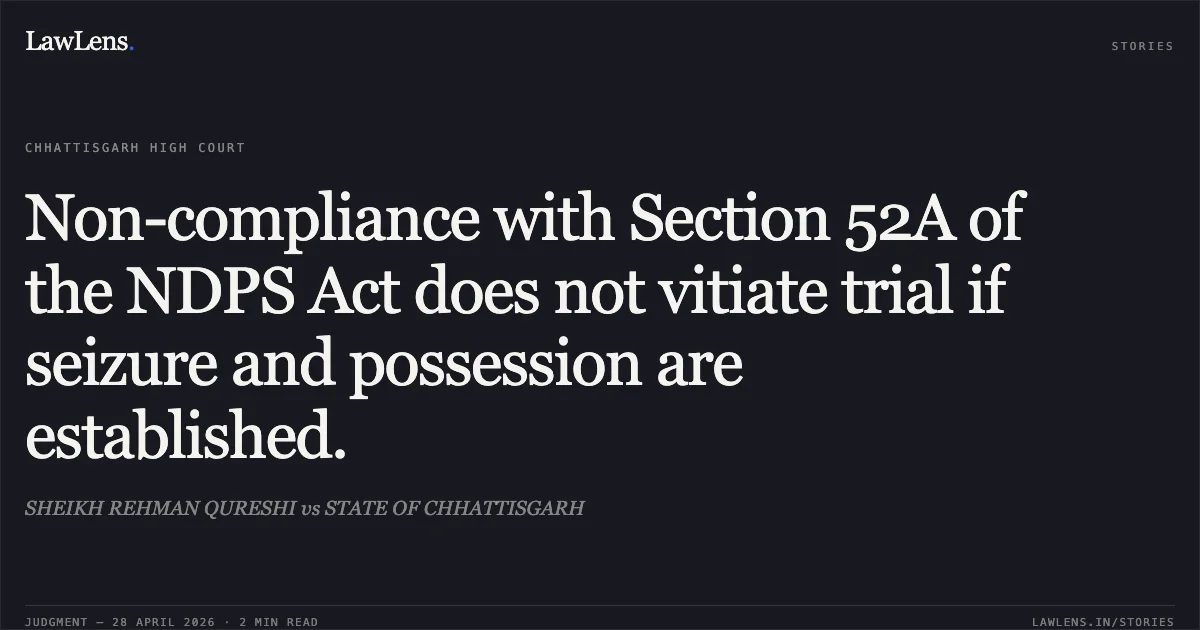
Source reference: para. 32(ii)3. Whether non-compliance with the procedural mandates of Sections 42, 50, and 52A of the NDPS Act vitiates the trial
Source reference: para. 17, 33, 59, 66Law Applied
The court applied Section 43 of the NDPS Act, which governs seizure and arrest in a "public place," distinguishing it from the mandates of Section 42 for "enclosed places" as established in Firdoskhan Khurshidkhan v. State of Gujarat
Source reference: para. 34, 35It applied Section 50 regarding "personal search," noting it is inapplicable to baggage searches per State of H.P. v. Pawan Kumar
Source reference: para. 63Procedural compliance for disposal and sampling was governed by Section 52A, with the court relying on Bharat Aambale v. State of Chhattisgarh to hold that "substantial compliance" is sufficient and procedural lapses do not automatically warrant acquittal if the chain of custody is established
Source reference: para. 66, 69-70Statutory presumptions of "conscious possession" under Sections 35 and 54 of the NDPS Act were also invoked
Source reference: para. 86Reasoning
The court determined that since the arrest occurred at an overbridge (a public place), Section 43 applied, rendering the strict documentation requirements of Section 42 unnecessary
Source reference: paras. 49-50Regarding Section 50, the court found no violation because the contraband was recovered from a bag, not a body search, making the "right to a Gazetted Officer" inapplicable
Source reference: paras. 60-65Addressing Section 52A, the court noted that samples were drawn before a Magistrate (Ex.P/47) and corroborated by the FSL report (Ex.P/50), thus fulfilling "substantial compliance"
Source reference: paras. 80-84It further held that the Investigating Officer was authorized via State Government notifications dated 11.11.1985
Source reference: para. 39the court concluded that the prosecution established an unbroken chain of custody through testimonies of official witnesses (PW-7 and PW-8) and malkhana entries, triggering the legal presumption of guilt which the appellant failed to rebut
Source reference: paras. 86, 91Holding
The Court answered both primary issues in the affirmative, holding that the Investigating Officer was competent and the appellant was in conscious possession of the contraband
The High Court dismissed the appeal and affirmed the Trial Court's judgment of conviction under Section 22(c) of the NDPS Act
Source reference: para. 94Acts & Sections Cited
15 provisions across 3 statutes referred to in this judgment. Each provision opens on LawLens.
Narcotic Drugs and Psychotropic Substances Act, 1985
Bharatiya Nagarik Suraksha Sanhita, 20232
Code of Criminal Procedure, 19732
Original Court PDF
SHEIKH REHMAN QURESHIvsSTATE OF CHHATTISGARH
Click to open original judgment
Original judgment, available to read, download and summarize on LawLens.in