Facts
FIR No. 121/2026 was registered at Police Station Mayapuri under Sections 118/3(5) of the Bharatiya Nyaya Sanhita, 2023 (“BNS”), following an altercation outside a café in which respondents 2 and 3 were stabbed and seriously injured
Source reference: p. 2, paras. 1, 6.1–6.2During the proceedings, the parties—who stated that they were friends—settled their dispute by a compromise deed dated 5 October 2026 and jointly sought quashing of the FIR
Source reference: pp. 2–3, paras. 6.3, 7–12The State objected but indicated that it would be satisfied if costs were imposed
Source reference: p. 3, para. 13Issues
Whether the High Court could quash the FIR and consequential proceedings for a non-compoundable offence on the basis of the parties’ settlement.
Source reference: pp. 4–6, paras. 16–20Whether, in the circumstances of this case, quashing the proceedings would secure the ends of justice, and what consequential directions should be made.
Source reference: pp. 3–4, paras. 13–16; p. 7, paras. 21–25Law Applied
The Court relied on Article 226 of the Constitution and Section 528 of the Bharatiya Nagarik Suraksha Sanhita, 2023 (“BNSS”), under which the High Court may quash criminal proceedings to secure the ends of justice or prevent abuse of process, including in appropriate cases involving non-compoundable offences.
Source reference: p. 1, para. 1; pp. 4–5, paras. 16–17Gian Singh v. State of Punjab, (2012) 10 SCC 303, establishes that such power may be exercised where settlement makes continuation futile and quashing serves justice, while cautioning against quashing serious offences with substantial public impact.
Source reference: pp. 4–5, para. 18Narinder Singh v. State of Punjab, (2014) 6 SCC 466, requires cautious, case-specific consideration, including the nature and gravity of the offence, the possibility of conviction, and whether continuation would cause injustice.
Source reference: pp. 5–6, para. 19The Court also cited Deepak Kumar v. State (Govt. of NCT) of Delhi, 2024 SCC OnLine Del 1305, for the principle that the decision depends on the facts and circumstances of each case and must account for the offence’s gravity and societal impact.
Source reference: p. 6, para. 20Reasoning
The Court accepted that the parties had resolved their dispute and, after interacting with them, noted their apologies and undertakings to conduct themselves appropriately in future.
Source reference: pp. 3–4, paras. 8–12It considered their young age, their friendship, their shared responsibility for the incident, and the settlement, and concluded that continuing the proceedings would be unfair and contrary to the interests of justice.
Source reference: p. 4, paras. 14–16Although the allegations involved stabbing and serious injuries, the Court exercised its inherent power to quash the proceedings, subject to costs.
Source reference: p. 2, para. 6.2; p. 7, paras. 21–24Holding
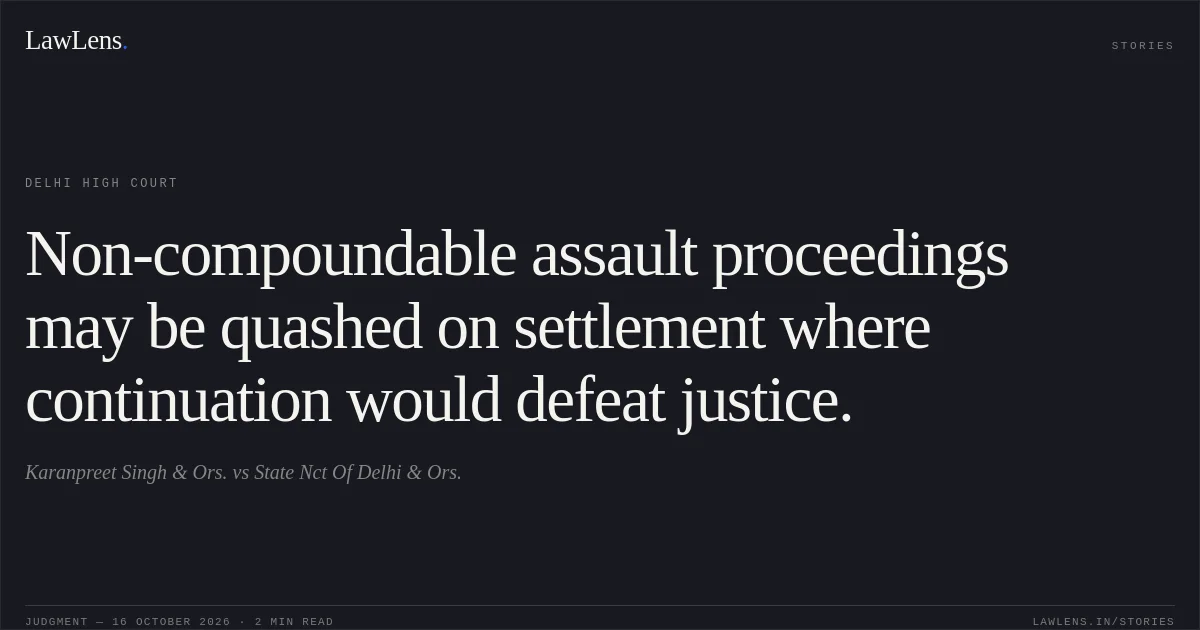
The Court quashed FIR No. 121/2026 and all consequential proceedings.
It directed petitioners 1 to 4 and respondent 2 to each pay ₹10,000 to the Delhi High Court Legal Services Committee within two weeks, and to file proof of payment with the Court and the Investigating Officer within the prescribed period.
Source reference: pp. 7–8, paras. 22–25Acts & Sections Cited
7 provisions across 3 statutes referred to in this judgment. Each provision opens on LawLens.
Bharatiya Nagarik Suraksha Sanhita, 20233
Bharatiya Nyaya Sanhita, 20232
Code of Criminal Procedure, 19732
Original Court PDF
Karanpreet Singh & Ors.vsState Nct Of Delhi & Ors.
Click to open original judgment
Original judgment, available to read, download and summarize on LawLens.in