Facts
The appellants were convicted by the Trial Court for rioting, house trespass, and causing damage by fire on the allegation that they demolished the complainant’s house and set her vehicle ablaze due to political and PIL-related animosity
Source reference: para. 2, 3Following their conviction under Sections 148, 427, 435, 440, and 452 read with Section 149 of the IPC, the appellants filed these appeals
Source reference: para. 2During the pendency of the appeals, the parties entered into a voluntary compromise and filed for compounding
Source reference: para. 8A verification report by the Registrar confirmed the settlement was made out of free will
Source reference: para. 9Issues
1. Whether non-compoundable offences under the IPC can be compounded at the appellate stage based on a private settlement
Source reference: para. 9, 132. Whether the court can grant the benefit of the Probation of Offenders Act to individuals whose non-compoundable convictions are upheld but who have reached an amicable settlement with the victim
Source reference: para. 11, 20Law Applied
Section 320 of the CrPC, which distinguishes between compoundable and non-compoundable offences
Source reference: para. 9Narinder Singh v. State of Punjab [(2014) 6 SCC 466], which permits quashing or leniency in personal disputes where parties settle
Source reference: para. 14Ishwar Singh v. State of M.P. [AIR 2009 SC 675], establishing that while non-compoundable offences cannot be formally compounded, the factum of compromise is a relevant circumstance for sentencing
Source reference: para. 15Sections 4, 5, and 12 of the Probation of Offenders Act, 1958, regarding the release of offenders on probation and the removal of disqualification attached to conviction
Source reference: para. 11, 21, 22Reasoning
The Court affirmed the conviction on merits, noting that the prosecution's evidence was well-supported by eye-witnesses and medical documentation
Source reference: para. 12Sections 148 and 427 IPC are compoundable, thus allowing acquittal for those specific charges based on the compromise
Source reference: para. 9, 19Regarding the non-compoundable offences (Sections 435, 440, and 452 IPC), the court reasoned that since the incident was 12 years old, the parties had restored their relationship, and the appellants were first-time offenders, sending them back to jail served no useful purpose
Source reference: para. 20, 21The court balanced the need for justice with the rehabilitation of the offenders, particularly noting that some appellants were government servants whose careers would be jeopardized by the conviction's disqualification
Source reference: para. 11, 20, 23Holding
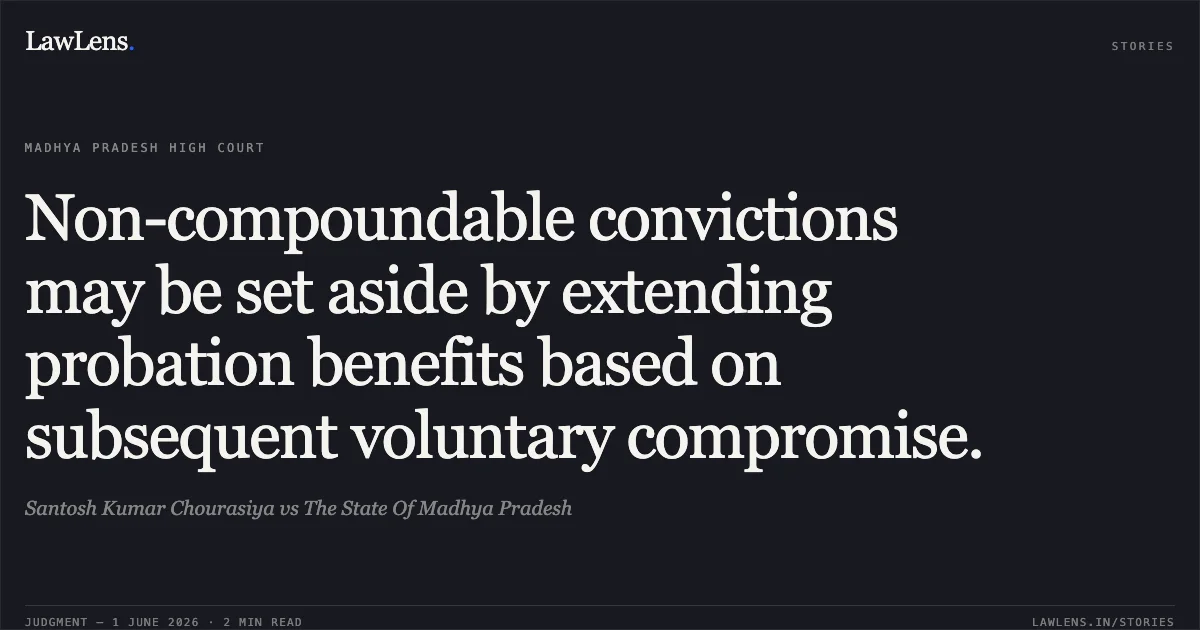
The High Court accepted the compromise for Sections 148 and 427 IPC and acquitted the appellants of those charges
For the non-compoundable offences under Sections 435/149, 440/149, and 452/149 IPC, the conviction was upheld, but the substantive sentence of imprisonment was set aside
Source reference: para. 21The appellants were directed to be released on probation of good conduct under Section 4 of the Probation of Offenders Act for two years upon furnishing a bond of Rs. 25,000/-
Source reference: para. 22Per Section 12 of the Act, the court directed that the conviction shall not operate as a disqualification in their service careers
Source reference: para. 23Acts & Sections Cited
20 provisions across 3 statutes referred to in this judgment. Each provision opens on LawLens.
Code of Criminal Procedure, 19735
Indian Penal Code, 1860
Probation of Offenders Act, 19583
Original Court PDF
Santosh Kumar ChourasiyavsThe State Of Madhya Pradesh
Click to open original judgment
Original judgment, available to read, download and summarize on LawLens.in


