Facts
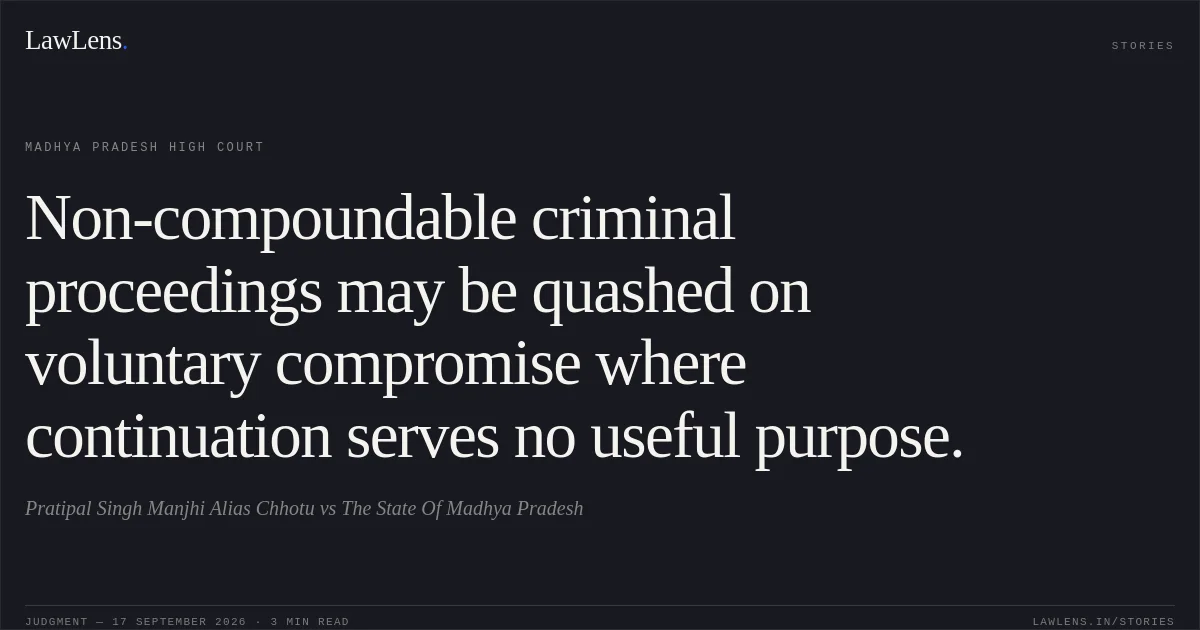
The petitioners invoked Section 528 of the BNSS seeking quashing of FIR Crime No. 150/2026 registered at Police Station Kotwali, District Datia, for offences under Sections 296(b), 115(2), 324(4), 140(3), 3(5) and 351(3) of the BNS, Sections 25 and 27 of the Arms Act, and Sections 11 and 13 of the MPDVPK Act.
Source reference: para. 1, p. 1During the proceedings, the petitioners and respondent Nos. 2 to 4/complainants entered into a compromise and filed applications for compounding, supported by affidavits.
Source reference: para. 2, p. 1The Principal Registrar verified the identity of the parties, the contents of the applications, and the voluntariness of their consent, finding no threat, inducement or coercion.
Source reference: para. 3, p. 1The complainants supported the petitioners’ request, while the State opposed it.
Source reference: paras. 4–6, pp. 1–2The dispute was described as a personal dispute relating to non-payment of financial instalments.
Source reference: para. 11, p. 3Issues
Whether the High Court could exercise its inherent jurisdiction under Section 528 of the BNSS to quash the FIR and consequential proceedings for non-compoundable offences on the basis of a voluntary compromise between the accused and the complainants.
Source reference: paras. 1, 9–12, pp. 1–4Whether, in view of the verified settlement and the personal nature of the dispute, continuation of the criminal proceedings against the petitioners would constitute an abuse of the process of law or serve any useful purpose.
Source reference: paras. 3, 10–12, pp. 1–4Whether the quashing relief should be confined to the petitioners who had entered into the compromise, without affecting the investigation against any remaining co-accused.
Source reference: paras. 12–14, pp. 3–4Law Applied
The Court applied the inherent jurisdiction under Section 528 of the BNSS, referring in its reasoning to the corresponding principle under Section 482 of the CrPC, to prevent abuse of the process of law and secure the ends of justice.
Source reference: paras. 1, 10, pp. 1, 3It relied on B.S. Joshi v. State of Haryana, Gian Singh v. State of Punjab, Madan Mohan Abbot v. State of Punjab, Shiji v. Radhika, Narinder Singh v. State of Punjab, Jagdish Channa v. State of Haryana, and Parbatbhai Ahir v. State of Gujarat, which recognise that criminal proceedings involving predominantly private or personal disputes may be quashed on the basis of a genuine and voluntary compromise even where the offences are non-compoundable, provided continuation of the proceedings would serve no meaningful purpose.
Source reference: para. 9, pp. 2–3The Court also treated verified consent, absence of coercion, and the personal character of the dispute as relevant considerations in exercising such jurisdiction.
Source reference: paras. 3, 8–11, pp. 1–3Reasoning
The Court found that the compromise was genuine and voluntary because the parties’ identities, signatures, intentions and affidavits had been verified by the Principal Registrar, with no allegation of threat, inducement or coercion.
Source reference: para. 3, p. 1Although the State opposed quashing, the complainants supported the settlement and the dispute was found to be essentially personal and connected with financial instalments.
Source reference: paras. 5–6, 11, pp. 2–3Applying the Supreme Court’s principles on quashing criminal proceedings after settlement, the Court concluded that continuation of the trial would be a futile exercise and would unnecessarily consume judicial resources.
Source reference: paras. 9–11, pp. 2–3The relief was accordingly limited to the petitioners who had settled the dispute, while preserving the authorities’ power to proceed against any remaining co-accused in accordance with law.
Source reference: paras. 12–14, pp. 3–4Holding
The Court allowed the petition and permitted compounding of the dispute.
FIR Crime No. 150/2026 registered at Police Station Kotwali, District Datia, together with all consequential proceedings, was quashed only in respect of Pratipal Singh Manjhi, Jitendra Kori, Hamid Khan and Rajpal Singh Manjhi, on the basis of compromise.
Source reference: paras. 11–13, pp. 3–4The order did not affect the investigation or proceedings against any remaining co-accused, which were directed to continue in accordance with law.
Source reference: para. 14, p. 4Acts & Sections Cited
10 provisions across 4 statutes referred to in this judgment. Each provision opens on LawLens.
Bharatiya Nagarik Suraksha Sanhita, 20231
Bharatiya Nyaya Sanhita, 20236
Arms Act, 19592
Code of Criminal Procedure, 19731
Original Court PDF
Pratipal Singh Manjhi Alias ChhotuvsThe State Of Madhya Pradesh
Click to open original judgment
Original judgment, available to read, download and summarize on LawLens.in