Facts
The petitioner invoked Section 528 of the Bharatiya Nagarik Suraksha Sanhita, 2023, seeking quashing of FIR Crime No. 98/2021 registered at Police Station Cyber Cell and High-Tech Crime, District Gwalior, for offences under Section 420 of the Indian Penal Code and Sections 66(C) and 66(D) of the Information Technology Act, along with consequential proceedings in S.S.T. No. 31/2022, on the basis of a compromise with respondent No. 2/complainant.
Source reference: para. 1The parties filed compromise applications, supported by affidavits, stating that they had voluntarily settled the dispute.
Source reference: para. 2The Principal Registrar verified the identity of the parties, the contents of the applications, and their signatures, and reported that the compromise was voluntary and free from threat, inducement, or coercion.
Source reference: para. 3The petitioner and complainant supported quashing of the criminal proceedings, whereas the State opposed the petition.
Source reference: paras. 4–6Issues
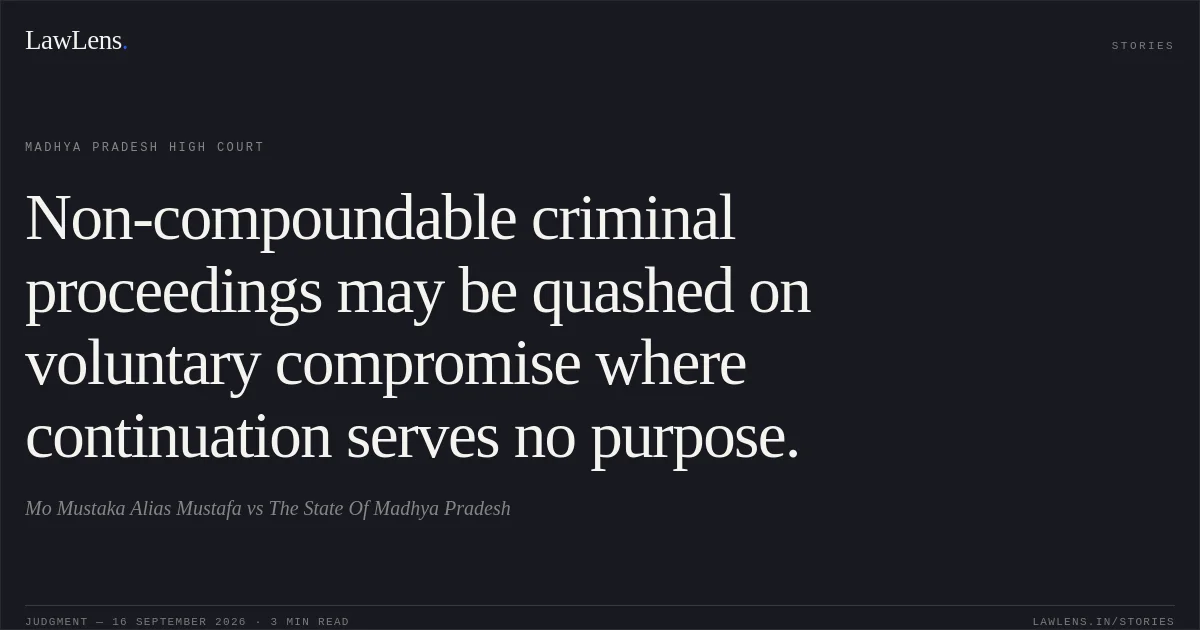
Whether the High Court could quash the FIR and consequential criminal proceedings for non-compoundable offences on the basis of a voluntary compromise between the accused and the complainant?
Source reference: paras. 8–12Whether the criminal proceedings should be quashed in respect of the petitioner alone when the prosecution may continue against the remaining co-accused?
Source reference: paras. 12–14Law Applied
The Court applied the inherent jurisdiction under Section 528 of the BNSS, while referring to the corresponding principles under Section 482 of the Code of Criminal Procedure, to prevent abuse of the process of law and secure the ends of justice.
Source reference: paras. 10–12It relied on B.S. Joshi v. State of Haryana, Gian Singh v. State of Punjab, Narinder Singh v. State of Punjab, Parbatbhai Ahir v. State of Gujarat, Madan Mohan Abbot v. State of Punjab, Shiji v. Radhika, and Jagdish Channa v. State of Haryana for the principle that criminal proceedings involving non-compoundable offences may, in appropriate cases, be quashed on the basis of a genuine and voluntary compromise where continuation of the prosecution would serve no useful purpose and would amount to an abuse of process.
Source reference: para. 9The Court further applied the principle that such relief may be confined to the accused who has settled the dispute, without prejudicing proceedings against other co-accused.
Source reference: paras. 12–14Reasoning
The Court found that the compromise applications and affidavits were duly verified and that the parties had settled the dispute voluntarily, without coercion or undue influence.
Source reference: paras. 2–3Since the complainant supported the petitioner’s request and the dispute had been amicably resolved, the Court concluded that continuation of the trial against the petitioner would be a futile exercise and would not serve any meaningful purpose.
Source reference: paras. 6–10Applying the Supreme Court’s principles on quashing criminal proceedings on the basis of compromise, the Court held that its inherent jurisdiction could be exercised to prevent abuse of process and avoid a wasteful continuation of the prosecution.
Source reference: paras. 9–11The relief was limited to the petitioner, leaving the trial against any remaining co-accused unaffected.
Source reference: paras. 12–14Holding
The petition was allowed.
The compromise applications were accepted, and FIR Crime No. 98/2021, registered at Police Station Cyber Cell and High-Tech Crime, District Gwalior, under Section 420 IPC and Sections 66(C) and 66(D) of the Information Technology Act, together with consequential proceedings in S.S.T. No. 31/2022, was quashed in respect of Mohd. Mustafa alias Mustafa only.
Source reference: para. 12The petition was disposed of accordingly, with the clarification that the trial against any remaining co-accused would proceed in accordance with law and would not be influenced by the order.
Source reference: paras. 13–14Acts & Sections Cited
3 provisions across 3 statutes referred to in this judgment. Each provision opens on LawLens.
Bharatiya Nagarik Suraksha Sanhita, 20231
Indian Penal Code, 18601
Code of Criminal Procedure, 19731
Original Court PDF
Mo Mustaka Alias MustafavsThe State Of Madhya Pradesh
Click to open original judgment
Original judgment, available to read, download and summarize on LawLens.in