Facts
Respondent No. 2 lodged FIR No. 0664/2021 at Police Station Jyoti Nagar, alleging that the petitioners repeatedly misbehaved with and abused her, attempted to break open her door, and threatened her. A chargesheet was filed against the petitioners under Sections 509, 506, 34 and 354(D) of the Indian Penal Code, 1860.
Source reference: p.2–3During the proceedings, the parties entered into a memorandum of undertaking dated 20 September 2026, agreeing not to contact one another and to cooperate in seeking quashing of the FIR. Respondent No. 2 accepted the petitioners’ apology and did not wish to pursue the matter; the petitioners undertook not to repeat their conduct.
Source reference: p.2–3Issues
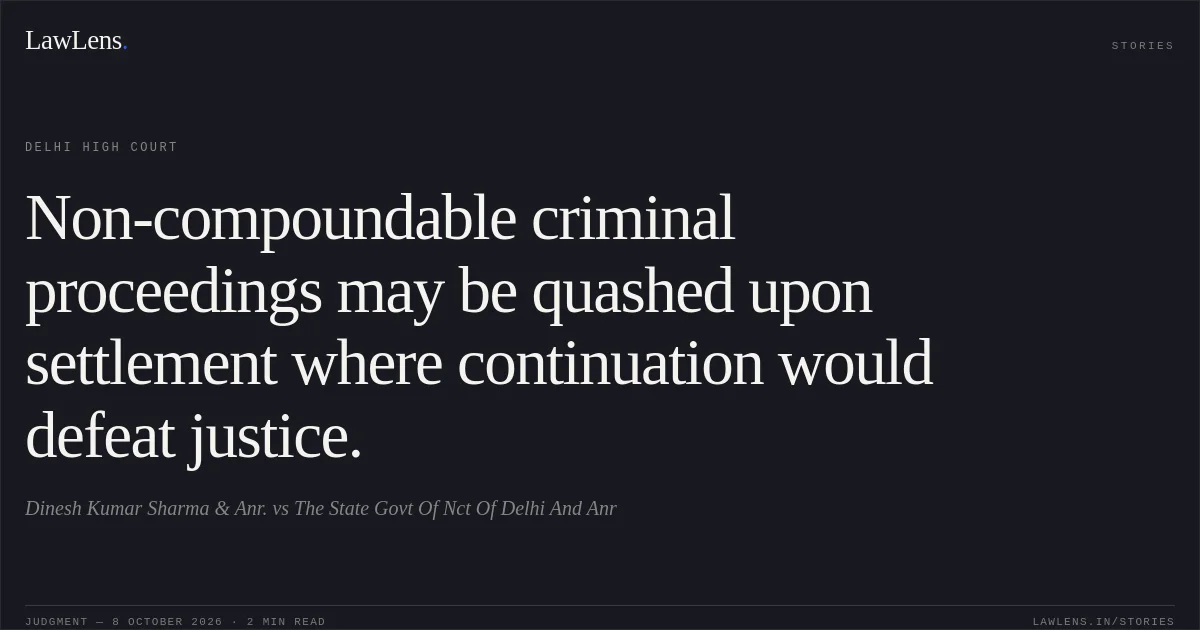
1. Whether the High Court could quash the FIR and consequential proceedings for non-compoundable offences on the basis of the parties’ settlement.
Source reference: p.3–62. Whether costs should be imposed as a condition of quashing the proceedings.
Source reference: p.3, 7Law Applied
Section 528 of the Bharatiya Nagarik Suraksha Sanhita, 2023, corresponding to Section 482 of the Code of Criminal Procedure, 1973, preserves the High Court’s inherent power to quash criminal proceedings, including for non-compoundable offences, to secure the ends of justice or prevent abuse of process.
Source reference: p.3–6Under Gian Singh v. State of Punjab, (2012) 10 SCC 303, and Narinder Singh v. State of Punjab, (2014) 6 SCC 466, that power must be exercised sparingly, with regard to the nature and gravity of the offence, its impact on society, the settlement, and the likelihood of conviction; serious offences ordinarily cannot be quashed merely on compromise.
Source reference: p.3–6The Court also cited Deepak Kumar v. State (Govt. of NCT) of Delhi, 2024 SCC OnLine Del 1305, for the principle that the decision depends on the facts and circumstances of each case.
Source reference: p.3–6Reasoning
The Court considered the parties’ settlement, the complainant’s acceptance of the petitioners’ apology and express wish not to pursue the case, and the petitioners’ undertaking not to repeat their conduct. In light of those circumstances, it concluded that the dispute had been resolved and that quashing was appropriate under its inherent powers.
Source reference: p.3–6The State’s request for costs was addressed by directing the petitioners to make a payment to the Delhi High Court Bar Association Lawyers Social Security & Welfare Fund.
Source reference: p.3, 7Holding
The Court allowed the petition and quashed FIR No. 0664/2021, registered under Sections 509, 506, 34 and 354(D) IPC, together with all consequential proceedings.
It directed the petitioners to deposit ₹30,000 with the specified fund within two weeks and to place proof of payment before the Court and the concerned IO/SHO within one week after payment.
Source reference: p.7Acts & Sections Cited
6 provisions across 3 statutes referred to in this judgment. Each provision opens on LawLens.
Bharatiya Nagarik Suraksha Sanhita, 20231
Code of Criminal Procedure, 19732
Indian Penal Code, 18603
Original Court PDF
Dinesh Kumar Sharma & Anr.vsThe State Govt Of Nct Of Delhi And Anr
Click to open original judgment
Original judgment, available to read, download and summarize on LawLens.in