Facts
The appellant, a cement manufacturer operating under an area-based exemption scheme, challenged an Order-in-Appeal that sustained three disputed liabilities: central excise duty of Rs. 24,33,138 for 29 August 2012 to September 2013; recovery of an alleged erroneous refund of Rs. 62,797; and service tax of Rs. 75,549.69, including cesses, for the period up to 30 June 2012.
Source reference: pp.2–4, 6–7, 10–12The excise demand was based on allegations that cement had been sold below the cost of production shown in CAS-4; the service-tax demand concerned freight collected from buyers in excess of the appellant’s actual freight expense.
Source reference: pp.2–4, 6–7, 10–12The show-cause notice was served on 16 October 2014 and invoked the extended period of limitation.
Source reference: pp.2–4, 6–7, 10–12The Commissioner (Appeals) had dropped certain other demands but upheld these disputed amounts and associated interest and penalties; the appellant appealed to the Tribunal.
Source reference: pp.2–4, 6–7, 10–12Issues
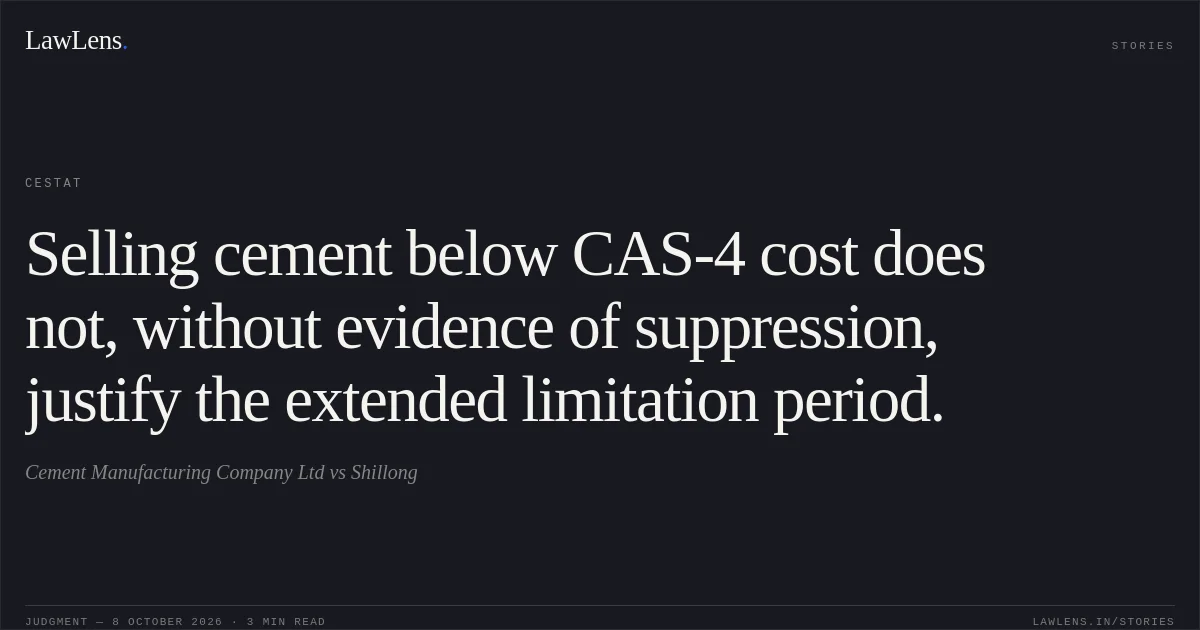
Whether the extended period of limitation could be invoked to sustain the central excise duty demand where the allegation was that goods were sold below CAS-4 cost, but no evidence of flow-back or suppression was shown.
Source reference: pp.8–10Whether service tax was payable on freight recovered in excess of the actual freight incurred by the appellant for the period up to 30 June 2012.
Source reference: pp.6–7, 11–12Whether the demand for recovery of the Rs. 62,797 refund, with interest and penalty, was sustainable on the facts and within the extended period of limitation.
Source reference: p.12Law Applied
The Tribunal considered the CBEC Circular No. 979/03/2014-CX dated 15 January 2014, issued following Commissioner of Central Excise v. Fiat India Pvt. Ltd., 2012 (283) E.L.T. 161 (S.C.), but held that the circular did not make the extended period automatically applicable: the relevant circumstances had to be comparable, and an allegation of sale below CAS-4 cost, without evidence of flow-back, did not by itself establish suppression of value.
Source reference: pp.8–10It relied on Commissioner of Central Excise & Service Tax v. Ultra Tech Cement Ltd. (decision dated 1 February 2018), which noted that the circular’s paragraph 7 precluded invoking the extended period in cases where the assessee had adopted an alternate interpretation before the Supreme Court’s judgment.
Source reference: pp.9–10For service tax, the Tribunal applied Rule 2(1)(d)(i)(B) of the Service Tax Rules, 1994, holding that the appellant’s liability was referable to freight paid by it and that the excess collected over the freight incurred was its profit, not an amount taxable under the provision.
Source reference: pp.11–12It also considered CCE v. Roofit Industries Ltd., 2015 (319) E.L.T. 221 (S.C.); CCE v. Ispat Industries Ltd., 2015 (324) E.L.T. 670 (S.C.); and CCE, Mumbai-III v. Emco Ltd., 2015 (322) E.L.T. 394 (S.C.).
Source reference: p.10Reasoning
The Tribunal found that the appellant’s area-based exemption and the Department’s verification of its records before granting refunds undermined the allegation of suppression with intent to evade duty.
Source reference: pp.8–10It further found no evidence that the appellant had received any flow-back, and held that CAS-4 cost was not an “approved price” for purposes of treating the sale as comparable to the circumstances addressed in Fiat India and the Board circular.
Source reference: pp.8–10The extended period therefore could not sustain the excise demand; the related interest and penalty also fell with it.
Source reference: pp.8–10As to freight, the Tribunal held that tax could not be imposed on the excess collected over actual freight under the cited Service Tax Rules provision, and rejected the demand for the period before 1 July 2012 as well as thereafter.
Source reference: pp.11–12For the refund demand, it again relied on the verified records and absence of suppression to conclude that the extended period was unavailable.
Source reference: p.12Holding
The Tribunal set aside the central excise duty demand of Rs. 24,33,138, the service-tax demand of Rs. 75,549.69, and the Rs. 62,797 refund-recovery demand, together with the associated interest and penalties, including penalties under Section 78 of the Finance Act, 1994.
It upheld the penalty of Rs. 10,000 imposed under Section 77 of that Act and disposed of the appeal accordingly.
Source reference: pp.12–13Acts & Sections Cited
1 provisions across 1 statute referred to in this judgment. Each provision opens on LawLens.
Central Excise Act, 19441
Original Court PDF
Cement Manufacturing Company LtdvsShillong
Click to open original judgment
Original judgment, available to read, download and summarize on LawLens.in