Facts
Opposite Party No. 2 married Anuj Avinash on 28 April 2019. She alleged that, shortly after the marriage, her husband and his relatives—Vivekanand Thakur, Veena Devi, Rishabh Chandan, Keerti Kumari and Pragya—subjected her to cruelty and harassment for non-fulfilment of dowry demands, refused to maintain her, and ultimately compelled her to reside at her parental home.
Source reference: p. 3, para. 4On these allegations, Mahila P.S. Case No. 23 of 2023, Banka, was registered under Sections 498A, 323, 504 and 506/34 IPC and Sections 3/4 of the Dowry Prohibition Act. The proceedings subsequently included a charge-sheet and a cognizance order dated 1 April 2024, in which cognizance was taken under Sections 498A, 427, 341, 323, 504 and 506/34 IPC and Sections 3/4 of the Dowry Prohibition Act.
Source reference: p. 2, paras. 2–3The relatives filed Criminal Miscellaneous No. 7120 of 2025 seeking quashing of the FIR and charge-sheet, while the husband filed Criminal Miscellaneous No. 22491 of 2025 seeking quashing of the cognizance order.
Source reference: p. 2, paras. 2–3During the proceedings, the parties appeared personally and stated that they had amicably settled their disputes. They had also obtained a decree of divorce by mutual consent under Section 13B of the Hindu Marriage Act and expressed their unwillingness to pursue the criminal case.
Source reference: p. 3, para. 5Issues
Whether the High Court could exercise its inherent jurisdiction under Section 528 of the Bharatiya Nagarik Suraksha Sanhita, 2023, corresponding to Section 482 Cr.P.C., to quash criminal proceedings arising from a matrimonial dispute after an amicable settlement, even though Section 498A IPC is non-compoundable?
Source reference: pp. 8–11, paras. 11–15Whether, in view of the mutual settlement and mutual-consent divorce, continuation of the FIR, charge-sheet and cognizance proceedings would amount to an abuse of the process of the court and be contrary to the ends of justice?
Source reference: p. 11, para. 15Law Applied
The Court applied Section 528 of the BNSS, 2023, which preserves the High Court’s inherent power to pass orders necessary to give effect to the BNSS, prevent abuse of the process of any court, or secure the ends of justice; the provision was held to correspond substantially to Section 482 Cr.P.C.
Source reference: p. 10, para. 12; p. 10, para. 13Relying on B.S. Joshi v. State of Haryana, (2003) 4 SCC 675, and Jitendra Raghuvanshi v. Babita Raghuvanshi, (2013) 4 SCC 58, the Court held that non-compoundability under Section 320 Cr.P.C. does not bar the High Court from quashing matrimonial criminal proceedings where the parties have genuinely and voluntarily settled their dispute.
Source reference: pp. 4–8, paras. 8–10Under Gian Singh v. State of Punjab, (2012) 10 SCC 303, quashing on the basis of settlement is distinct from statutory compounding under Section 320 Cr.P.C.; the High Court must determine whether quashing is justified by the material on record and the ends of justice.
Source reference: pp. 8–9, para. 11The Court also relied on M.A. Arshad v. State of Bihar, 2017 SCC OnLine Pat 2779, concerning quashing of criminal proceedings in settled matrimonial disputes.
Source reference: p. 11, para. 14Reasoning
The Court found that the dispute was essentially matrimonial and private in nature, and that the parties had personally confirmed a voluntary and amicable settlement, reinforced by their mutual-consent divorce.
Source reference: p. 3, para. 5Although Section 498A IPC is non-compoundable and the trial court could not terminate the proceedings merely on the basis of compromise, the High Court’s inherent jurisdiction under Section 528 BNSS was not restricted by Section 320 Cr.P.C.
Source reference: p. 3, para. 6; pp. 8–11, paras. 11–14Applying the principles in B.S. Joshi, Gian Singh and Jitendra Raghuvanshi, the Court concluded that continuing the prosecution despite the settlement would cause unnecessary harassment, agony and pain to both sides and would serve no legitimate criminal-justice purpose.
Source reference: p. 11, para. 15Such continuation would therefore constitute an abuse of the process of the court and would not advance the ends of justice.
Source reference: p. 11, para. 15Holding
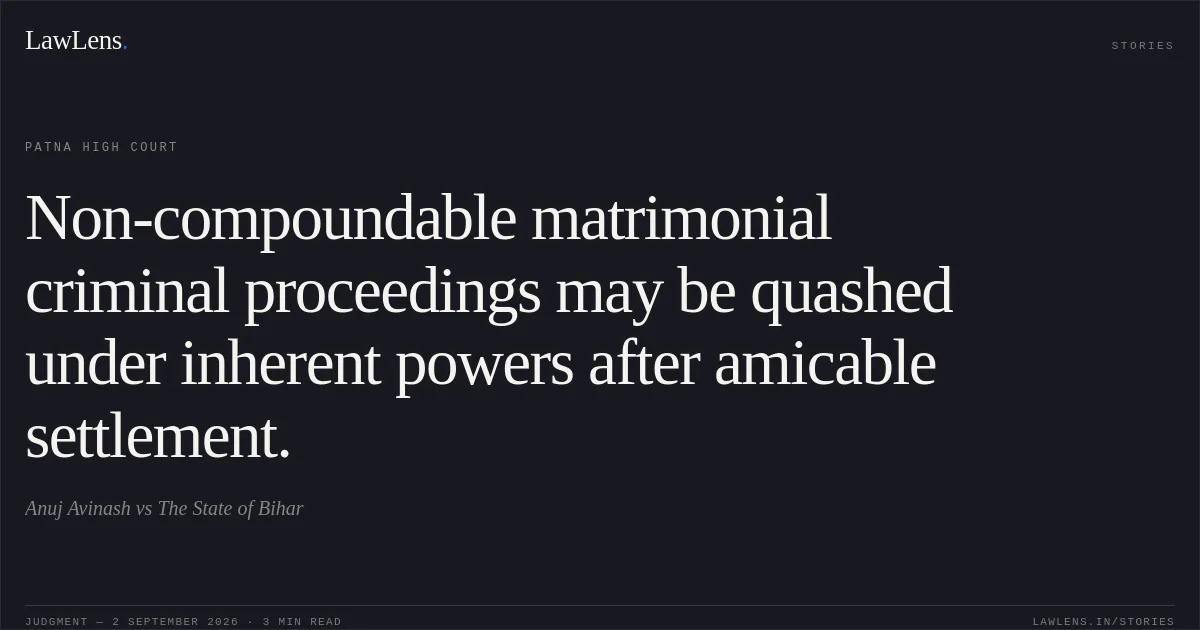
The High Court answered the issues in favour of the petitioners. Exercising its inherent jurisdiction under Section 528 BNSS, 2023, it allowed both petitions and quashed Mahila P.S. Case No. 23 of 2023, including the charge-sheet, in Criminal Miscellaneous No. 7120 of 2025.
It also quashed the cognizance order dated 1 April 2024 challenged in Criminal Miscellaneous No. 22491 of 2025.
Source reference: p. 12, para. 16Any pending interlocutory applications were also disposed of.
Source reference: p. 12, para. 17Acts & Sections Cited
11 provisions across 4 statutes referred to in this judgment. Each provision opens on LawLens.
Bharatiya Nagarik Suraksha Sanhita, 20231
Code of Criminal Procedure, 19732
Indian Penal Code, 18606
Original Court PDF
Anuj AvinashvsThe State of Bihar
Click to open original judgment
Original judgment, available to read, download and summarize on LawLens.in