Facts
Petitioner No. 1 and Respondent No. 2 married on 15 March 2021 and began living separately on 5 December 2022. Following matrimonial disputes, an FIR was registered against Petitioner No. 1 and his relatives under Sections 498A, 406 and 34 IPC and Section 4 of the Dowry Prohibition Act, 1961
Source reference: pp.1–2The parties subsequently settled their disputes through mediation, agreeing to dissolve the marriage by mutual consent and for Petitioner No. 1 to pay Respondent No. 2 ₹20,00,000 in full and final settlement
Source reference: pp.2–3The divorce decree was granted on 28 July 2026; the full settlement amount was paid, and Respondent No. 2 appeared before the Court and confirmed her consent to quashing the FIR
Source reference: p.3The other inter se proceedings had been withdrawn, and the FIR remained the only pending proceeding between the parties
Source reference: p.3Issues
1. Whether the High Court could exercise its inherent jurisdiction under Section 528 BNSS to quash the FIR and consequential proceedings for non-compoundable matrimonial offences after the parties had settled their disputes
Source reference: pp.3–4, 7–82. Whether the settlement, completed payment and Respondent No. 2’s consent justified quashing the proceedings against all petitioners
Source reference: pp.7–8Law Applied
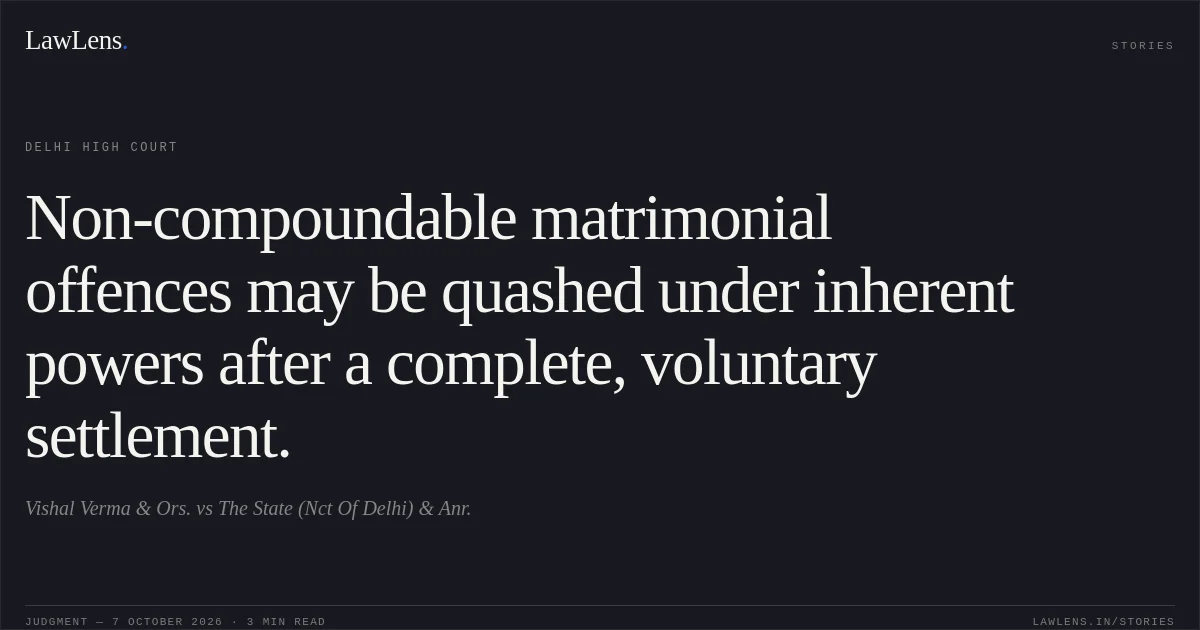
Section 528 of the Bharatiya Nagarik Suraksha Sanhita, 2023 (corresponding to Section 482 CrPC) confers inherent power to quash criminal proceedings to secure the ends of justice or prevent abuse of process; that power is distinct from, and not restricted by, the statutory power to compound offences under Section 359 BNSS (formerly Section 320 CrPC)
Source reference: pp.3–4Under Gian Singh v. State of Punjab, (2012) 10 SCC 303, and Narinder Singh v. State of Punjab, (2014) 6 SCC 466, the High Court may quash non-compoundable offences arising predominantly from private or matrimonial disputes where the parties have settled, while excluding serious or heinous offences and considering whether conviction is remote
Source reference: pp.4–6Jitendra Raghuvanshi v. Babita Raghuvanshi, (2013) 4 SCC 58, affirms the use of inherent powers to quash criminal proceedings following an amicable settlement of a private matrimonial dispute
Source reference: p.6Sections 498A, 406 and 34 IPC and Section 4 of the Dowry Prohibition Act formed the basis of the FIR; the Court noted that Sections 498A IPC and 4 of the Dowry Prohibition Act are non-compoundable, while Section 406 IPC is compoundable with the requisite permission
Source reference: pp.1, 3Reasoning
The Court treated the FIR as arising from a private matrimonial dispute, not a heinous or serious offence against society.
Source reference: pp.3, 7–8The parties had resolved their disputes, obtained a mutual-consent divorce, completed payment of the agreed ₹20,00,000, and withdrawn their other proceedings; Respondent No. 2 also confirmed her voluntary consent and filed an affidavit of no objection
Source reference: pp.3, 7–8Since the case was at the stage of arguments on charge, no prosecution witness had been examined, and Petitioner Nos. 5 to 7 had not been charge-sheeted, the Court found the possibility of conviction remote and bleak
Source reference: p.8It concluded that continuing the prosecution would serve no fruitful purpose and that the non-compoundable character of some offences did not bar quashing under Section 528 BNSS
Source reference: pp.3–4, 7–8Holding
The Court allowed the petition and quashed FIR No. 0571/2023, registered at Police Station Nand Nagri under Sections 498A, 406 and 34 IPC and Section 4 of the Dowry Prohibition Act, together with all consequential proceedings, against all petitioners
The petition, the accompanying application and any pending applications were disposed of accordingly
Source reference: p.8Acts & Sections Cited
11 provisions across 6 statutes referred to in this judgment. Each provision opens on LawLens.
Bharatiya Nagarik Suraksha Sanhita, 20232
Code of Criminal Procedure, 19732
Indian Penal Code, 18602
Bharatiya Nyaya Sanhita, 20233
Dowry Prohibition Act, 19611
Protection of Women from Domestic Violence Act, 20051
Original Court PDF
Vishal Verma & Ors.vsThe State (Nct Of Delhi) & Anr.
Click to open original judgment
Original judgment, available to read, download and summarize on LawLens.in