Facts
Petitioner No. 1 and respondent No. 2 married on 8 March 2019, separated in September 2021, and had no children.
Source reference: pp. 1–3, paras. 1–11The dispute led to FIR No. 422/2021 under Sections 498A, 406 and 34 IPC.
Source reference: pp. 1–3, paras. 1–11The parties later entered into a mediation settlement on 23 January 2026, agreed to dissolve their marriage and settle their disputes; a mutual-consent divorce decree was passed on 16 April 2026.
Source reference: pp. 1–3, paras. 1–11Of the agreed sum of ₹5,00,000, ₹3,00,000 had been paid; ₹1,75,000 was payable upon quashing this FIR and ₹25,000 upon quashing a separate FIR.
Source reference: pp. 1–3, paras. 1–11The DV Act and related execution proceedings had been withdrawn.
Source reference: pp. 1–3, paras. 1–11Respondent No. 2 confirmed that the settlement was voluntary, and the parties jointly sought quashing.
Source reference: pp. 1–3, paras. 1–11Issues
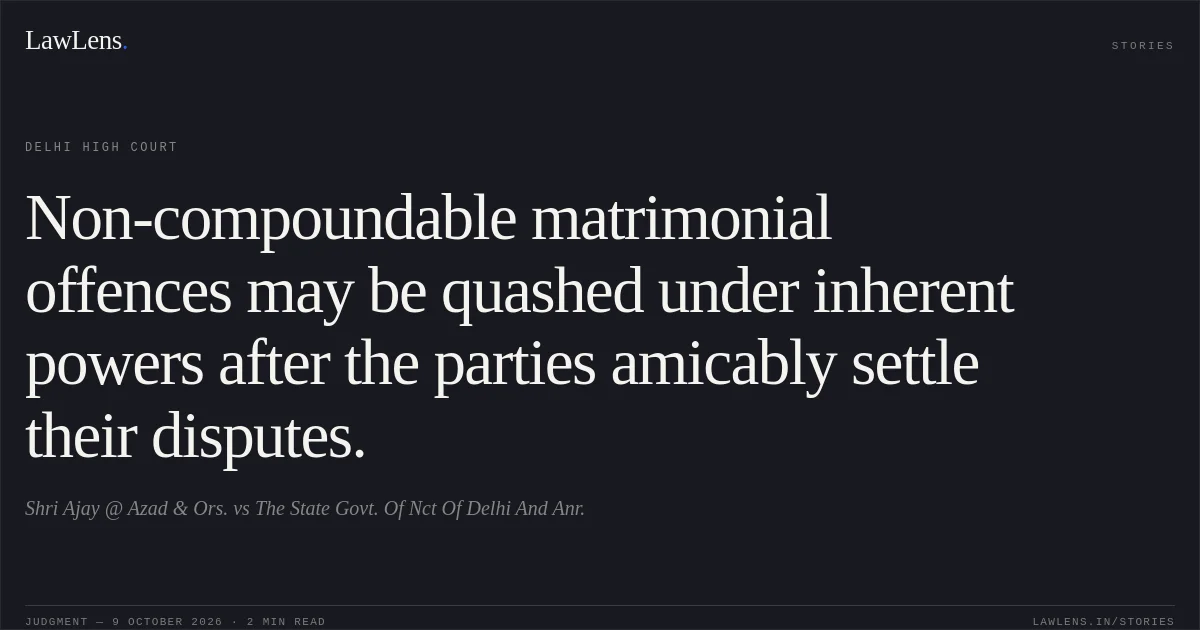
Whether the High Court could quash proceedings under Sections 498A, 406 and 34 IPC under Section 528 BNSS on the basis of a matrimonial settlement, notwithstanding the non-compoundable nature of Section 498A IPC.
Source reference: pp. 3–4, para. 12Whether, in the circumstances of this case, continuation of the prosecution would serve a useful purpose or instead defeat the ends of justice.
Source reference: pp. 6–7, paras. 17–18Law Applied
Section 528 BNSS preserves the High Court’s inherent power to quash proceedings to secure the ends of justice or prevent abuse of process; that power is distinct from, and not confined by, the statutory compounding provisions in Section 359 BNSS (formerly Sections 482 and 320 CrPC).
Source reference: p. 3, para. 12Under Gian Singh v. State of Punjab, (2012) 10 SCC 303, Narinder Singh v. State of Punjab, (2014) 6 SCC 466, and Jitendra Raghuvanshi v. Babita Raghuvanshi, (2013) 4 SCC 58, matrimonial and other predominantly private disputes may be quashed after a genuine settlement, even where the offences are non-compoundable, if quashing serves the ends of justice; serious and heinous offences ordinarily do not qualify.
Source reference: pp. 3–6, paras. 13–15The Court also relied on Navneesh Aggarwal v. State of Haryana, 2025 SCC OnLine SC 1680, concerning settlement-based quashing of matrimonial prosecutions after divorce.
Source reference: p. 6, para. 16Reasoning
The Court treated the FIR as arising from a matrimonial dispute and found that the alleged offences did not fall within the category of heinous or serious offences that would preclude settlement-based quashing.
Source reference: pp. 6–7, paras. 17–18, 21The parties had divorced by mutual consent, resolved their inter se disputes, withdrawn related proceedings, and respondent No. 2 confirmed the settlement and her consent in Court.
Source reference: pp. 2–3, paras. 6–9; pp. 6–7, paras. 17–18, 21Although ₹2,00,000 remained payable under the settlement—₹1,75,000 upon quashing this FIR and ₹25,000 upon quashing the separate FIR—the parties undertook to abide by the settlement.
Source reference: pp. 2–3, paras. 6–9; pp. 6–7, paras. 17–18, 21In these circumstances, the Court concluded that continuation of the prosecution would serve no fruitful purpose.
Source reference: pp. 6–7, paras. 17–18, 21Holding
The Court allowed the petition and quashed FIR No. 422/2021, registered under Sections 498A, 406 and 34 IPC, and all proceedings arising from it, as against all petitioners.
The petition, accompanying application and any other pending applications were disposed of, and the parties’ undertaking to comply with the settlement was taken on record.
Source reference: p. 7, paras. 19–21Acts & Sections Cited
6 provisions across 3 statutes referred to in this judgment. Each provision opens on LawLens.
Bharatiya Nagarik Suraksha Sanhita, 20232
Code of Criminal Procedure, 19732
Indian Penal Code, 18602
Original Court PDF
Shri Ajay @ Azad & Ors.vsThe State Govt. Of Nct Of Delhi And Anr.
Click to open original judgment
Original judgment, available to read, download and summarize on LawLens.in