Facts
The petitioner was the husband of Opposite Party No. 2. Their marriage was solemnized on 28 November 2012.
Source reference: paras. 2–4; pp. 2–3The informant alleged that, immediately after marriage, the petitioner and his family members subjected her to cruelty and harassment for non-fulfilment of a dowry demand of ₹5,00,000 for purchasing a car.
Source reference: paras. 2–4; pp. 2–3She was allegedly sent to her parental home on 4 December 2012, and it was further alleged that the petitioner subsequently took her to Rewa, Madhya Pradesh, where he continued to ill-treat and humiliate her.
Source reference: paras. 2–4; pp. 2–3On the basis of these allegations, Rajiv Nagar P.S. Case No. 215 of 2015 was registered for offences under Section 498A of the Indian Penal Code and Sections 3 and 4 of the Dowry Prohibition Act.
Source reference: para. 1; p. 1The learned SDJM, Patna took cognizance of the offences by order dated 18 August 2016.
Source reference: para. 1; p. 1During the pendency of the proceedings, the parties amicably settled their matrimonial dispute.
Source reference: para. 5; pp. 3–4They obtained a decree of divorce by mutual consent under Section 13-B of the Hindu Marriage Act, 1955, in Matrimonial Case No. 1327 of 2019.
Source reference: para. 5; pp. 3–4The settlement provided for payment of ₹25 lakhs as full and final alimony and withdrawal of the criminal proceedings and other disputes between the parties.
Source reference: para. 5; pp. 3–4The parties also successfully resolved the dispute through mediation before the Patna High Court Mediation and Conciliation Centre.
Source reference: para. 6; p. 4Issues
Whether the High Court could exercise its inherent jurisdiction under Section 482 Cr.P.C. to quash proceedings for offences under Section 498A IPC and Sections 3 and 4 of the Dowry Prohibition Act, notwithstanding that the offences are non-compoundable, when the matrimonial dispute had been amicably settled and the parties had obtained mutual-consent divorce?
Source reference: paras. 7–10, 14; pp. 4–7Whether continuation of the criminal proceedings after the settlement and dissolution of the marriage would amount to an abuse of the process of the Court and serve any useful purpose?
Source reference: paras. 7–8, 14; pp. 4–5, 7Law Applied
The Court applied Section 482 of the Code of Criminal Procedure, 1973, which preserves the High Court’s inherent power to prevent abuse of the process of any court and secure the ends of justice.
Source reference: paras. 1, 8, 10; pp. 1, 4–5Although offences under Section 498A IPC and Sections 3 and 4 of the Dowry Prohibition Act are non-compoundable, the Court held that inherent jurisdiction may be exercised to quash criminal proceedings in appropriate cases where the dispute is essentially matrimonial and has been genuinely settled.
Source reference: paras. 10–12; pp. 5–7Relying on Gian Singh v. State of Punjab, (2012) 10 SCC 303, the Court recognised that proceedings arising from matrimonial or family disputes may be quashed after settlement where continuation would be futile and the ends of justice require termination of the case.
Source reference: para. 12; pp. 6–7It also relied on Narinder Singh v. State of Punjab, (2014) 6 SCC 466, which distinguishes quashing under Section 482 Cr.P.C. from statutory compounding under Section 320 Cr.P.C. and requires such power to be exercised sparingly and cautiously.
Source reference: para. 11; pp. 5–6The Court further referred to Naushey Ali v. State of U.P., (2025) 4 SCC 78, observing that continuation of a trial after an amicable settlement may be futile and constitute an abuse of process.
Source reference: para. 13; p. 7Reasoning
The Court found that the dispute was primarily matrimonial in nature and that the parties had conclusively resolved it through mediation, a formal settlement, payment of agreed alimony, and dissolution of their marriage by mutual consent.
Source reference: paras. 5–7, 14; pp. 3–4, 7Applying the principles in Gian Singh and Narinder Singh, the Court held that the non-compoundable character of the offences did not bar exercise of the separate inherent power of quashing under Section 482 Cr.P.C.
Source reference: paras. 10–12; pp. 5–7Since the complainant supported the settlement, the State raised no objection, and no dispute survived between the parties, continuation of the prosecution would not advance the administration of justice and would instead amount to an abuse of the process of the Court.
Source reference: paras. 7, 9, 14; pp. 4–5, 7Holding
The High Court answered the issues in favour of the petitioner.
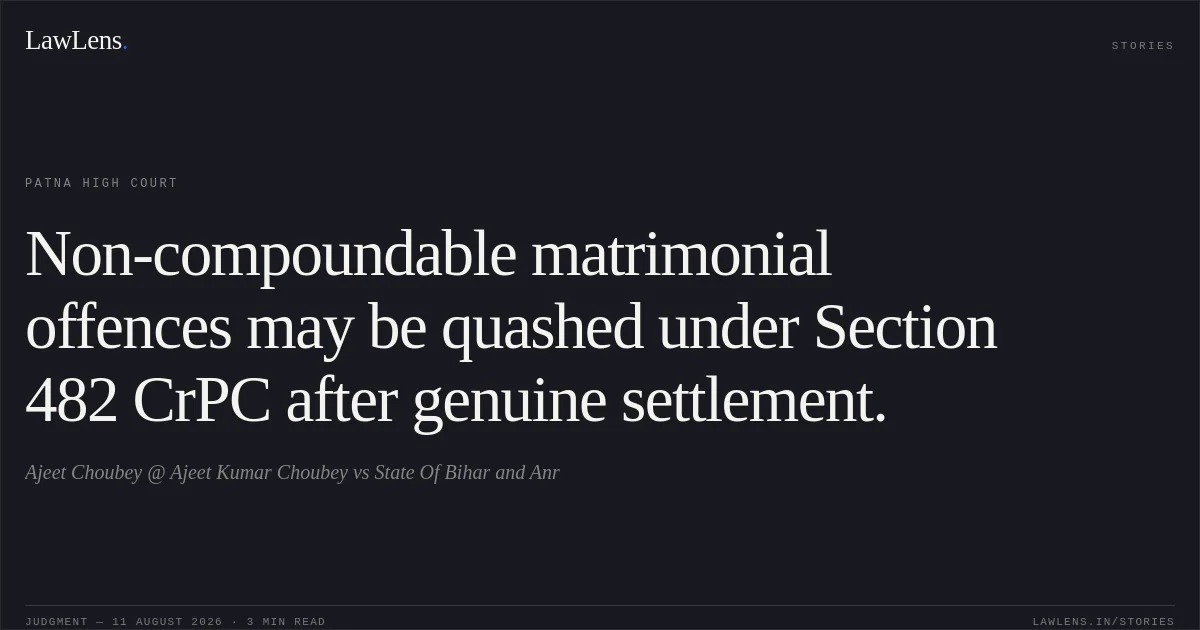
Exercising its inherent jurisdiction under Section 482 Cr.P.C., it quashed the order dated 18 August 2016 taking cognizance of the offences under Section 498A IPC and Sections 3 and 4 of the Dowry Prohibition Act, along with all consequential proceedings arising from Rajiv Nagar P.S. Case No. 215 of 2015, corresponding to G.R. No. 5773 of 2015.
Source reference: para. 15; p. 8The parties were directed to abide by the terms of their settlement, and the petition was accordingly allowed.
Source reference: paras. 16–17; p. 8Acts & Sections Cited
4 provisions across 2 statutes referred to in this judgment. Each provision opens on LawLens.
Code of Criminal Procedure, 19732
Original Court PDF
Ajeet Choubey @ Ajeet Kumar ChoubeyvsState Of Bihar and Anr
Click to open original judgment
Original judgment, available to read, download and summarize on LawLens.in