Facts
The marriage between petitioner no. 1 and respondent no. 2 took place on 7 July 2019, and they have one minor child. Respondent no. 2’s complaint led to registration of FIR No. 684/2021 at PS Dwarka North under Sections 498A/406/34 IPC; a chargesheet was later filed under Sections 498A/406/506/34 IPC. Related domestic-violence and maintenance proceedings were also initiated
Source reference: pp. 2–3, paras. 2–4The parties settled their disputes through a mediation settlement dated 16 April 2026, providing for payment of ₹15,50,000 to respondent no. 2. After mutual-consent divorce, petitioner no. 1 paid the remaining ₹7,00,000 by demand draft in court. Respondent no. 2 confirmed that she did not wish to pursue the matter
Source reference: pp. 3–4, paras. 5–6, 12–15Issues
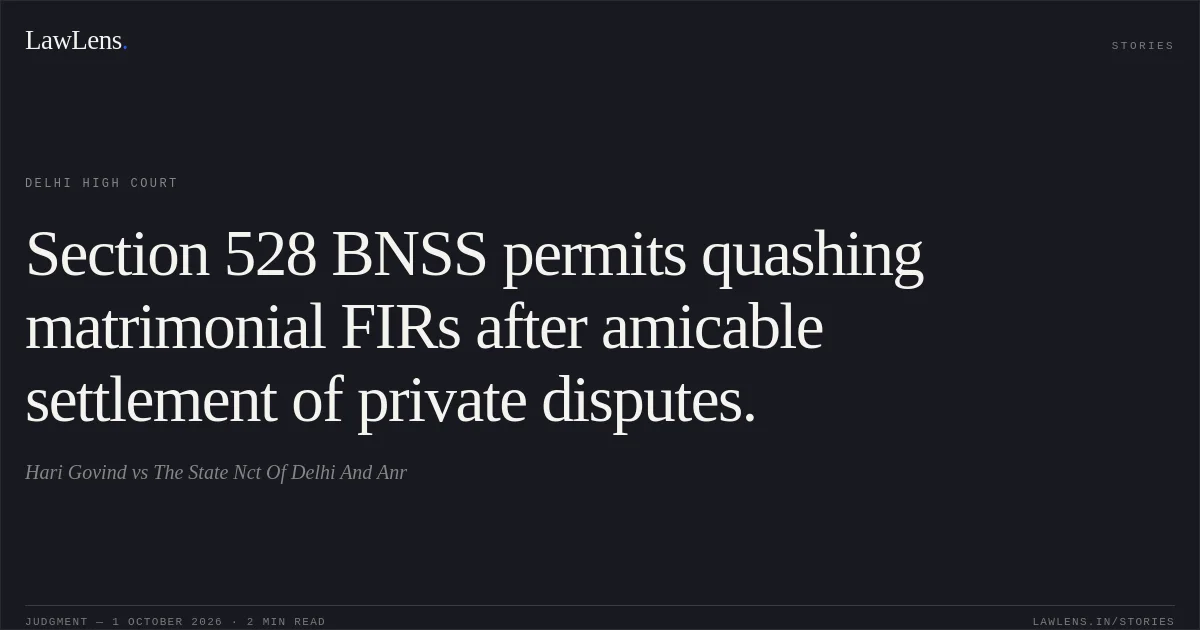
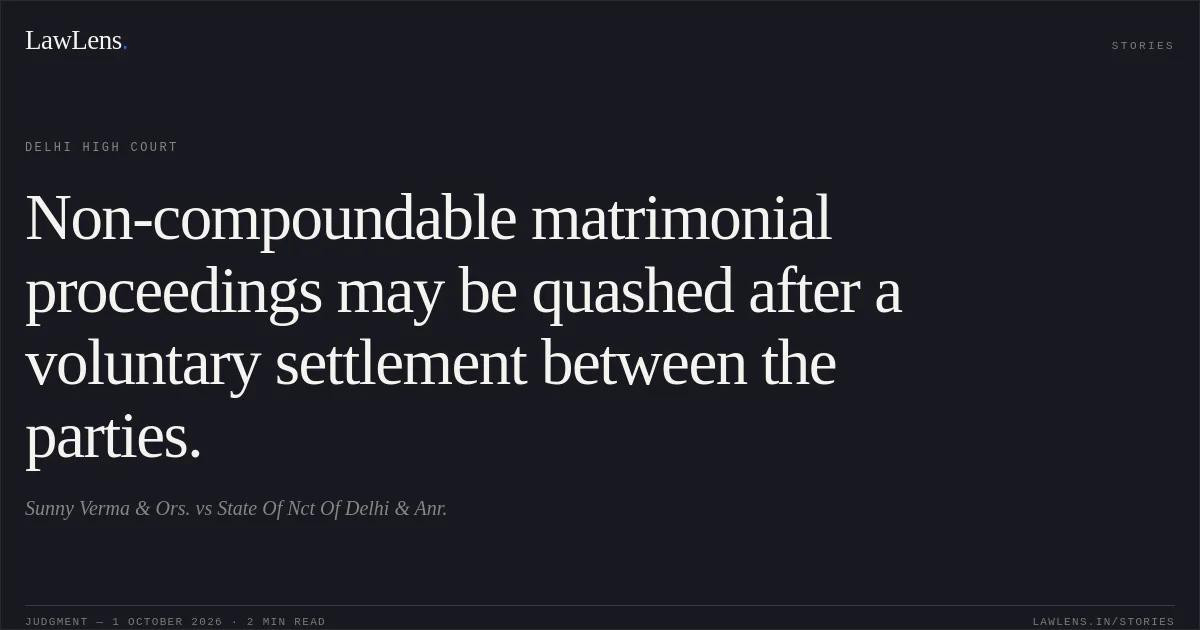
Whether the High Court should exercise its inherent jurisdiction under Section 528 BNSS to quash the FIR and consequential proceedings for non-compoundable matrimonial offences after the parties have settled their disputes
Source reference: pp. 2, 4–5, paras. 1, 18–23Whether quashing the proceedings should be made subject to protection of the minor child’s rights
Source reference: p. 4, para. 16; p. 5, para. 23Law Applied
Section 528 of the Bharatiya Nagarik Suraksha Sanhita, 2023, corresponding to Section 482 CrPC, preserves the High Court’s inherent power to quash criminal proceedings to secure the ends of justice
Source reference: p. 2, para. 1Although Section 498A IPC is non-compoundable, the Supreme Court in Jitendra Raghuvanshi v. Babita Raghuvanshi, (2013) 4 SCC 58, held that the High Court may quash proceedings arising from matrimonial disputes where the settlement is genuine and voluntary, notwithstanding the non-compoundable nature of the offences, provided the exercise serves the ends of justice
Source reference: pp. 4–5, paras. 19–21Reasoning
The Court found that the parties had amicably settled their disputes, obtained a mutual-consent divorce, and completed the agreed payment, with respondent no. 2 accepting the final ₹7,00,000 and confirming that she did not wish to continue the case
Source reference: pp. 3–4, paras. 12–15, 18, 22Applying the principle in Jitendra Raghuvanshi, the Court concluded that the settlement justified quashing the matrimonial criminal proceedings despite the non-compoundable nature of Section 498A IPC. It addressed the State’s concern regarding the child by expressly preserving the minor’s rights
Source reference: pp. 4–5, paras. 16, 19–23Holding
The Court allowed the petition and quashed FIR No. 684/2021, registered under Sections 498A/406/34 IPC, and all proceedings emanating from it.
The order expressly clarified that the parties’ settlement would not affect the rights of the minor child
Source reference: p. 5, paras. 23–24Acts & Sections Cited
8 provisions across 4 statutes referred to in this judgment. Each provision opens on LawLens.
Bharatiya Nagarik Suraksha Sanhita, 20231
Code of Criminal Procedure, 19733
Indian Penal Code, 18603
Protection of Women from Domestic Violence Act, 20051
Original Court PDF
Sunny Verma & Ors.vsState Of Nct Of Delhi & Anr.
Click to open original judgment
Original judgment, available to read, download and summarize on LawLens.in