Facts
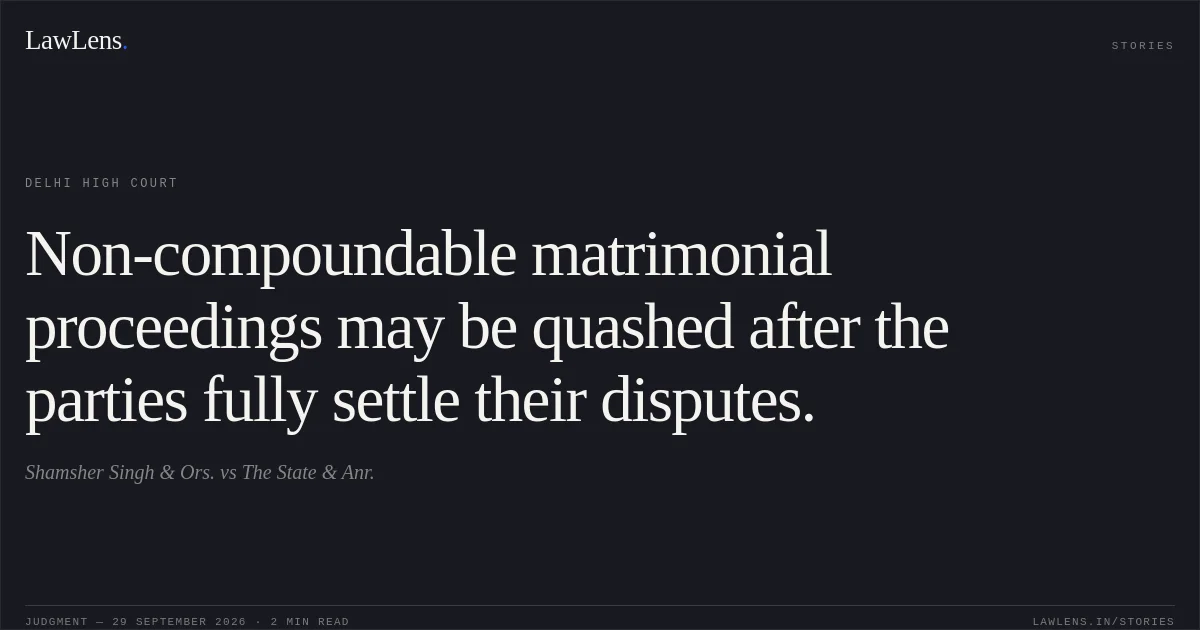
The petitioners sought quashing under Section 482 of the Code of Criminal Procedure, 1973 (CrPC), of FIR No. 105/2024, registered at Police Station Seemapuri under Sections 498A, 506, 509 and 34 of the Indian Penal Code, 1860, and Section 4 of the Dowry Prohibition Act, 1961, and the proceedings arising from it
Source reference: p. 1, para. 1The parties had entered into a settlement before the Delhi Mediation Centre on 22 March 2024, under which petitioner no. 1 agreed to pay respondent no. 2 ₹1 lakh in full and final settlement of their matrimonial disputes
Source reference: p. 2, paras. 4–5The parties obtained a mutual-consent divorce; respondent no. 2 also withdrew her domestic-violence and maintenance proceedings
Source reference: pp. 2–3, paras. 6–10At the hearing, respondent no. 2 confirmed receipt of the final ₹50,000 instalment and stated that she did not wish to pursue the FIR
Source reference: p. 3, paras. 11–13Issues
1. Whether the High Court could exercise its inherent jurisdiction under Section 482 CrPC to quash the FIR and consequential proceedings, including in respect of non-compoundable offences, on the basis of the parties’ settlement
Source reference: pp. 1, para. 1; pp. 4–7, paras. 15–162. Whether, having regard to the nature of the allegations and the complete settlement of the matrimonial disputes, continuation of the criminal proceedings would serve any useful purpose
Source reference: pp. 7–8, paras. 17–21Law Applied
Section 482 CrPC (corresponding to Section 528 of the Bharatiya Nagarik Suraksha Sanhita, 2023) preserves the High Court’s inherent power to quash proceedings to secure the ends of justice or prevent abuse of the process of any court; that power is distinct from the statutory power to compound offences under Section 320 CrPC
Source reference: pp. 1, para. 1; p. 5, para. 15; pp. 6–7, para. 16Under Gian Singh v. State of Punjab, (2012) 10 SCC 303, and Narinder Singh v. State of Punjab, (2014) 6 SCC 466, the High Court may quash non-compoundable offences following settlement where the dispute is predominantly private—such as a matrimonial dispute—and the nature and gravity of the offence, the prospect of conviction, and the interests of justice support quashing. Such relief is generally inappropriate for heinous or serious offences, offences affecting society at large, or offences under special statutes of the kind identified in those decisions
Source reference: pp. 4–7, paras. 15–16Reasoning
The Court treated the case as a matrimonial dispute that had been fully resolved: the parties had settled their claims, obtained a mutual-consent divorce, and respondent no. 2 had withdrawn related proceedings and confirmed that she did not wish to pursue the FIR
Source reference: pp. 2–3, paras. 4–13Applying Gian Singh and Narinder Singh, the Court found that the FIR did not concern a heinous crime or an offence implicating public interest, and that continuation of the proceedings would serve no fruitful purpose and could perpetuate hostility between the parties
Source reference: pp. 7–8, paras. 17–21Holding
The Court answered the issues in favour of quashing.
It allowed the petition and quashed FIR No. 105/2024, registered at Police Station Seemapuri, together with all consequential proceedings
Source reference: p. 8, para. 22The petition and pending application were disposed of.
Source reference: p. 8, para. 23Acts & Sections Cited
8 provisions across 4 statutes referred to in this judgment. Each provision opens on LawLens.
Code of Criminal Procedure, 19733
Bharatiya Nagarik Suraksha Sanhita, 20231
Indian Penal Code, 18603
Dowry Prohibition Act, 19611
Original Court PDF
Shamsher Singh & Ors.vsThe State & Anr.
Click to open original judgment
Original judgment, available to read, download and summarize on LawLens.in