Facts
Respondent no. 2 lodged FIR No. 577/2022 against her husband and mother-in-law under Sections 498A, 406 and 34 IPC, alleging, among other things, unlawful dowry demands and refusal to return her jewellery.
Source reference: p. 1–2The spouses had lived separately since 29 August 2021, and a chargesheet was filed on 11 May 2023.
Source reference: p. 1–2They later settled their matrimonial disputes under an agreement dated 9 December 2024, which provided for payment of ₹10,00,000 to respondent no. 2 in instalments.
Source reference: p. 2–5The marriage was dissolved, and the final instalment was paid in Court; respondent no. 2 confirmed receipt and stated that she did not wish to pursue the case.
Source reference: p. 2–5She also affirmed that the settlement was voluntary.
Source reference: p. 2–5Issues
1. Whether the High Court could quash proceedings for non-compoundable offences under Sections 498A, 406 and 34 IPC under Section 528 BNSS on the basis of a settlement in a matrimonial dispute.
Source reference: p. 1, 42. Whether the settlement was voluntary and had been acted upon so as to warrant quashing the FIR and consequential proceedings.
Source reference: p. 3–5Law Applied
Section 528 of the BNSS, corresponding to Section 482 CrPC, preserves the High Court’s inherent power to quash criminal proceedings to secure the ends of justice.
Source reference: p. 4–5That power may be exercised in respect of non-compoundable offences where the dispute is private, the parties have genuinely and voluntarily settled it, and quashing would not adversely affect an overriding public interest.
Source reference: p. 4–5Relying on Jitendra Raghuvanshi v. Babita Raghuvanshi, (2013) 4 SCC 58, the Court reiterated that Section 320 CrPC does not bar quashing matrimonial proceedings under the High Court’s inherent powers where the parties have amicably resolved their differences.
Source reference: p. 4–5Reasoning
Although the offence under Section 498A IPC was non-compoundable, the dispute arose from matrimonial relations and had been settled.
Source reference: p. 3–5The parties had divorced, the agreed settlement amount had been paid in full, and respondent no. 2 confirmed both receipt of payment and her desire not to pursue the proceedings.
Source reference: p. 3–5Having interacted with her and satisfied itself that the agreement was voluntary and free from coercion or undue influence, the Court found no reason to continue the prosecution.
Source reference: p. 3–5Holding
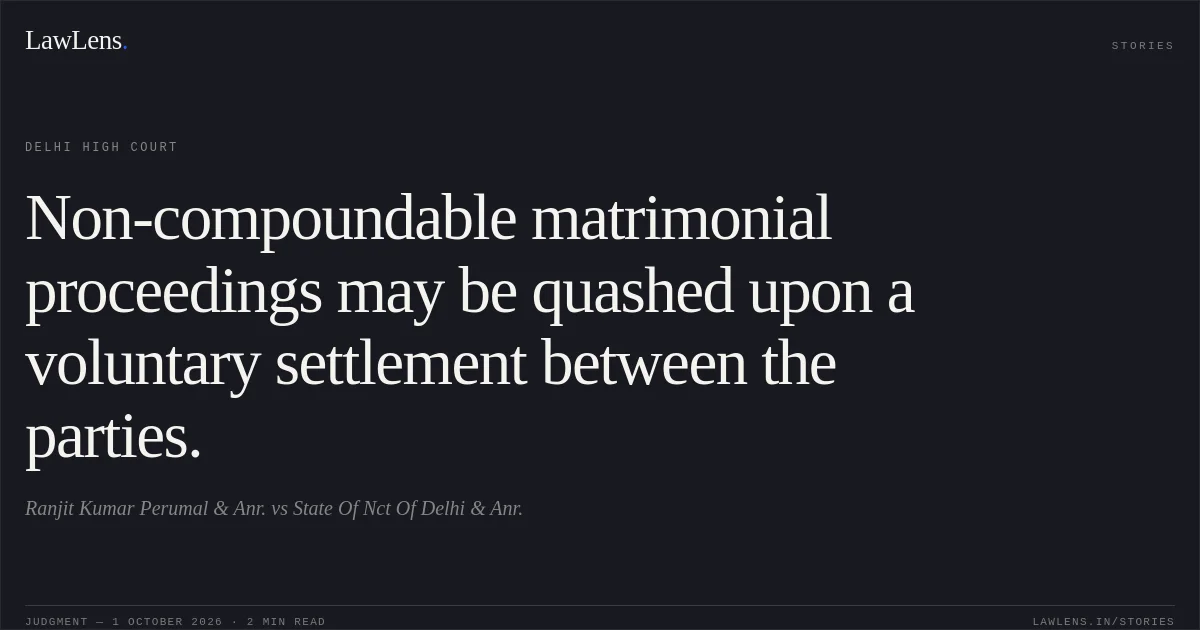
The Court held that the FIR and consequential proceedings could be quashed in view of the parties’ voluntary settlement of their matrimonial dispute.
FIR No. 577/2022, registered at PS Sagarpur under Sections 498A, 406 and 34 IPC, and all proceedings arising from it, were quashed.
Source reference: p. 5The parties remain bound by the settlement agreement, and the petition and pending applications were disposed of.
Source reference: p. 5Acts & Sections Cited
5 provisions across 3 statutes referred to in this judgment. Each provision opens on LawLens.
Bharatiya Nagarik Suraksha Sanhita, 20231
Code of Criminal Procedure, 19732
Indian Penal Code, 18602
Original Court PDF
Ranjit Kumar Perumal & Anr.vsState Of Nct Of Delhi & Anr.
Click to open original judgment
Original judgment, available to read, download and summarize on LawLens.in