Facts
Respondent no. 2 lodged FIR No. 1232/2015 against the petitioner, her husband, and his family members under Sections 498A, 406 and 34 of the IPC.
Source reference: para. 1Proceedings against the petitioner’s father- and brother-in-law had abated following their deaths.
Source reference: para. 3–4The petitioner and respondent no. 2 later executed a memorandum of understanding (MoU), under which she confirmed receipt of her stridhan and mehar and agreed to seek quashing of the FIR.
Source reference: para. 5–7She affirmed before the Court that the settlement was voluntary and that she did not wish to pursue the case.
Source reference: para. 13The parties had lived separately for approximately six years; their three children were in respondent no. 2’s custody.
Source reference: para. 12, 14Issues
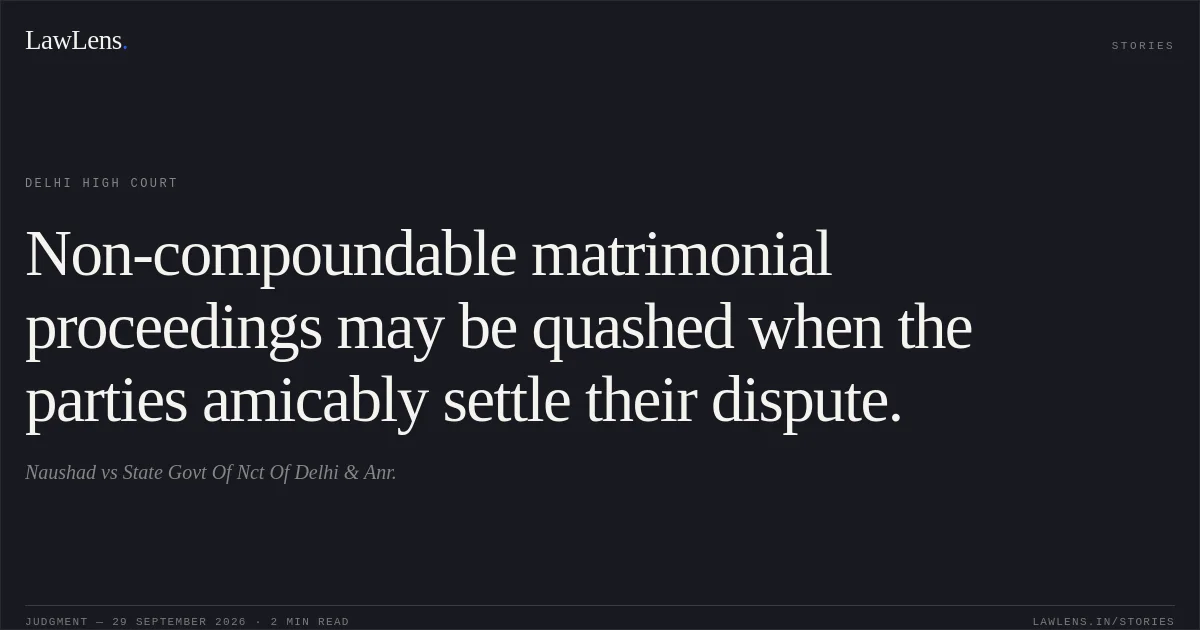
Whether the FIR and consequential proceedings under Sections 498A, 406 and 34 IPC could be quashed under Section 528 BNSS on the basis of the parties’ settlement, despite Section 498A being non-compoundable.
Source reference: para. 1, 8–11Whether the children’s potential legal claims against the petitioner should remain open notwithstanding the settlement and quashing of the FIR.
Source reference: para. 14–18Law Applied
Section 528 of the Bharatiya Nagarik Suraksha Sanhita, 2023 (corresponding to Section 482 CrPC), preserves the High Court’s inherent power to quash criminal proceedings to secure the ends of justice or prevent abuse of process, including in appropriate cases involving non-compoundable offences.
Source reference: no citationUnder *Gian Singh v. State of Punjab*, (2012) 10 SCC 303, proceedings arising from matrimonial or family disputes may be quashed where the parties have settled and continuation would serve no useful purpose, provided the offence is not one whose gravity or public impact makes quashing inappropriate.
Source reference: para. 10*Narinder Singh v. State of Punjab*, (2014) 6 SCC 466, further requires the Court to exercise this power cautiously, considering the nature of the offence, the completeness of the settlement, and whether conviction is remote and continuation would cause injustice.
Source reference: para. 11The judgment notes that Section 406 IPC is compoundable, whereas Section 498A IPC is non-compoundable.
Source reference: para. 8Reasoning
The Court treated the case as a matrimonial dispute that had been settled between the spouses.
Source reference: no citationRespondent no. 2 personally confirmed the settlement, its voluntariness, and her wish not to continue the prosecution; the MoU recorded that her stridhan and mehar had been received and no claims remained pending against the petitioner.
Source reference: para. 5–7, 13Applying *Gian Singh* and *Narinder Singh*, the Court concluded that the settlement justified quashing notwithstanding the non-compoundable Section 498A charge.
Source reference: para. 9–11, 16In response to the State’s concern that the MoU did not address the parties’ three children, the Court expressly preserved their rights to pursue legal claims against their father.
Source reference: para. 14–18Holding
The Court allowed the petition and quashed FIR No. 1232/2015, registered under Sections 498A, 406 and 34 IPC, together with all consequential proceedings.
The parties were directed to remain bound by the MoU, while the children’s rights to pursue any legal claim against the petitioner were kept open.
Source reference: para. 16–19Acts & Sections Cited
5 provisions across 3 statutes referred to in this judgment. Each provision opens on LawLens.
Bharatiya Nagarik Suraksha Sanhita, 20231
Code of Criminal Procedure, 19732
Indian Penal Code, 18602
Original Court PDF
NaushadvsState Govt Of Nct Of Delhi & Anr.
Click to open original judgment
Original judgment, available to read, download and summarize on LawLens.in