01Facts
The petitioners sought quashing under Article 226 of the Constitution of India of F.I.R./Case Crime No. 0163 of 2026, registered at P.S. Dineshpur, District Udham Singh Nagar, for offences under Sections 351(3), 352 and 69 of the Bharatiya Nyaya Sanhita, 2023 (B.N.S.), on the basis of a compromise.
¶ 4The complainant (respondent no. 3) alleged that petitioner no. 1 had established physical relations with her on a false promise of marriage. Petitioner no. 2 is petitioner no. 1's mother.
¶ 5Petitioners contended that the parties were in a love relationship, the dispute arose from personal misunderstandings, and they had since resolved it and solemnized marriage.
¶ 6A joint compounding application, I.A. No. 2 of 2026, supported by affidavits of the petitioners and respondent no. 3, was filed.
¶ 7Respondent no. 3 stated that she did not wish to pursue the proceedings and had no objection to quashing.
¶ 7Petitioner no. 1 and respondent no. 3 appeared in person; petitioner no. 2 appeared by video conferencing. Respondent no. 3 affirmed the compromise, stated that the marriage was registered under the Uniform Civil Code (U.C.C.), and confirmed the parties were living together as husband and wife.
¶ 8The State opposed relief on the ground that the offences are serious and non-compoundable, but did not dispute the marriage or the filing of the compounding application.
¶ 902Issues
i.1. Whether the High Court may quash criminal proceedings for non-compoundable offences under Sections 351(3), 352 and 69 B.N.S. on the basis of a compromise, independently of the statutory power of compounding.
¶ 13ii.2. Whether the subsequent marriage between the accused and the complainant, together with the complainant's voluntary affirmation of the settlement, justifies quashing where the allegation under Section 69 B.N.S. involves a false promise of marriage.
¶ 14iii.3. Whether continuation of the criminal proceedings would serve any useful purpose or would amount to an abuse of the process of law.
¶ 1503Law Applied
The Court relied on Article 226 of the Constitution as the source of its jurisdiction to interfere.
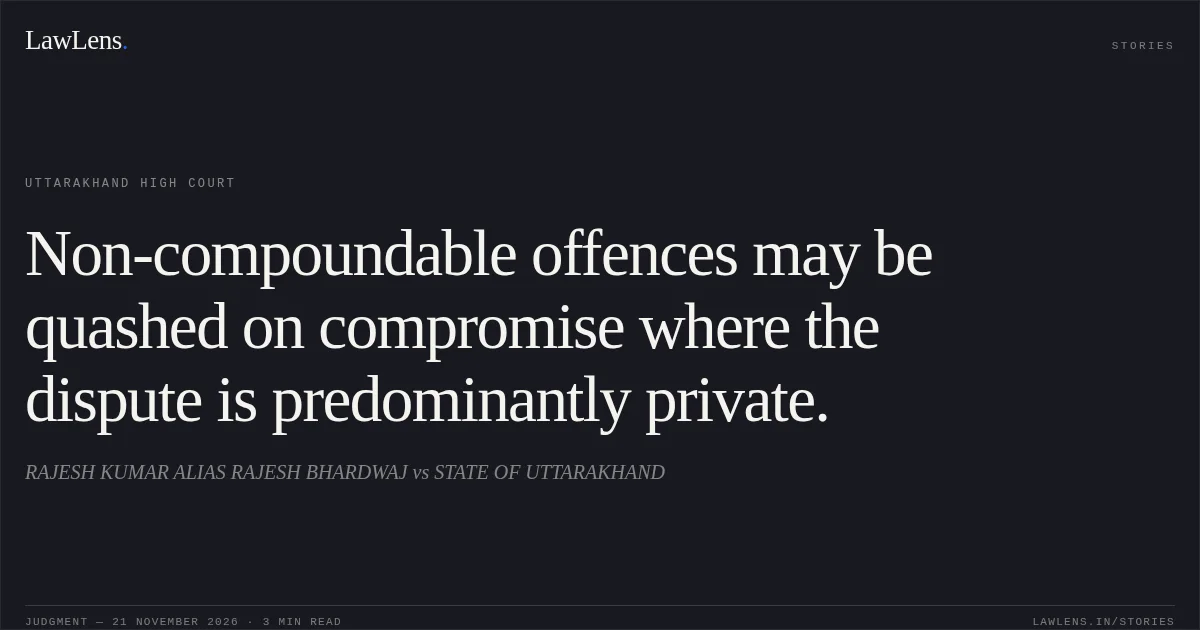
¶ 15The High Court may exercise inherent jurisdiction to quash criminal proceedings on the basis of a compromise, independently of the statutory compounding power, where doing so secures the ends of justice.
¶ 13Gian Singh v. State of Punjab, (2012) 10 SCC 303, Narinder Singh v. State of Punjab, (2014) 6 SCC 466, and Parbatbhai Aahir v. State of Gujarat, (2017) 9 SCC 641 hold that proceedings for non-compoundable offences may be quashed where the dispute is predominantly private in nature, having regard to the nature and gravity of the offence and the circumstances of the case.
¶ 13An allegation under Section 69 B.N.S. cannot be treated as a mere matrimonial dispute merely because the parties have subsequently married.
¶ 14Quashing is an exercise of power to prevent abuse of the process of law.
¶ 15Provisions in the judgment · 3 · Linked ones open on LawLens
Bharatiya Nyaya Sanhita, 2023 Section 351Section 352Section 69
04Reasoning
The Court first found that the dispute originated in a personal relationship and that the parties had subsequently married, with the marriage registered under the U.C.C.
¶ 11The Court assessed the voluntariness of the settlement. Respondent no. 3 was interacted with in person, affirmed the compromise and expressed willingness to continue the marital relationship. Her statement, the joint compounding application and the affidavits together satisfied the Court that the settlement was free of coercion, pressure or undue influence.
¶ 12Applying the Gian Singh line of authority, the Court treated the dispute as predominantly private.
¶ 13The Court expressly declined to treat the Section 69 allegation as a mere matrimonial dispute solely because of the subsequent marriage, and still weighed the peculiar facts, the continuing marriage and the complainant's unequivocal stand.
¶ 14The Court held that continuing the prosecution would serve no useful purpose and would amount to abuse of process, which justified interference under Article 226.
¶ 1505Holding
The Court answered the issues in the affirmative. It held that, despite the non-compoundable nature of the offences, the High Court could quash the proceedings on the strength of the voluntary compromise, the subsequent marriage and the complainant's unwillingness to proceed, since continuation would be an abuse of process.
¶ 13–15The joint compounding application (I.A. No. 2 of 2026) was allowed. F.I.R./Case Crime No. 0163 of 2026 registered at P.S. Dineshpur, along with all consequential proceedings, was quashed qua the petitioners.
¶ 15–16The writ petition was allowed and pending applications were disposed of.
¶ 17–18Original Court PDF
RAJESH KUMAR ALIAS RAJESH BHARDWAJvsSTATE OF UTTARAKHAND
Click to open original judgment
Original judgment, available to read, download and summarize on LawLens.in