01Facts
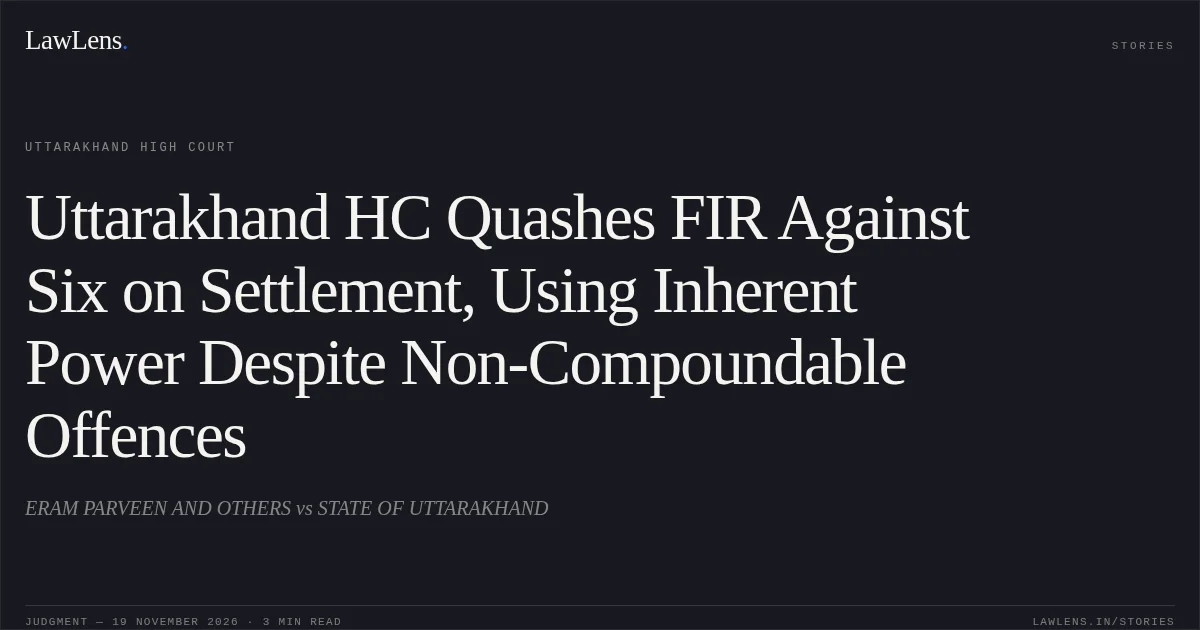
The petitioners sought quashing of FIR No. 0481 of 2026 dated 17.09.2026, registered at Police Station Rudrapur, District Udham Singh Nagar, under Sections 308(6), 351(1) and 352 of the Bharatiya Nyaya Sanhita, 2023 (BNS).
¶ 2The petitioners filed a joint compounding application (IA/2/2026), supported by affidavits of the petitioners and Respondent No. 4 (Shahida Jahan), stating that the parties had reached a compromise and seeking quashing on that basis.
¶ 3–4Before the Court, Respondent No. 4 stated that she did not wish to prosecute the case in view of the amicable settlement, and all parties conceded no objection to allowing the compounding application.
¶ 5The learned State Counsel raised a preliminary objection that the offences were non-compoundable.
¶ 602Issues
i.1. Whether the High Court may quash an FIR for non-compoundable offences on the basis of a compromise between the parties, notwithstanding the bar under Section 320 of the Code of Criminal Procedure (Cr.P.C.).
¶ 6–8ii.2. Whether, in the facts of the case, continuation of the criminal proceedings would be unfair or contrary to the interest of justice, such that quashing is warranted in the exercise of inherent/extraordinary jurisdiction.
¶ 9–1003Law Applied
Section 320 Cr.P.C., which governs compounding of offences, does not limit the High Court's power under Article 226 of the Constitution to quash criminal proceedings.
¶ 8B.S. Joshi v. State of Haryana, (2003) 4 SCC 675: Section 320 is no bar to quashing where necessary to secure the ends of justice, the exercise of such power depending on the facts of each case.
¶ 7Gian Singh v. State of Punjab, (2013) 1 SCC (Cri) 160: the High Court's inherent power to quash is distinct from compounding under Section 320, is exercised to secure the ends of justice or prevent abuse of process, and may be used in settled cases where the possibility of conviction is remote and bleak and continuation would cause oppression or extreme injustice.
¶ 9The offences under Sections 308(6), 351(1) and 352 BNS are referred to, but their elements are not discussed in the judgment.
¶ 2, 6Provisions in the judgment · 4 · Linked ones open on LawLens
Bharatiya Nyaya Sanhita, 2023 Section 308Section 351Section 352
Code of Criminal Procedure, 1973 Section 320
04Reasoning
The Court first addressed the State's objection by holding that the non-compoundable nature of the offences does not bar quashing, since the High Court's power under Article 226 and its inherent jurisdiction operate independently of Section 320.
¶ 7–8The Court then applied the Gian Singh test, taking into account that the parties had fully settled their dispute, that the complainant/victim (Respondent No. 4) expressly declined to prosecute, and that all parties consented to quashing. On this basis, the Court concluded that the possibility of conviction was remote or bleak and that continuing the proceedings would be unfair and contrary to the interest of justice. The judgment does not separately analyse the gravity of the alleged offences or the nature of the allegations, and the decision rests principally on the settlement and the consent of the victim.
¶ 5, 1005Holding
The Court answered both issues in the affirmative: Section 320 Cr.P.C. does not bar quashing of non-compoundable offences where the ends of justice so require, and continuation of the proceedings would be unfair in the present circumstances.
¶ 8, 10The compounding application (IA/2/2026) was allowed and the compromise accepted. FIR No. 0481 of 2026 dated 17.09.2026 (PS Rudrapur, Udham Singh Nagar) was quashed qua the petitioners, and all consequential proceedings arising from the FIR were directed to come to an end. The writ petition was allowed and pending applications, if any, were disposed of.
¶ 11–13Original Court PDF
ERAM PARVEEN AND OTHERSvsSTATE OF UTTARAKHAND
Click to open original judgment
Original judgment, available to read, download and summarize on LawLens.in