01Facts
The complainants alleged that the applicant induced them to pay ₹98.97 lakh by representing that he owned a property, which they later discovered he did not own.
¶ 4–7After investigation, a charge-sheet was filed for offences under Sections 420, 406, 467, 468, 471, 506 and 120-B IPC, and the Magistrate took cognizance.
¶ 4–7The applicant sought quashing of the charge-sheet, cognizance/summoning order dated 03.05.2018 and the pending criminal proceedings.
¶ 4–7The parties subsequently settled: the applicant refunded the full amount, and the complainants confirmed the settlement before the High Court and stated that they did not wish to pursue the case.
¶ 4–702Issues
i.1. Whether the High Court could quash proceedings involving non-compoundable offences under its inherent jurisdiction, on the basis of the parties’ settlement.
¶ 11ii.2. Whether, in light of the refund and the complainants’ unwillingness to prosecute, continuation of the proceedings would amount to an abuse of the process of law.
¶ 10–1203Law Applied
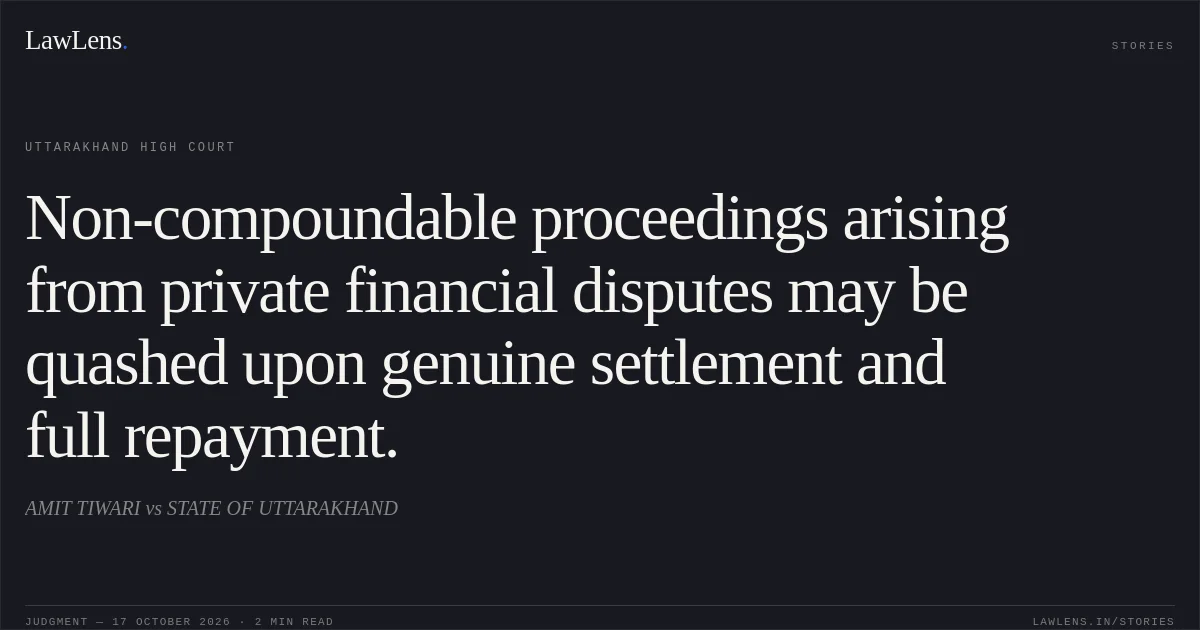
The Court stated that the High Court may exercise its inherent jurisdiction under Section 482 Cr.P.C./Section 528 B.N.S.S. to quash proceedings for non-compoundable offences where the dispute is predominantly private and continuation would constitute an abuse of process.
¶ 11It relied on Gian Singh v. State of Punjab, Narinder Singh v. State of Punjab and Parbatbhai Aahir v. State of Gujarat for the principles governing quashing on the basis of an amicable settlement, including whether the ends of justice warrant such relief.
¶ 11Provisions in the judgment · 8 · Linked ones open on LawLens
Indian Penal Code, 1860 Section 420Section 406Section 467Section 468Section 471Section 506
Code of Criminal Procedure, 1973 Section 482
Bharatiya Nagarik Suraksha Sanhita, 2023 Section 528
04Reasoning
The Court found that the dispute arose from a financial transaction and that the complainants had received the full ₹98.97 lakh.
¶ 8–12Their confirmation of the settlement and stated unwillingness to pursue the prosecution supported the finding that the compromise was genuine, voluntary and free from coercion.
¶ 8–12Although the State objected that some alleged offences were non-compoundable, it did not dispute the settlement.
¶ 8–12Applying the inherent-jurisdiction principles, the Court concluded that further prosecution would serve no useful purpose and would amount to an abuse of process.
¶ 8–1205Holding
The Court allowed the compounding application and quashed the charge-sheet, the cognizance/summoning order dated 03.05.2018, and the proceedings in Criminal Case No. 2211 of 2018 arising from FIR No. 173 of 2017.
¶ 13–15The C-528 application was allowed, and any pending applications were disposed of.
¶ 13–15Original Court PDF
AMIT TIWARIvsSTATE OF UTTARAKHAND
Click to open original judgment
Original judgment, available to read, download and summarize on LawLens.in