Facts
The petitioners, residents of Andhra Pradesh, entered into a business arrangement with the Complainant (O.P. No. 2) regarding a Delhi-based company.
Source reference: para. 3The Complainant alleged that the petitioners demanded a return of their investment with profit and subsequently made a telephonic demand for Rs. 50 lakhs as rangdari (extortion), threatening his life.
Source reference: para. 3A complaint was filed at Patna after local police refused registration.
Source reference: para. 3The Magistrate, after examining the complainant and one witness, took cognizance under Sections 384 and 504 of the IPC and issued summons.
Source reference: para. 2, 4The petitioners moved the High Court seeking quashing of the proceedings, contending non-compliance with Section 202 Cr.P.C. and the absence of essential ingredients for the alleged offences.
Source reference: para. 5-6Issues
1. Whether the Magistrate complied with the mandatory requirement of Section 202(1) Cr.P.C. regarding an inquiry before issuing process against accused persons residing beyond his territorial jurisdiction.
Source reference: para. 112. Whether the allegations in the complaint satisfy the essential ingredients of the offences under Sections 384 (extortion) and 504 (intentional insult) of the IPC.
Source reference: para. 93. Whether the dispute is fundamentally civil/commercial in nature and constitutes an abuse of the process of the court.
Source reference: para. 10Law Applied
Section 202(1) of the Cr.P.C. (as amended in 2005) mandates that a Magistrate must conduct an inquiry or investigation before issuing process if the accused resides outside his territorial jurisdiction to prevent harassment.
Source reference: para. 11-14The court relied on Vijay Dhanuka v. Najima Mamtaj [(2014) 14 SCC 638] and Jaideep Bose v. Bid And Hammer Auctioneers [2025 SCC OnLine SC 348] to affirm this mandatory nature.
Source reference: para. 12, 14For Section 383/384 IPC (Extortion), the court applied the rule from Dhananjay Alias Dhananjay Kumar Singh v. State of Bihar [(2007) 14 SCC 768], which requires "intentional putting in fear" resulting in "delivery of property".
Source reference: para. 15The court also invoked the principles from State of Haryana v. Bhajan Lal [1992 Supp (1) SCC 335] regarding the quashing of proceedings where allegations do not constitute an offence or are manifestly mala fide.
Source reference: para. 20Reasoning
The court found that although the Magistrate examined one witness, that witness admitted he did not know the accused and had only heard of the occurrence via phone, rendering the "inquiry" substantively hollow.
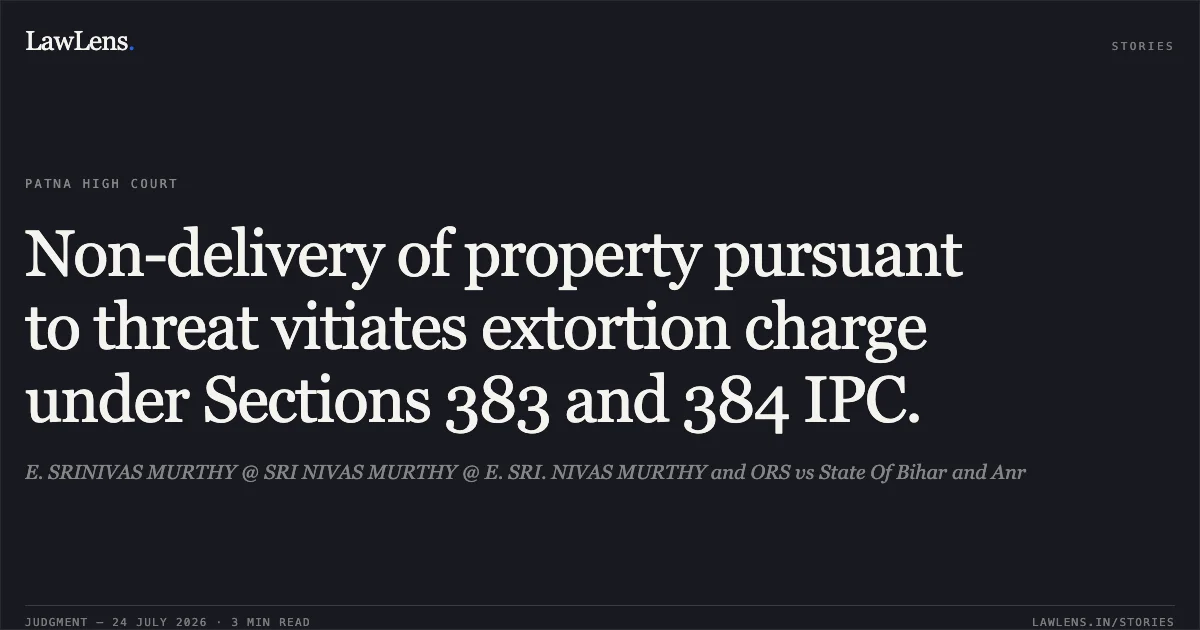
Source reference: para. 18Applying the law to the facts, the court observed that the essential ingredients of Section 384 IPC were absent; while a telephonic demand was alleged, there was no assertion that the Complainant actually delivered any property or valuable security due to fear.
Source reference: para. 19Regarding Section 504 IPC, there were no allegations of an intentional insult designed to provoke a breach of peace.
Source reference: para. 19The court noted that the dispute arose from a business transaction and concluded that the criminal process was being used to give a civil recovery matter the "colour of criminality" to exert pressure, fitting the profiles for quashing under the Bhajan Lal guidelines.
Source reference: para. 20Holding
The Court held that the continuation of the criminal proceeding amounted to an abuse of the process of law as the allegations failed to disclose the basic ingredients of the alleged offences.
The Court answered the issues in favour of the petitioners, ruling that the impugned order suffered from non-application of mind.
Source reference: para. 20The order dated 24.01.2018 passed in Complaint Case No. 4938(C) of 2017 was set aside, and the entire criminal proceeding against the petitioners was quashed.
Source reference: para. 21-22Acts & Sections Cited
7 provisions across 2 statutes referred to in this judgment. Each provision opens on LawLens.
Code of Criminal Procedure, 19734
Indian Penal Code, 18603
Original Court PDF
E. SRINIVAS MURTHY @ SRI NIVAS MURTHY @ E. SRI. NIVAS MURTHY and ORSvsState Of Bihar and Anr
Click to open original judgment
Original judgment, available to read, download and summarize on LawLens.in