01Facts
The deceased, a 69-year-old pensioner, was fatally injured when a Bolero driven rashly and negligently struck him on 21 June 2013.
pp. 2–4, 6His widow and son filed a claim petition; the widow died during its pendency, and the son continued the proceeding.
pp. 2–4, 6The Motor Accident Claims Tribunal awarded ₹1,10,000, including no-fault compensation and conventional heads, but denied the son compensation for loss of dependency because he was not shown to be dependent.
pp. 2–4, 6The son appealed for enhancement
pp. 2–4, 602Issues
i.1. Whether a son who is a legal representative but not shown to be dependent may maintain a claim and receive compensation beyond conventional heads.
pp. 4, 7–9ii.2. Whether the widow’s death during the claim proceeding affected the compensation rights that had accrued when the claim was filed.
pp. 4–5, 9–10iii.3. Whether the Tribunal’s award should be enhanced, and, if so, how compensation should be calculated.
pp. 3, 10–1203Law Applied
Section 166(1)(c) of the Motor Vehicles Act, 1988 permits “all or any” legal representatives of a deceased accident victim to apply for compensation; dependency is not a condition for maintaining the claim.
pp. 7–8A non-dependent legal representative may nevertheless receive a different amount from a dependent, with the calculation turning on the circumstances of the case.
pp. 7–8National Insurance Co. Ltd. v. Birender and Jitender Kumar v. Sanjay Prasad recognise that major, married or earning children who are legal representatives may claim compensation, while permitting a 50% deduction where dependency is not established.
pp. 8–9The Court also relied on Kirti v. Oriental Insurance Co. for the principle that rights crystallise at the time of the accident and subsequent events ordinarily do not alter pending claims, and on Pranay Sethi and Satinder Kaur for conventional heads and consortium.
pp. 4–5, 10–11Provisions in the judgment · 3 · Linked ones open on LawLens
Motor Vehicles Act, 1988 Section 173Section 166Section 165
04Reasoning
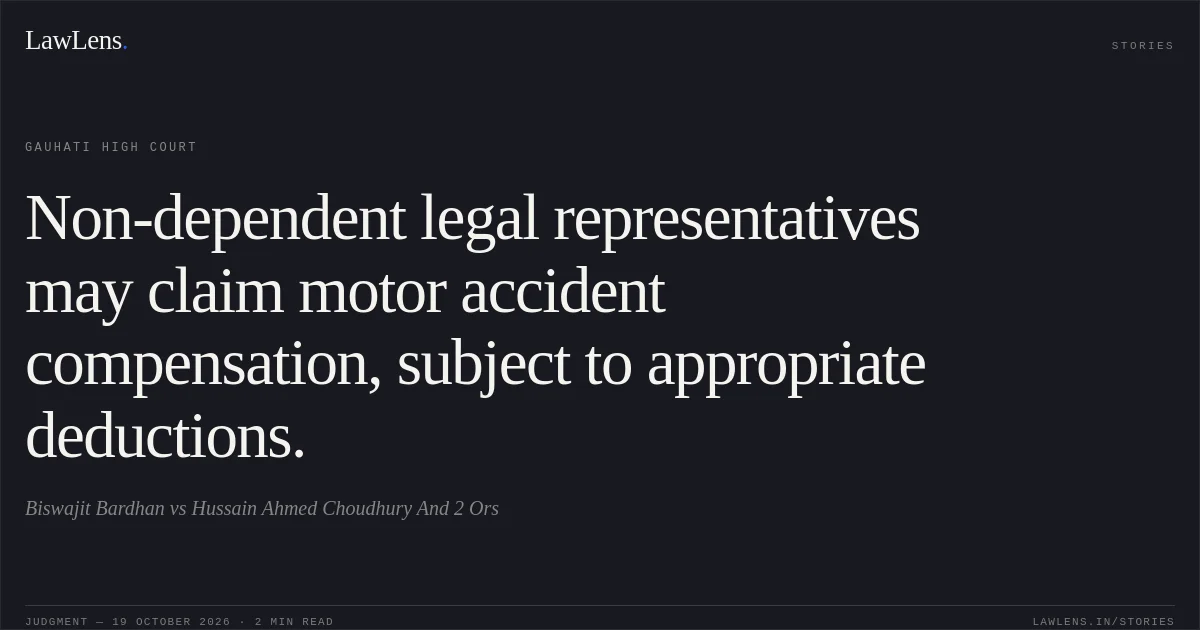
The Court held that the son’s status as a legal representative entitled him to maintain the claim; his lack of proven dependency did not justify limiting recovery to conventional heads alone.
pp. 6–7, 10It considered N.P. Joy distinguishable because that case involved a 95-year-old deceased who would likely have depended on his family, whereas the deceased here was a pensioner.
pp. 6–7, 10Applying a 50% deduction for the son’s non-dependency, the Court calculated loss of dependency using the deceased’s monthly pension of ₹12,237 and a multiplier of 5.
pp. 10–12It further held that the widow’s death during the proceeding did not extinguish the consortium amount that had accrued to her upon filing of the claim; it awarded the son consortium with the applicable increase, and included loss of estate and funeral expenses.
pp. 10–1205Holding
The appeal was allowed.
pp. 10–12The Court set aside the Tribunal’s award and fixed compensation at ₹4,91,810, comprising ₹3,67,110 for loss of dependency, ₹18,150 for loss of estate, ₹48,400 for the son’s consortium, ₹40,000 for the widow’s accrued consortium, and ₹18,150 for funeral expenses.
pp. 10–12Interest at 9% from the date of filing of the claim petition was ordered, with any amount already paid to be deducted.
pp. 10–12Original Court PDF
Biswajit BardhanvsHussain Ahmed Choudhury And 2 Ors
Click to open original judgment
Original judgment, available to read, download and summarize on LawLens.in