Facts
The original Plaintiff and Defendant were neighbors in a Wadala housing society
Source reference: para. 2aIn May 1978, they entered into an oral agreement for the sale of the Defendant’s Flat No. 13 to the Plaintiff for ₹50,000
Source reference: para. 2d, 3aThe Plaintiff paid ₹30,000 in two installments (May and September 1978), for which receipts were issued
Source reference: para. 2d-fDespite the Plaintiff's requests for possession to accommodate his daughter’s marriage, the Defendant inducted his brother into the flat
Source reference: para. 2hIn September 1981, the Plaintiff formally demanded possession, but the Defendant repudiated the contract, claiming "changed circumstances" required the flat for his personal use, and attempted to refund the ₹30,000 via cheques, which the Plaintiff did not encash
Source reference: para. 2h-iThe Trial Court in 2007 partly decreed the suit, ordering a refund of the earnest money with 12% interest but denying specific performance on the grounds that the Plaintiff failed to deposit the balance amount in court and that the daughter's marriage had likely already occurred
Source reference: para. 1, 5, 42The Plaintiffs (heirs of the original purchaser) appealed the denial of specific performance
Source reference: para. 7Issues
1. Whether the original Plaintiff was ready and willing to perform his part of the contract?
Source reference: para. 8A2. Whether the Plaintiffs are entitled to specific performance of the contract?
Source reference: para. 8B3. What reliefs are the Plaintiffs entitled to?
Source reference: para. 8CLaw Applied
Section 16(c) of the Specific Relief Act, 1963, which requires the plaintiff to aver and prove continuous readiness and willingness to perform the contract
Source reference: para. 16, 22Under Explanation (i) to Section 16(c), a plaintiff is not required to actually tender or deposit money in court unless specifically directed by the court
Source reference: para. 23P. Daivasigamani v. S. Sambandan (2022), which established that "readiness" refers to financial capacity and "willingness" to the intention to perform, and that non-deposit of the balance consideration is not a ground for dismissal
Source reference: para. 21-24, 40Section 20 of the Specific Relief Act (pre-amendment), which guides the judicial discretion to grant specific performance based on equity and hardship, as summarized in Kamal Kumar v. Premlata Joshi (2019)
Source reference: para. 42, 47Reasoning
The High Court found the Trial Court’s findings erroneous regarding the Plaintiff's readiness and willingness.
Source reference: para. 33, 39, 45It determined that the Plaintiff’s letter dated September 1, 1981, clearly expressed an urgent desire to complete the transaction for his daughter’s marriage, satisfying the "willingness" requirement
Source reference: para. 33, 39, 45The court noted that the Defendant's claim—that the Plaintiff lacked funds in 1978—was an afterthought because it was absent from the 1981 repudiation letter
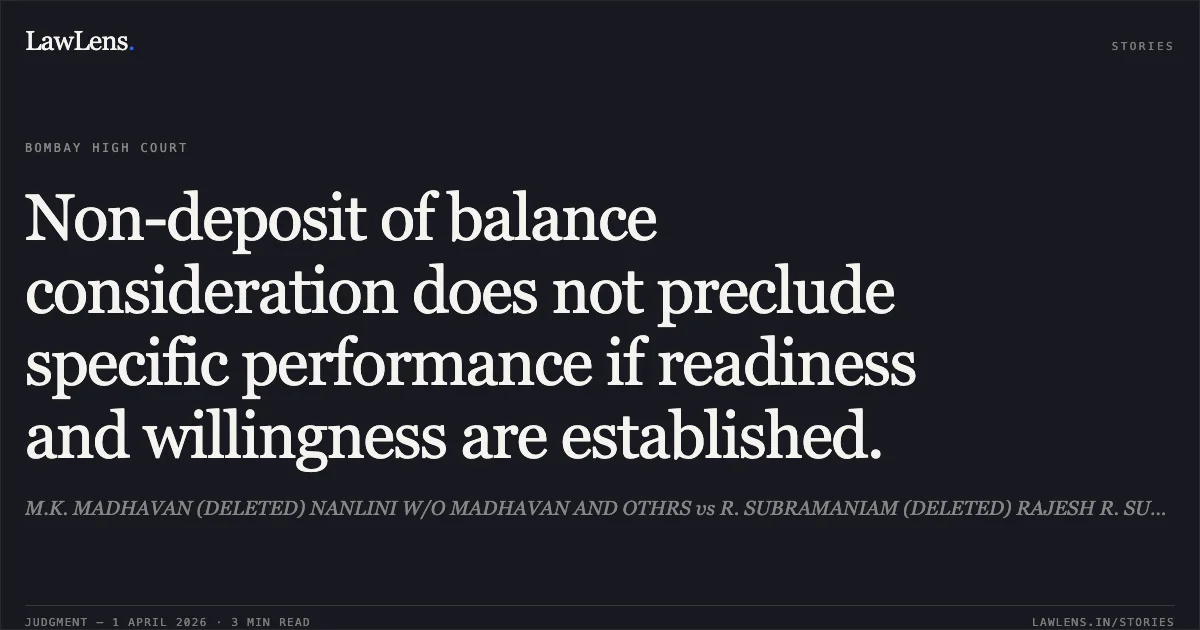
Source reference: para. 36, 46Applying P. Daivasigamani, the court held that the Plaintiff was not legally required to deposit the balance ₹20,000 during the suit's pendency
Source reference: para. 40-41Regarding judicial discretion under Section 20, the court found no evidence that the Plaintiff obtained an "unfair advantage"
Source reference: para. 43However, recognizing the steep rise in Mumbai real estate prices since 1978 and the 48-year delay, the court determined that granting specific performance solely for the original balance (₹20,000) would be inequitable to the Defendant
Source reference: para. 54Consequently, it balanced the equities by requiring an additional payment to the Defendants
Source reference: para. 54Holding
The Court allowed the First Appeal and set aside the Trial Court’s judgment
It held that the Plaintiffs proved continuous readiness and willingness and were entitled to specific performance
Source reference: para. 46, 49The court granted a decree for specific performance of the oral agreement for Flat No. 13, subject to the Appellants/Plaintiffs paying the Respondent/Defendant the balance of ₹20,000 plus an additional compensatory sum of ₹25,00,000 (Total: ₹25,20,000)
Source reference: para. 54, 56cNo order as to costs was made
Source reference: para. 56dActs & Sections Cited
6 provisions across 1 statute referred to in this judgment. Each provision opens on LawLens.
Specific Relief Act, 19636
Original Court PDF
M.K. MADHAVAN (DELETED) NANLINI W/O MADHAVAN AND OTHRSvsR. SUBRAMANIAM (DELETED) RAJESH R. SUBRAMANIAM AND OTHRS
Click to open original judgment
Original judgment, available to read, download and summarize on LawLens.in