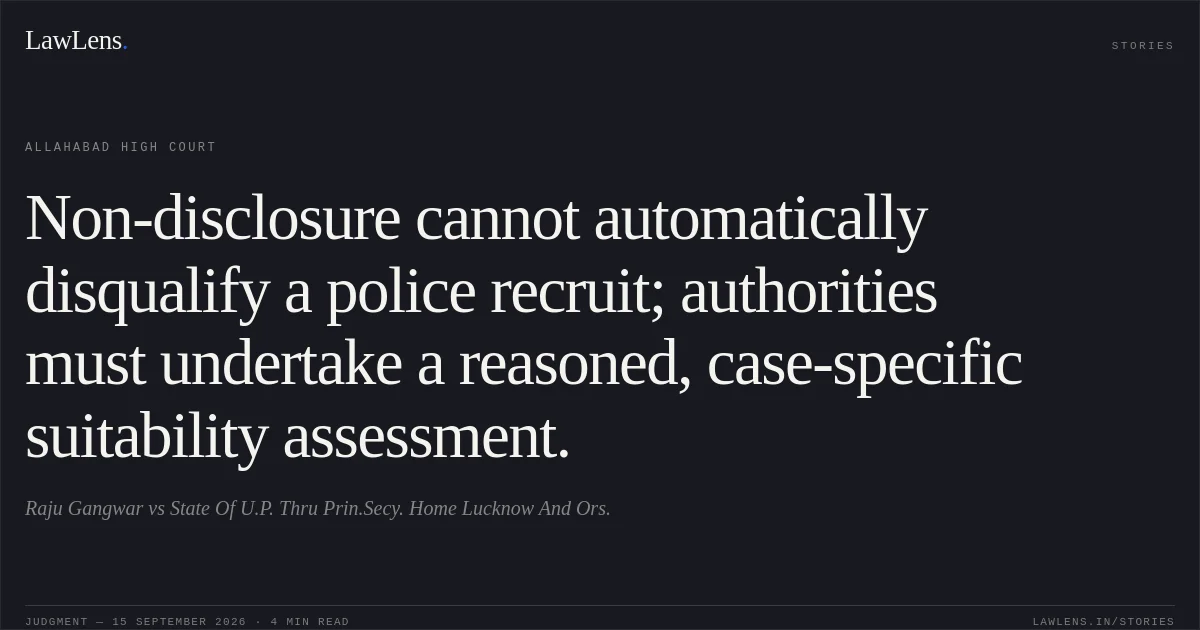
Facts
The Uttar Pradesh Police Recruitment and Promotion Board issued Advertisement/Notification No. PRPB-1(82)/2015 dated 29 December 2015 for recruitment to the posts of Male Police Constable and Constable PAC.
Source reference: para. 2–4The petitioner applied online and declared that he had never been convicted by any court; the online form did not contain a specific column requiring disclosure of a pending criminal case.
Source reference: para. 2–4At the time of the alleged criminal incident and registration of the FIR in 2014, the petitioner was approximately seventeen years old. A case under Sections 323, 325, 504 and 506 IPC was pending against him, but he was acquitted on 25 August 2018 after the prosecution witnesses stated that no incident had occurred.
Source reference: para. 4–6The petitioner secured the requisite marks, fell within the zone of consideration, underwent verification, and was permitted to proceed for training after the District Magistrate and Superintendent of Police found him suitable.
Source reference: para. 5–7Subsequently, the Superintendent of Police, Sitapur, cancelled his candidature on 2 January 2019 on the grounds that he had criminal antecedents and had concealed them.
Source reference: para. 8The petitioner challenged the cancellation under Article 226 of the Constitution.
Source reference: no citationIssues
1. Whether the petitioner’s declaration that he had never been convicted amounted to deliberate suppression or a false declaration when the online application form did not specifically require disclosure of a pending criminal case?
Source reference: para. 232. Whether the respondents could cancel the petitioner’s candidature mechanically on the basis of his criminal antecedents and alleged suppression, without considering the trivial nature of the offences, his age, the nature of his acquittal, and the prior favourable character verification?
Source reference: para. 17, 21–283. Whether the impugned order dated 2 January 2019 was arbitrary, non-speaking and violative of Article 14 of the Constitution?
Source reference: para. 27–29Law Applied
The Court applied Article 14 of the Constitution, requiring administrative decisions affecting public employment to be non-arbitrary, reasoned and based on relevant considerations.
Source reference: no citationIt considered the Government Order dated 28 April 1958, which governs character verification and suitability for police employment, as requiring a case-specific assessment rather than an automatic disqualification based merely on involvement in a criminal case.
Source reference: para. 19Under Avtar Singh v. Union of India, (2016) 8 SCC 471, suppression of criminal antecedents does not justify an automatic refusal of appointment or termination; the employer must consider the nature of the post, the precise information sought, the gravity and character of the offence, the result of the criminal case, the nature of the acquittal, and the candidate’s age and circumstances, with the decision reflecting due application of mind.
Source reference: para. 17Commissioner of Police v. Sandeep Kumar, (2011) 4 SCC 644, cautions against denying employment for youthful indiscretions involving trivial offences.
Source reference: para. 18Ram Kumar v. State of U.P., (2011) 14 SCC 709, holds that the 1958 Government Order does not create an absolute bar based solely on criminal involvement or pendency.
Source reference: para. 19Pawan Kumar v. Union of India, (2023) 12 SCC 317, reiterates that suppression may affect suitability but the competent authority must exercise its discretion reasonably and objectively.
Source reference: para. 20State of M.P. v. Parvez Khan, (2015) 2 SCC 591, recognizes the employer’s discretion in police recruitment but does not dispense with the obligation to exercise that discretion judicially and through a reasoned decision.
Source reference: para. 21Reasoning
The Court held that the petitioner’s online declaration was confined to whether he had ever been convicted, and that declaration was factually correct when made because he had neither been convicted nor faced a concluded trial; the absence of a specific query regarding a pending case meant that non-disclosure at that stage could not automatically be treated as deliberate suppression.
Source reference: para. 23The alleged offences arose from a youthful quarrel, did not involve moral turpitude or dishonesty, and were committed when the petitioner was a minor.
Source reference: para. 24–25His subsequent acquittal was treated as an honourable, merits-based acquittal rather than one founded on the benefit of doubt.
Source reference: para. 25Further, the District Magistrate and Superintendent of Police had already considered the criminal case and acquittal and found him suitable for training; the impugned order neither addressed that determination nor identified any independent material justifying departure from it.
Source reference: para. 26Since the cancellation order merely recited the criminal case and relied on the relevant circulars and Government Order without examining the petitioner’s age, the nature of the offence, the acquittal or the prior suitability assessment, it was mechanical, non-speaking and contrary to the requirements laid down in Avtar Singh, Ram Kumar, Sandeep Kumar and Pawan Kumar.
Source reference: para. 27–29Holding
The High Court allowed the writ petition and quashed the order dated 2 January 2019 cancelling the petitioner’s candidature.
The respondents were directed to treat the petitioner as validly selected pursuant to Advertisement No. PRPB-1(82)/2015 and to permit him to undergo training and/or issue the consequential appointment order within eight weeks of production of a certified copy of the judgment, subject only to verification of any other independent eligibility condition.
Source reference: para. 31The respondents were not permitted to reopen the issue of suppression already adjudicated in the judgment.
Source reference: para. 31The Court clarified that the decision was confined to the peculiar facts of the case and would not apply mechanically where the offence was grave, involved moral turpitude, or resulted in conviction.
Source reference: para. 32–35Acts & Sections Cited
8 provisions across 1 statute referred to in this judgment. Each provision opens on LawLens.
Indian Penal Code, 18608
Original Court PDF
Raju GangwarvsState Of U.P. Thru Prin.Secy. Home Lucknow And Ors.
Click to open original judgment
Original judgment, available to read, download and summarize on LawLens.in
![RBE No. 41/2013 cannot retrospectively withdraw grade-pay benefits validly granted under earlier instructions.. MOHAMMAD ANWAR KHAN vs M/o Defence. CAT - ['Allahabad']. LawLens](/stories/thumbnails/rbe-no-41-2013-cannot-retrospectively-withdraw-grade-pay-benefits-validly-granted-under-ea-d825d8900cf0403f90d903a2a4e3d6a6.webp)