Facts
The respondent was appointed as a Driver by the Delhi Transport Corporation (DTC) on 13.01.2011
Source reference: p. 2He was subsequently terminated on 03.12.2012 following a domestic inquiry for concealing a prior criminal case (FIR No. 679/2003 under Sections 279/338 IPC) in his Character Verification Roll (CVR), despite having been acquitted in said case on 15.07.2011
Source reference: p. 2The respondent challenged his termination before the Labour Court, which, via an award dated 12.04.2018, directed his reinstatement with consequential benefits and 25% back wages
Source reference: p. 1-2DTC reinstated the workman on 14.09.2018 but challenged the grant of back wages and consequential benefits in this writ petition
Source reference: p. 2Issues
1. Whether the Labour Court erred in granting 25% back wages and consequential benefits despite holding the domestic inquiry to be fair and proper?
Source reference: p. 3, para. 7-82. Whether the principle of "No Work No Pay" and the delay in raising the dispute disentitled the workman to any financial relief?
Source reference: p. 3, para. 4-5Law Applied
Clause 9(a)(i) of the DRTA (Conditions of Appointment and Service) Regulations, 1952, alongside internal Circulars dated 05.08.1955 and 28.08.2012, which mandate lenient punishment for non-disclosure of petty offences
Source reference: p. 4, para. 8The principle from J.K. Synthetics Ltd. v. K.P. Agrawal noting that while back wages are not automatic, they are permissible where misconduct is petty or punishment is disproportionate
Source reference: p. 5, para. 11The doctrine from Commissioner of Police v. Sandeep Kumar, establishing that non-disclosure of involvement in minor criminal cases (not involving moral turpitude) should not lead to termination if the candidate was acquitted
Source reference: p. 5, para. 11The limitation of power under Article 226 of the Constitution per Syed Yakoob v. K.S. Radhakrishnan, limiting interference to errors of jurisdiction or perversity
Source reference: p. 6, para. 13Reasoning
The court found the petitioner's reliance on "No Work No Pay" misplaced, distinguishing J.K. Synthetics by noting that the workman's misconduct was a "frivolous or petty" non-disclosure of a minor accident case (Sections 279/338 IPC) rather than grave criminality or moral turpitude
Source reference: p. 5, para. 10-11The court observed that the DTC failed to follow its own internal circulars which suggested minor penalties (warning/censure) for such omissions
Source reference: p. 4, para. 8Regarding back wages, the court held that since the workman asserted unemployment and the management failed to provide evidence of gainful employment, the initial burden of proof was discharged
Source reference: p. 6, para. 12The court determined that the Labour Court’s decision to award only 25% back wages was a "balanced and equitable approach" rather than a perverse one
Source reference: p. 6, para. 12-14Holding
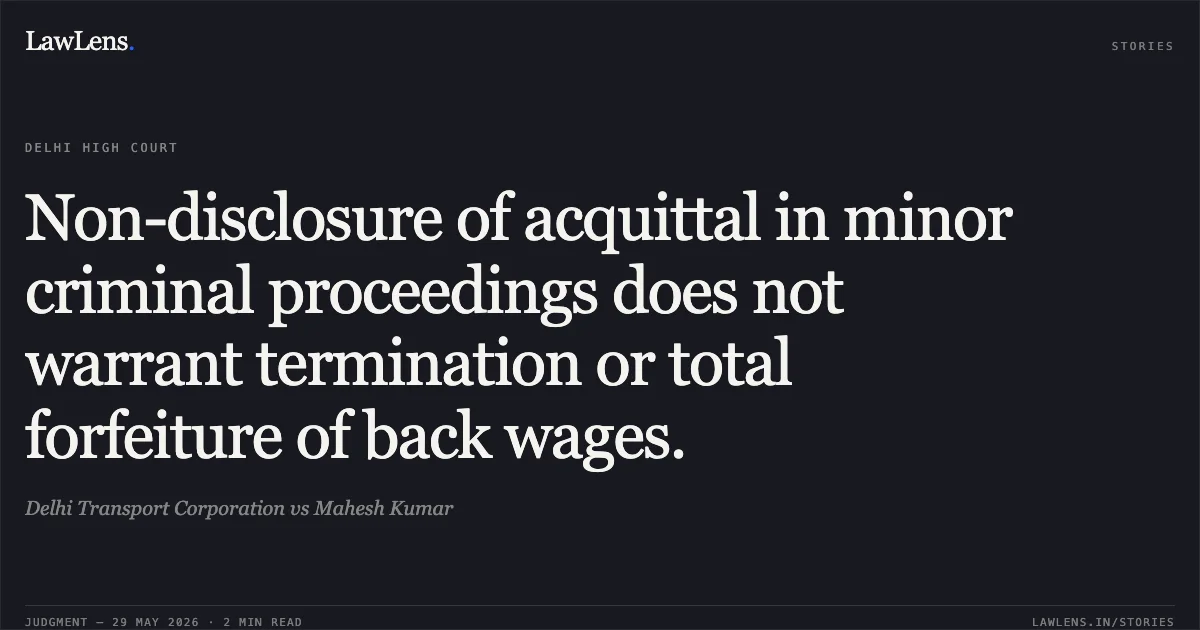
The High Court dismissed the writ petition and upheld the Labour Court’s award, holding that the termination was illegal and disproportionate given the petty nature of the non-disclosed offence
The court directed that the back wages deposited by the petitioner with the Court be released to the respondent workman along with accrued interest
Source reference: p. 7, para. 16Acts & Sections Cited
1 provisions across 1 statute referred to in this judgment. Each provision opens on LawLens.
Indian Penal Code, 18601
Original Court PDF
Delhi Transport CorporationvsMahesh Kumar
Click to open original judgment
Original judgment, available to read, download and summarize on LawLens.in


