Facts
The Appellant, a Constable at P.S. Mehrauli, was accused of demanding and accepting a bribe of ₹1,000 from the informant, Narender Kumar, on 30.07.1994
Source reference: p. 2The gratification was allegedly for the return of the informant's identity card, which had been confiscated during a police check on the night of 26.07.1994
Source reference: p. 2A trap was organized by the Anti-Corruption Branch (ACB) where the accused was apprehended, and tainted currency was recovered from his person
Source reference: p. 10-11The trial court convicted the Appellant under Sections 7 and 13(1)(d) r/w 13(2) of the Prevention of Corruption Act (PC Act)
Source reference: p. 4-5During the pendency of the appeal, the Appellant passed away; however, the court proceeded on merits as no legal representatives came forward
Source reference: p. 5Issues
1. Whether the conviction can be sustained in the absence of the testimony of the informant/complainant to prove the demand of illegal gratification
Source reference: p. 7 / para. 112. Whether the recovery of tainted currency, supported by the testimony of a panch (shadow) witness, is sufficient to establish guilt under the PC Act
Source reference: p. 14 / para. 203. Whether the sanction for prosecution was validly accorded by a competent authority
Source reference: p. 6 / para. 11Law Applied
The court applied Section 7 (Public servant taking gratification) and Section 13 (Criminal misconduct) of the PC Act, 1988
Source reference: p. 1It relied on the Supreme Court precedent Neeraj Dutta v. State (Govt. of NCT of Delhi), which establishes that if a complainant is unavailable or dead, the demand for high gratification can be proved through circumstantial evidence or other witnesses
Source reference: p. 15The court also invoked the statutory presumption under Section 20 of the PC Act, which mandates that once the demand and acceptance of a bribe are proven, it is presumed to be for motive or reward unless the contrary is proved
Source reference: p. 17Regarding sanction, the court referred to Sections 12 and 21 of the Delhi Police Act, 1978, identifying the Additional Deputy Commissioner of Police as a competent authority to appoint or remove subordinate officers
Source reference: p. 18Reasoning
The court reasoned that while the informant was untraceable, his absence was not fatal to the prosecution's case because the shadow witness (PW5) provided a reliable and consistent account of the recovery and the demand made during the trap
Source reference: p. 16The court noted that PW5 saw the accused demand money, accept it with his left hand, and place it in his pocket
Source reference: p. 11Under the Neeraj Dutta principle, such corroborative evidence is sufficient to prove "demand" even without the complainant's testimony
Source reference: p. 15Furthermore, the successful recovery of phenolphthalein-treated notes and the subsequent pink reaction in the hand wash (LHW) and pocket wash (LPPW) established "acceptance"
Source reference: p. 11Since the Appellant failed to provide a plausible explanation to rebut the presumption under Section 20 of the PC Act, the foundational facts were deemed proved
Source reference: p. 17-18Regarding the sanction, the court clarified that as the Additional DCP has the power to remove a Constable under the Delhi Police Act, the sanction issued by him was legally valid under Section 19(1)(c) of the PC Act
Source reference: p. 18-19Holding
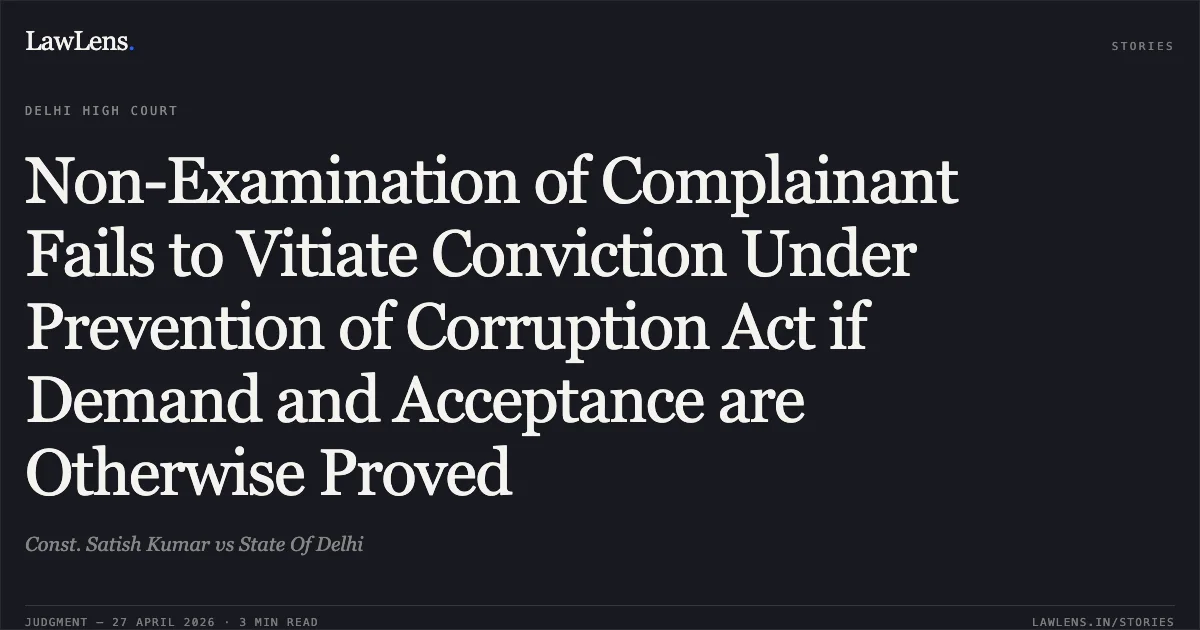
The High Court answered all issues in the affirmative, holding that the prosecution successfully proved the demand and acceptance of illegal gratification through circumstantial and eyewitness testimony despite the informant's absence
The court upheld the conviction and sentence of one year of rigorous imprisonment and a fine for the offences
Source reference: p. 5, 19The appeal was dismissed on merits
Source reference: p. 19Acts & Sections Cited
9 provisions across 3 statutes referred to in this judgment. Each provision opens on LawLens.
Code of Criminal Procedure, 19733
Prevention of Corruption Act, 19884
Delhi Police Act, 19782
Original Court PDF
Const. Satish KumarvsState Of Delhi
Click to open original judgment
Original judgment, available to read, download and summarize on LawLens.in