Facts
The prosecution alleged that on January 10, 2006, the appellants, Sanjay Singh and Hira Singh, along with several others, intercepted the deceased (Abhimanyu Singh) and the informant (PW-3). Sanjay Singh allegedly struck the deceased with a pistol butt, and upon Hira Singh’s order, co-accused Shrawan Singh fired a bullet into the deceased's abdomen
Source reference: p. 3The trial court convicted the appellants under Sections 148 and 302/149 of the IPC, sentencing them to life imprisonment, while acquitting seven other co-accused
Source reference: p. 2, 17The appellants challenged this, citing material contradictions between ocular and medical evidence, and the fact that the Investigating Officer (I.O.) was not examined
Source reference: p. 6Issues
1. Whether the non-examination of the Investigating Officer and the failure to record statements under Section 161 CrPC caused material prejudice to the accused
Source reference: p. 6, 182. Whether the ocular evidence was sufficiently corroborated by the medical evidence to sustain a conviction under Section 302 IPC
Source reference: p. 15, 173. Whether the conviction with the aid of Section 149 IPC is sustainable when the majority of the alleged unlawful assembly members were acquitted on the same evidence
Source reference: p. 24, 25Law Applied
The Court applied Section 161 of the CrPC, which mandates recording witness statements during investigation to provide a procedural safeguard for the defense
Source reference: p. 18It relied on Darshan Singh v. State of Punjab regarding the necessity of using Section 161 statements to confront witnesses and the prejudice caused by their absence
Source reference: para. 30, 31The principles of Munna Lal v. State of Uttar Pradesh were applied concerning the vital importance of examining the I.O. to clear gaps in the prosecution case
Source reference: para. 16Additionally, the court examined Section 149 of the IPC regarding the liability of members of an unlawful assembly in prosecution of a common object
Source reference: p. 25Reasoning
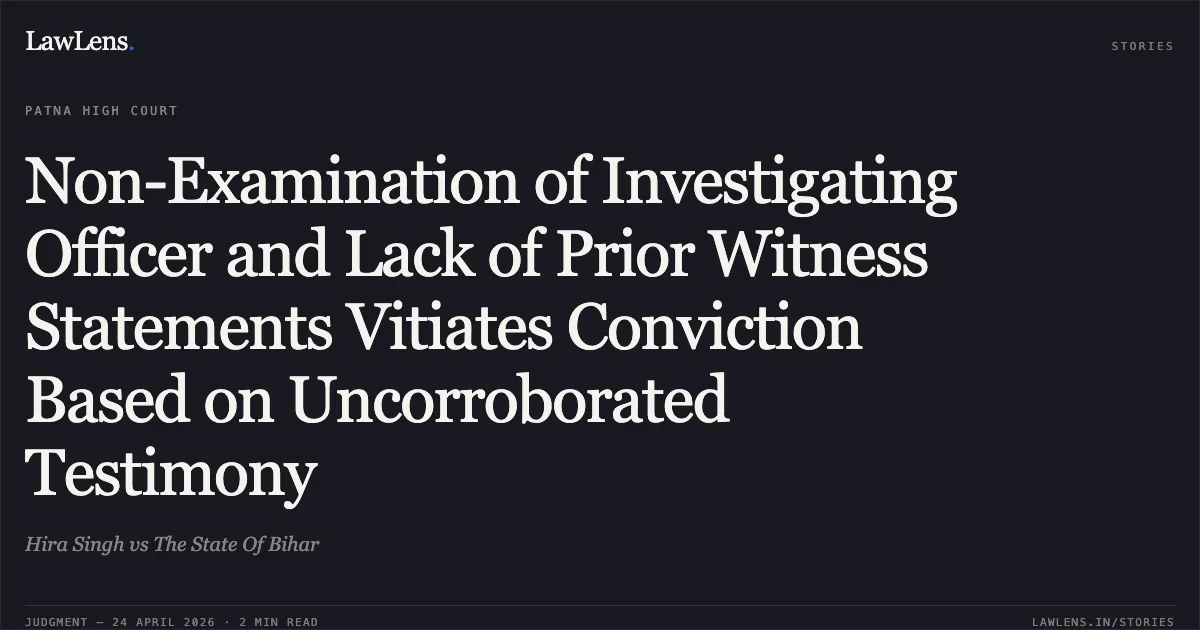
The Court found the prosecution's case fundamentally flawed due to the absolute lack of Section 161 CrPC statements, which deprived the appellants of their right to cross-examine and impeach the credibility of the witnesses
Source reference: p. 19, 20The non-examination of the I.O. was deemed a material lacuna that created reasonable doubt
Source reference: p. 18Specifically, the ocular testimony of PW-3 (informant) claiming a gunshot wound was directly contradicted by the medical report of PW-5, which found no gunshot injuries but only lacerations and a stab wound
Source reference: p. 15-17Furthermore, the court noted that since seven out of nine accused were acquitted on the same evidence, the theory of an "unlawful assembly" acting with a "common object" under Section 149 IPC could not be sustained against only the two remaining appellants
Source reference: p. 24, 25Holding
The Court held that the prosecution failed to prove the charges beyond a reasonable doubt, noting that "suspicion, however grave, cannot take the place of proof"
The High Court set aside the judgment of conviction dated July 30, 2018, and the order of sentence dated July 31, 2018. The appellants were acquitted of all charges; Sanjay Singh was ordered to be released forthwith, and Hira Singh was discharged from his bail bonds
Source reference: p. 25, 26Acts & Sections Cited
8 provisions across 2 statutes referred to in this judgment. Each provision opens on LawLens.
Indian Penal Code, 18607
Arms Act, 19591
Original Court PDF
Hira SinghvsThe State Of Bihar
Click to open original judgment
Original judgment, available to read, download and summarize on LawLens.in