Facts
The Appellant-State challenged the acquittal of Accused No. 1 (a Police Sub-Inspector) and Accused No. 2 (a private person) from charges under Sections 7, 12, 13(1)(d), and 13(2) of the Prevention of Corruption Act, 1988
Source reference: p. 1-2The prosecution alleged that Accused No. 1 demanded an illegal gratification of ₹5,000 from the complainant (Manager of a Credit Society) to avoid naming him as an abettor in a pending cheating case
Source reference: p. 2-3During the anti-corruption trap, it was alleged that Accused No. 1 instructed Accused No. 2 to receive ₹3,000 from the complainant’s colleague, Naranbhai
Source reference: p. 6-7The Trial Court acquitted the respondents on 31.03.2009, leading to the present appeal
Source reference: p. 8Issues
1. Whether the prosecution proved the essential ingredients of "demand" and "acceptance" of illegal gratification beyond reasonable doubt
Source reference: p. 10 / para. 102. Whether the non-examination of a material witness (Naranbhai) and inconsistencies in the trap proceedings were fatal to the prosecution’s case
Source reference: p. 22-23 / para. 103. Whether there is any manifest illeaglity or perversity in the Trial Court’s acquittal warranting interference by the Appellate Court
Source reference: p. 11-13 / para. 6-7Law Applied
The Court applied the principles governing appeals against acquittal as laid down in Chandrappa v. State of Karnataka, emphasizing the double presumption of innocence and that if two views are possible, the appellate court should not disturb an acquittal
Source reference: p. 11-13It further relied on Neeraj Dutta v. State (Govt. of N.C.T. of Delhi) regarding the "sine qua non" requirement of proving demand and acceptance for offences under Sections 7 and 13 of the PC Act
Source reference: p. 14-16The court also noted that if a complainant turns hostile, demand must be proved through other direct or circumstantial evidence
Source reference: p. 16Reasoning
The High Court found that the complainant (PW-1) had turned hostile and denied any demand for money by the accused, stating instead that the PSI only insisted on the production of a suspect
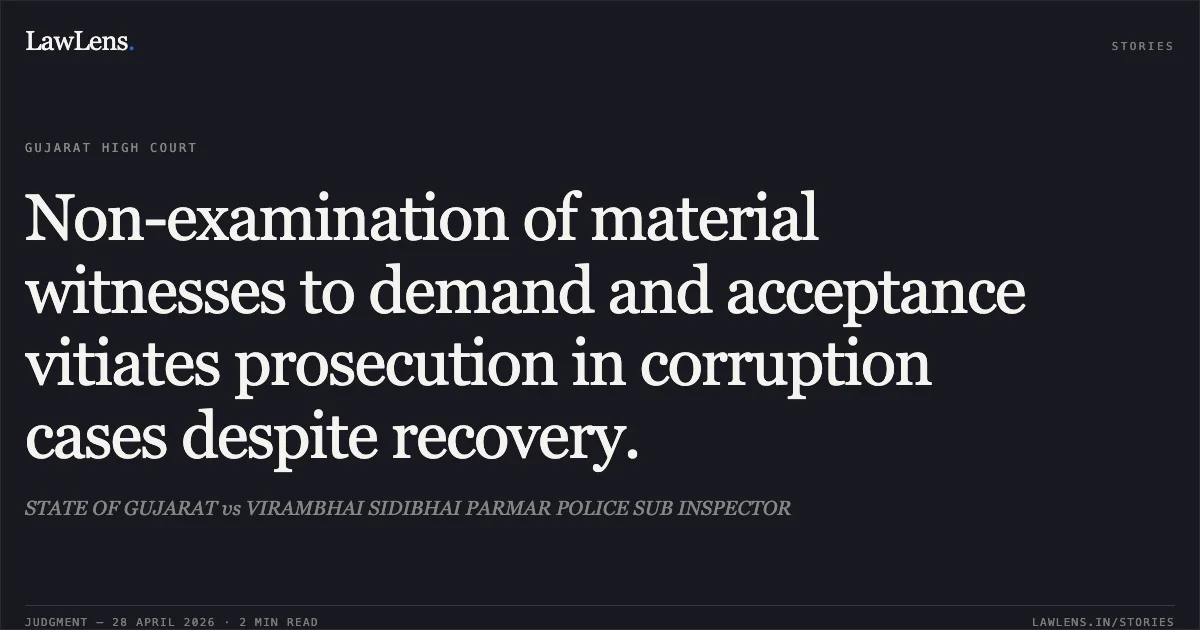
Source reference: p. 17-18The Court observed a "fatal lacuna" in the prosecution's failure to examine Naranbhai Ratilal Gohil—the most material witness who allegedly handed over the money and gave the signal
Source reference: p. 22-23The court highlighted technical inconsistencies in the "trap" procedure, specifically that no cigarette or matchbox (used for the signal) was found on Naranbhai during the pre-trap search
Source reference: p. 23-24PW-2 (panch witness) admitted he could not see or hear the alleged instruction from Accused No. 1 to Accused No. 2
Source reference: p. 19, 24Consequently, the "foundational facts" required to invoke the presumption under Section 20 of the PC Act were never established
Source reference: p. 24-25Holding
The Court answered the issues in the negative, holding that mere recovery of currency is insufficient without proof of demand and voluntary acceptance
The Court upheld the Trial Court's judgment, concluding that the acquittal was a plausible and reasonable view. The appeal was dismissed, the acquittal of the respondents was confirmed, and the bail bonds were cancelled
Source reference: p. 25-26Acts & Sections Cited
9 provisions across 3 statutes referred to in this judgment. Each provision opens on LawLens.
Code of Criminal Procedure, 19734
Prevention of Corruption Act, 19884
Indian Penal Code, 18601
Original Court PDF
STATE OF GUJARATvsVIRAMBHAI SIDIBHAI PARMAR POLICE SUB INSPECTOR
Click to open original judgment
Original judgment, available to read, download and summarize on LawLens.in