Facts
The informant (PW-5) alleged that on September 24, 1993, while returning from tuition, he was confronted by the appellant and others near Rani Sati Temple.
Source reference: para. 7The appellant allegedly shot the informant in the stomach with a pistol following a long-standing land dispute.
Source reference: para. 7The informant reached home via rickshaw, and his parents (PW-1 and PW-4) took him to the hospital.
Source reference: para. 16, 20The Trial Court convicted the appellant under Section 307 r/w 34 of the IPC and Section 27 of the Arms Act, sentencing him to seven years’ imprisonment, while acquitting the co-accused, Pawan Sharma.
Source reference: para. 1, 13The appellant challenged this conviction on grounds of serious evidentiary gaps and the non-examination of material witnesses.
Source reference: para. 32Issues
1. Whether the Trial Court was justified in convicting the appellant under Section 307 r/w 34 of the IPC and Section 27 of the Arms Act despite the acquittal of the co-accused on the same evidence?
Source reference: para. 14(i)2. Whether the prosecution proved the guilt of the appellant beyond reasonable doubt, specifically regarding the intention to murder and the nature of injuries sustained?
Source reference: para. 14(ii)Law Applied
Section 307 of the IPC (Attempt to Murder) requires proof of intent or knowledge that an act could cause death, and Section 27 of the Arms Act regarding the use of prohibited weapons.
Source reference: para. 34-35The court relied on State of M.P. v. Kanha @ Om Prakash, establishing that while grievous injury isn't a sine qua non for Section 307, the intention must be gatherable from circumstances like the weapon used and the nature of the blow.
Source reference: para. 40The "Principle of Parity" as articulated in Ajmer Singh v. State of Haryana dictates that if co-accused persons are placed in similar situations, the benefit of doubt given to one must extend to the other.
Source reference: para. 47Adverse impact of non-examination of the Investigating Officer (I.O.) and the Doctor, as seen in Bambam Singh v. State of Bihar.
Source reference: para. 44Reasoning
There was an unexplained delay in lodging the FIR despite the police station being only half a kilometer from the occurrence site.
Source reference: para. 26The prosecution failed to examine the Doctor or the Investigating Officer, and the injury report was never formally marked as an exhibit, leaving the nature of the injury unproven.
Source reference: para. 27, 36-38The court noted material contradictions between the testimonies of the mother (PW-1), father (PW-4), and the informant (PW-5) regarding their presence and the details of the incident.
Source reference: para. 28-30The High Court held that convicting the appellant while acquitting the co-accused under Section 34 (common intention) was legally inconsistent when both were acquitted on the same set of facts.
Source reference: para. 51-52The lack of recovery of any firearm further weakened the charges under the Arms Act.
Source reference: para. 41Holding
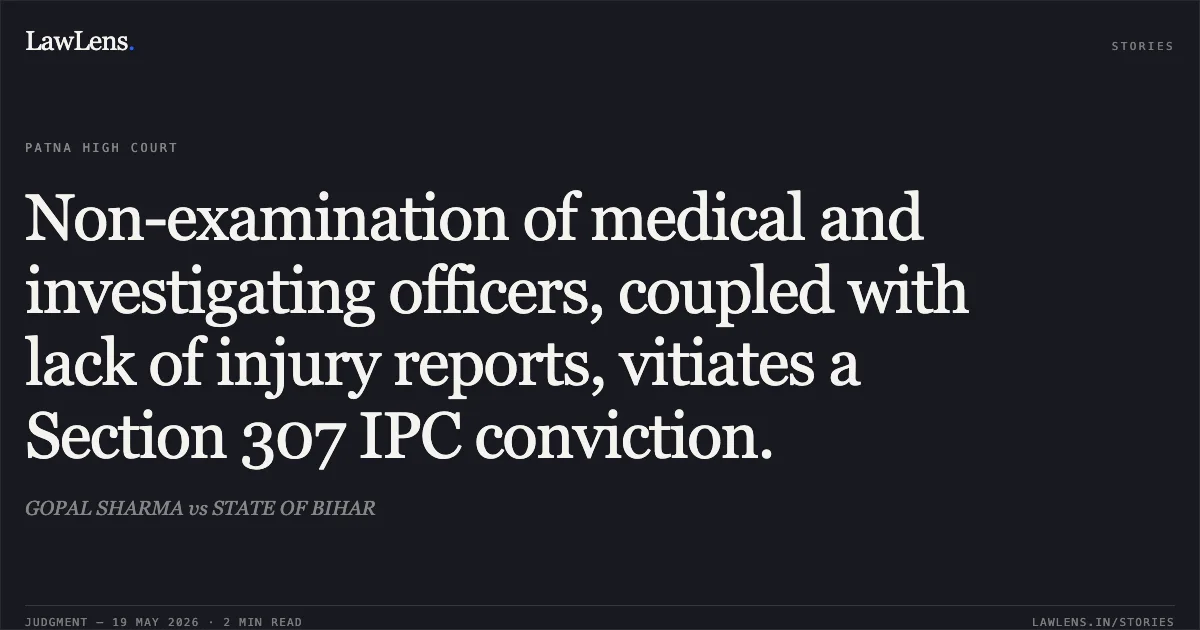
The Court held that the prosecution miserably failed to prove the charges beyond reasonable doubt and that the principle of parity necessitated the appellant's acquittal since the co-accused had been acquitted on identical evidence.
The High Court set aside the judgment of conviction and order of sentence dated April 30, 2005, and May 2, 2005, passed by the 7th Additional Sessions Judge, Bhagalpur; the appeal was allowed, and the appellant was discharged from his bail bonds.
Source reference: para. 53, 54-55Acts & Sections Cited
9 provisions across 3 statutes referred to in this judgment. Each provision opens on LawLens.
Indian Penal Code, 18604
Arms Act, 19591
Code of Criminal Procedure, 19734
Original Court PDF
GOPAL SHARMAvsSTATE OF BIHAR
Click to open original judgment
Original judgment, available to read, download and summarize on LawLens.in


