Facts
The petitioner was employed by the Delhi Transport Corporation as a retainer crew conductor from 1998. On 3 December 2005, while he was performing duty on bus No. 5286, checking officials allegedly found that he had collected money from two passengers without issuing tickets and had misappropriated ₹20, besides charging ₹4 less than the prescribed fare.
Source reference: pp.2–3; paras. 2–3Following a departmental enquiry, he was found guilty of misappropriation and dismissed from service.
Source reference: pp.2–3; paras. 2–3In proceedings under the Industrial Disputes Act, the Labour Court held that the enquiry complied with the principles of natural justice and upheld the dismissal.
Source reference: pp.2–3; paras. 4–6The petitioner challenged those findings under Article 226, contending that the passengers were not examined, no defence assistant was appointed, and the Enquiry Officer himself questioned the witnesses.
Source reference: p.3; paras. 8–9Issues
Whether the departmental enquiry was vitiated merely because the passengers were not examined and the findings were based principally on the evidence of the checking staff.
Source reference: pp.4–6; paras. 14–17Whether the enquiry was vitiated because no defence assistant was appointed and the Enquiry Officer put questions to the witnesses.
Source reference: p.7; para. 18Whether the Labour Court’s order upholding the enquiry and the award sustaining the petitioner’s dismissal disclosed perversity or arbitrariness warranting interference under Article 226.
Source reference: pp.4, 7–8; paras. 13, 19–21Law Applied
The High Court reiterated that its jurisdiction under Article 226 is supervisory and not appellate; it cannot substitute its own view for that of the Labour Court unless the decision is arbitrary or perverse.
Source reference: p.4; para. 13Relying on State of Haryana v. Rattan Singh, (1977) 2 SCC 491, the Court held that strict rules of evidence do not apply to domestic enquiries, hearsay evidence may be relied upon if it has a reasonable nexus and credibility, and the relevant inquiry is whether there is “some evidence” supporting the finding, rather than no evidence.
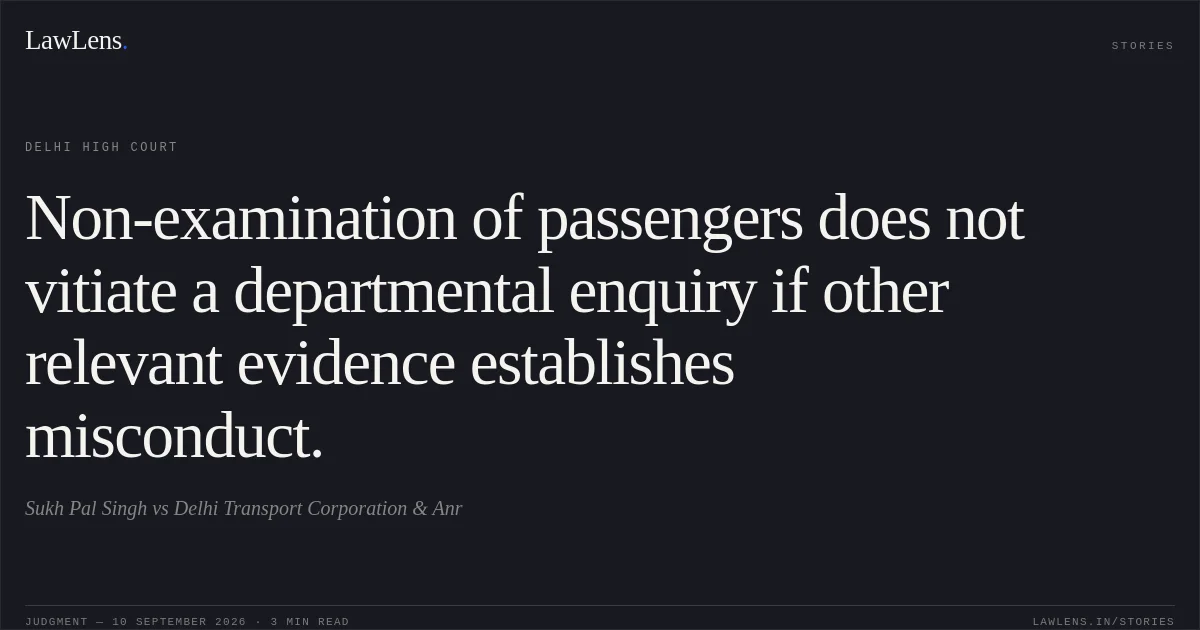
Source reference: pp.4–6; para. 15The mere non-examination of passengers does not invalidate a departmental enquiry, and departmental instructions regarding recording passenger statements are ordinarily instructions of prudence rather than mandatory requirements whose breach vitiates the proceedings.
Source reference: p.6; para. 15An enquiry is not vitiated merely because the Enquiry Officer questions witnesses or because a defence assistant was not appointed, particularly where the employee was afforded a full opportunity to participate and present his case.
Source reference: p.7; para. 18Reasoning
The Court found that the checking staff gave evidence that the petitioner had collected money from two passengers, returned part of it, and failed to issue tickets; the passengers’ statements recorded during checking also supported the management’s case.
Source reference: p.6; para. 16The petitioner himself did not dispute the failure to issue tickets, but offered an explanation concerning verification of the currency note, which the Labour Court was entitled to reject on the evidence before it.
Source reference: p.6; para. 16Applying Rattan Singh, the Court held that the checking staff’s testimony constituted relevant evidence and that the absence of passenger testimony did not amount to absence of evidence.
Source reference: pp.5–6; paras. 15–17The petitioner also admitted that he had been given full opportunity to participate in the enquiry; therefore, the absence of an appointed defence assistant and the Enquiry Officer’s questioning of witnesses did not establish denial of natural justice.
Source reference: p.7; para. 18Since the finding of misappropriation was supported by evidence and no demonstrable perversity or arbitrariness was shown, interference under Article 226 was unwarranted.
Source reference: pp.7–8; paras. 19–21Holding
The High Court answered the issues against the petitioner.
It held that the departmental enquiry was fair and consistent with natural justice, that non-examination of the passengers did not invalidate the proceedings, and that the Labour Court’s decision was neither perverse nor arbitrary.
Source reference: pp.7–8; paras. 18–21The writ petition was dismissed, the order upholding the enquiry and the award sustaining the petitioner’s dismissal were left undisturbed, and the pending application was disposed of.
Source reference: p.8; para. 22Original Court PDF
Sukh Pal SinghvsDelhi Transport Corporation & Anr
Click to open original judgment
Original judgment, available to read, download and summarize on LawLens.in