01Facts
Late Sh. Jhullu Mal (testator) died on 30.12.1990 at age 90.
p. 2His children (petitioners/respondents) propounded a registered Will dated 03.03.1989.
p. 2The testator's other sons (objectors/appellants) challenged this, propounding a subsequent unregistered Will dated 28.11.1990.
p. 2The Trial Court (ADJ) via order dated 30.11.2007 granted Letters of Administration in favor of the registered 1989 Will.
p. 1The objectors appealed, alleging the 1989 Will was suspicious due to the testator's ill health (loss of voice), contradictions in witness testimonies, and non-examination of the second attesting witness.
pp. 2-3They further raised technical objections regarding Section 228 and 281 of the Indian Succession Act.
p. 302Issues
i.1. Whether the registered Will dated 03.03.1989 was validly executed and attested as per the legal requirements of the Indian Succession Act and Evidence Act.
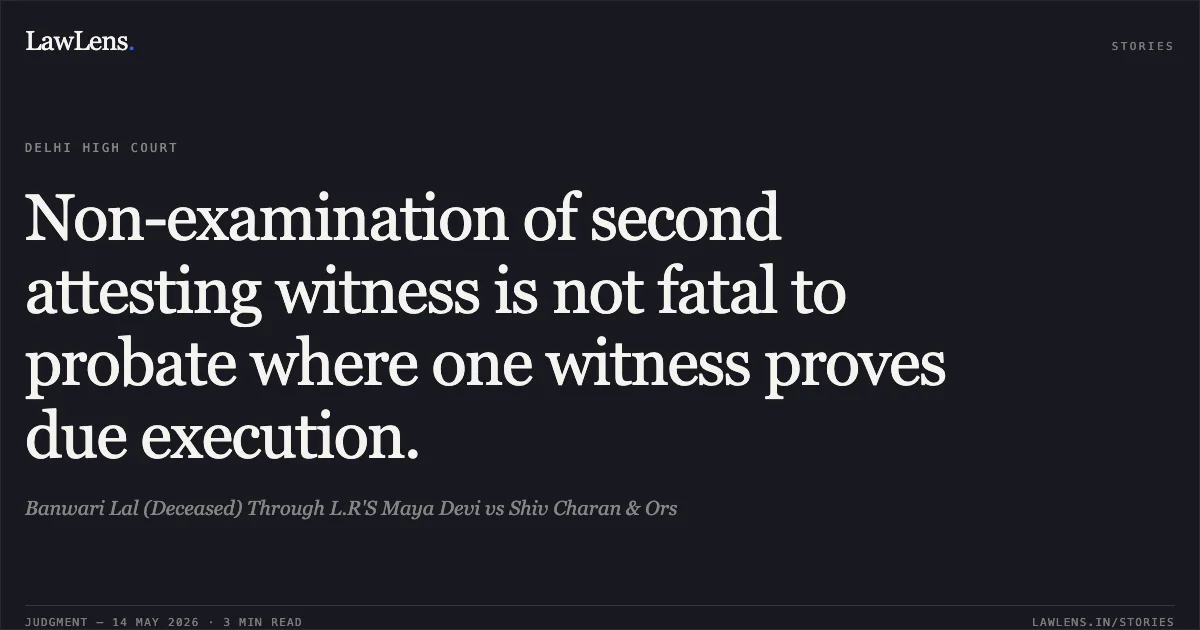
p. 5ii.2. Whether the non-examination of the second attesting witness is fatal to the grant of Letters of Administration.
pp. 5-6iii.3. Whether procedural technicalities under Sections 228 and 281 of the Indian Succession Act vitiate the inheritance proceedings.
pp. 10-1103Law Applied
The Court applied Section 63 of the Indian Succession Act, 1925, which mandates that an unprivileged Will must be attested by two or more witnesses.
p. 5It further applied Section 68 of the Indian Evidence Act, 1872, which stipulates that a document required by law to be attested shall not be used as evidence until at least one attesting witness has been examined to prove its execution.
p. 5Additionally, the court interpreted Section 281 of the Indian Succession Act regarding the verification of petitions by witnesses as a "directory" rather than "mandatory" provision due to the inclusion of the phrase "when procurable".
p. 11Provisions in the judgment · 3 · Linked ones open on LawLens
Indian Succession Act, 1925 Section 63Section 228Section 281
04Reasoning
The Court found that PW-3 (attesting witness) provided a consistent and credible account of the execution, noting that it is natural for a testator to choose familiar neighbors as witnesses.
pp. 4-5Since PW-3 proved the execution, the non-examination of the second witness (Sh. Ramesh Kumar) was held not to be fatal under Section 68 of the Evidence Act.
p. 6Regarding the testator’s capacity, the Court noted that while his voice was diminished following a 1987 surgery, judicial records from a contemporary suit (Suit No. 889/1989) proved he was actively attending court proceedings in person until shortly before his death, refuting claims of physical or mental incapacity.
p. 8The Court observed that the 1989 Will was registered and specifically noted the testator’s strained relationship with the objectors, who had filed partition suits against him during his lifetime.
pp. 9-10The subsequent unregistered 1990 Will propounded by the objectors had already been rejected in prior probate proceedings, which attained finality.
p. 6Finally, the Court dismissed the technical objections, ruling that procedural nomenclature (Section 228) cannot override substantive justice and that the Section 281 verification requirement is directory and cannot be raised for the first time at the appellate stage.
pp. 10-1105Holding
The High Court answered the issues in the negative for the appellants and upheld the Trial Court's judgment.
p. 11It held that the registered Will dated 03.03.1989 was duly proved and executed in accordance with Section 63 of the Act and Section 68 of the Evidence Act.
pp. 5-6The Court dismissed the appeal, confirming the grant of Letters of Administration to the petitioners and rejecting the technical and procedural challenges raised by the objectors.
p. 11Original Court PDF
Banwari Lal (Deceased) Through L.R'S Maya DevivsShiv Charan & Ors
Click to open original judgment
Original judgment, available to read, download and summarize on LawLens.in