Facts
The appellant was married to Mustt. Ajima Khatun, who died by suicidal hanging at her matrimonial home on 30 November 2012, approximately 3–4 months after the marriage.
Source reference: pp. 2–5The prosecution alleged that the appellant subjected her to physical and mental cruelty for dowry, particularly demanding wooden furniture, and rejected furniture purchased by her father.
Source reference: pp. 2–5The victim’s father, PW2, lodged the FIR, leading to registration of Nagarbera P.S. Case No. 73/2012 under Section 304B IPC.
Source reference: pp. 2–5After investigation, the appellant alone was charge-sheeted; he was tried under Sections 304B and 302 IPC and pleaded not guilty.
Source reference: pp. 2–5The prosecution examined eight witnesses, while the Investigating Officer was not examined because he had died during the trial.
Source reference: pp. 2–5, 15The Sessions Court convicted the appellant under Section 304B IPC and sentenced him to eight years’ rigorous imprisonment and a fine of ₹20,000.
Source reference: pp. 2–5Issues
Whether the prosecution proved beyond reasonable doubt that the deceased was subjected to cruelty or harassment by the appellant in connection with a dowry demand soon before her death, thereby attracting Section 304B IPC and the presumption under Section 113B of the Evidence Act.
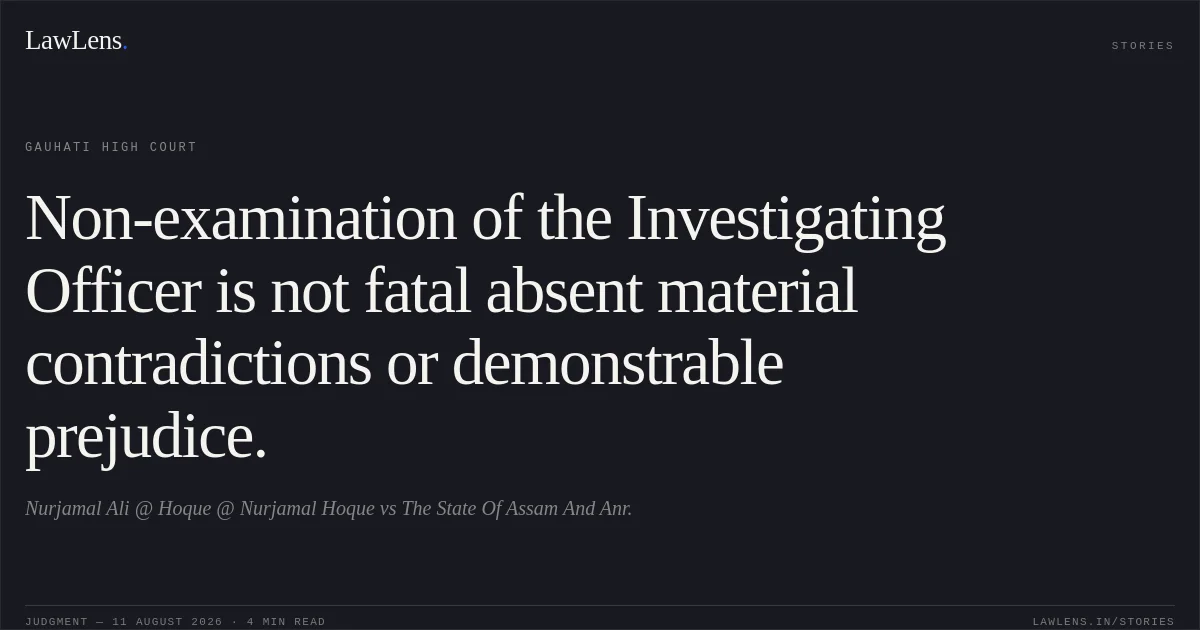
Source reference: pp. 10–14, 17–18; paras. 24–28, 37–38Whether the non-examination of the Investigating Officer caused prejudice to the appellant by preventing him from proving contradictions under Section 145 of the Evidence Act read with Sections 161–162 CrPC.
Source reference: pp. 14–17; paras. 30–35Whether the conviction and sentence imposed by the Sessions Court required appellate interference.
Source reference: p. 19; paras. 39–40Law Applied
Section 304B IPC applies where a woman’s death is caused by burns, bodily injury, or occurs otherwise than under normal circumstances within seven years of marriage, and it is shown that soon before her death she was subjected to cruelty or harassment by her husband or his relatives in connection with a dowry demand.
Source reference: pp. 17–18; para. 37Once these foundational facts are established, Section 113B of the Indian Evidence Act raises a presumption of dowry death against the accused.
Source reference: para. 37Section 106 of the Evidence Act places on the accused the burden of explaining facts particularly within his knowledge, including the circumstances surrounding an unnatural death in the matrimonial home.
Source reference: para. 38Non-examination of the Investigating Officer is not per se fatal; it matters only where the accused demonstrates prejudice or material contradictions requiring proof through the Investigating Officer, as held in Bahadur Naik v. State of Bihar, (2000) 9 SCC 153, Behari Prasad v. State of Bihar, (1996) 2 SCC 317, Dinesh Yadav v. State of Jharkhand, and Lahu Kamlakar Patil v. State of Maharashtra, (2013) 6 SCC 417.
Source reference: pp. 14–17; paras. 30, 33–35Mere unnatural death within seven years of marriage is insufficient without proof of the statutory ingredients, as recognised in Charan Singh @ Charanjit Singh v. State of Uttarakhand.
Source reference: p. 17; para. 36Reasoning
The Court found that the medical evidence established antemortem suicidal hanging and therefore confirmed that the death was otherwise than under normal circumstances.
Source reference: p. 13; para. 25The evidence of PW2, PW3, PW5 and PW6 consistently established that the marriage had occurred only a few months earlier and that the appellant demanded furniture, rejected the furniture purchased by the victim’s father, and continued subjecting the victim to physical and mental cruelty shortly before her death.
Source reference: pp. 6–13, 15–18; paras. 10, 14–15, 20–23, 32, 37The Court treated the evidence of PW2, PW3, PW5 and PW6 as materially corroborative and held that the defence had not elicited any material contradiction under Section 145 of the Evidence Act.
Source reference: pp. 11–17; paras. 22, 26–28, 30–35Consequently, the absence of the Investigating Officer did not prejudice the appellant.
Source reference: pp. 11–17; paras. 30–35Since the prosecution established the proximity between the dowry-related cruelty and the suicidal death, the presumption under Section 113B operated against the appellant.
Source reference: pp. 17–18; paras. 37–38His general denial under Section 313 CrPC and failure to explain the circumstances of the death were held insufficient to rebut that presumption.
Source reference: pp. 17–18; paras. 37–38The Court distinguished Charan Singh because, unlike that case, the essential ingredients of dowry death were proved here.
Source reference: p. 17; para. 37Holding
The appeal was partly allowed only on the question of sentence.
The conviction of the appellant under Section 304B IPC was upheld, the Court holding that the prosecution had proved dowry-related cruelty soon before the deceased’s suicidal death and that the statutory presumption under Section 113B applied.
Source reference: p. 19; paras. 37–39The sentence was reduced from eight years’ rigorous imprisonment and a ₹20,000 fine to the statutory minimum of seven years’ rigorous imprisonment and a fine of ₹1,000, with one month’s rigorous imprisonment in default of payment.
Source reference: p. 19; paras. 39–41The appeal was accordingly disposed of and the Trial Court Records were directed to be sent back.
Source reference: p. 19; paras. 39–41Acts & Sections Cited
5 provisions across 3 statutes referred to in this judgment. Each provision opens on LawLens.
Bharatiya Nagarik Suraksha Sanhita, 20231
Indian Penal Code, 18601
Code of Criminal Procedure, 19733
Original Court PDF
Nurjamal Ali @ Hoque @ Nurjamal HoquevsThe State Of Assam And Anr.
Click to open original judgment
Original judgment, available to read, download and summarize on LawLens.in