Facts
On 18 May 2008, the informant alleged that, near the house of Vishwanath Gope, he was surrounded by the accused persons and that the appellant, Surendra Gope, assaulted him on the head with a garasa, causing an incised injury. The other accused allegedly assaulted him with lathis and took ₹12,000 from him.
Source reference: p. 3, para. 3An FIR was registered under Sections 341, 323, 324, 379 and 307/34 of the IPC, and the case was committed to the Sessions Court.
Source reference: p. 2, para. 4The prosecution examined seven witnesses, including the injured informant and the doctor, while the defence examined two witnesses.
Source reference: p. 2, paras. 5–8The trial court acquitted Munni Gope and Dayanand Gope but convicted the appellant under Section 324 IPC and sentenced him to three years’ rigorous imprisonment, with a fine of ₹1,000 and two months’ imprisonment in default.
Source reference: p. 2, para. 2; p. 4, para. 9The appellant challenged the conviction primarily on the grounds that the Investigating Officer and independent witnesses had not been examined.
Source reference: p. 5, para. 10Issues
Whether the non-examination of the Investigating Officer and the absence of independent witnesses rendered the prosecution evidence unreliable or caused prejudice to the appellant.
Source reference: p. 5, para. 10; p. 6, para. 12Whether the evidence of the injured informant, supporting witnesses and the doctor sufficiently established that the appellant voluntarily caused the informant’s injury with a sharp-edged weapon, attracting Section 324 IPC.
Source reference: p. 4, para. 9; p. 6, para. 12Whether, in view of the appellant’s age, the lapse of time since the incident and his conduct after the FIR, the sentence should be reduced.
Source reference: p. 6, paras. 13–14Law Applied
The Court applied Section 324 of the Indian Penal Code, which criminalises voluntarily causing hurt by means of a dangerous weapon or other sharp-edged instrument.
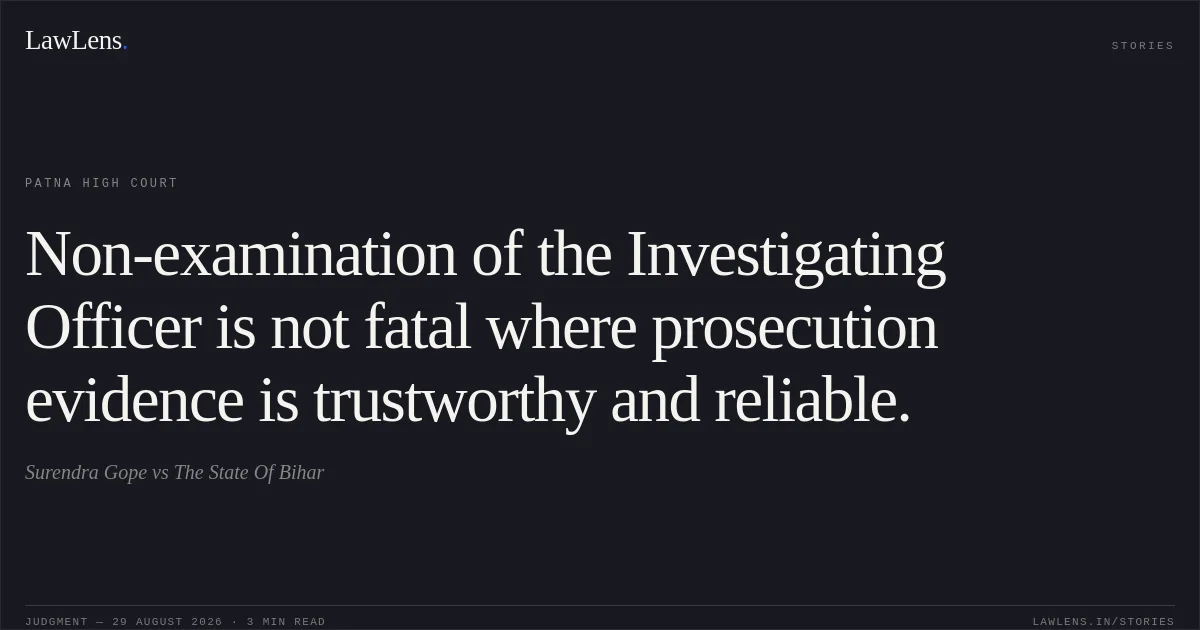
Source reference: no citationThe Court relied on the settled principle that non-examination of the Investigating Officer is not by itself fatal to the prosecution where the evidence on record is otherwise trustworthy and the accused fails to demonstrate actual prejudice.
Source reference: p. 6, para. 12It also applied the evidentiary principle that the testimony of an injured witness ordinarily carries substantial weight, particularly where it is corroborated by other witnesses and medical evidence.
Source reference: p. 4, para. 9; p. 6, para. 12In sentencing, the Court considered the prolonged passage of time, the appellant’s advanced age and the absence of any subsequent complaint against him.
Source reference: p. 6, para. 14Reasoning
The Court found the evidence of the injured informant, P.W.5, to be consistent with the prosecution case: he specifically attributed the head injury to the appellant’s assault with a garasa.
Source reference: p. 4, para. 9; p. 6, para. 12P.Ws. 1, 2 and 4 materially supported this account, while the doctor confirmed that the informant had sustained a simple injury on the head caused by a sharp-edged weapon.
Source reference: p. 4, para. 9; p. 6, para. 12Although the Investigating Officer was not examined, the Court held that the prosecution evidence was “completely trustworthy” and that no sufficient prejudice to the defence had been established.
Source reference: p. 6, para. 12The medical evidence corroborated both the nature of the injury and the alleged weapon, thereby satisfying the requirements of Section 324 IPC.
Source reference: p. 4, para. 9; p. 6, para. 12However, while maintaining the finding of guilt, the Court considered that the incident had occurred in 2008, the appellant was approaching 60 years of age, and there had been no subsequent complaint against him.
Source reference: p. 6, para. 14Holding
The appeal was partly allowed.
The conviction of Surendra Gope under Section 324 IPC was upheld, as the prosecution had proved through reliable ocular and medical evidence that he caused the informant’s head injury with a sharp-edged weapon.
Source reference: p. 6, para. 12The substantive sentence of three years’ rigorous imprisonment was reduced to the period already undergone, and the fine of ₹1,000 was waived.
Source reference: pp. 6–7, paras. 14–15The appellant was discharged from the liability of his bail bond, and the appeal was disposed of accordingly.
Source reference: p. 7, paras. 16–17Acts & Sections Cited
6 provisions across 1 statute referred to in this judgment. Each provision opens on LawLens.
Indian Penal Code, 18606
Original Court PDF
Surendra GopevsThe State Of Bihar
Click to open original judgment
Original judgment, available to read, download and summarize on LawLens.in
![A police constable cannot be removed for unauthorized absence without a Rule 359-compliant inquiry.. Mohammad Sidiq Khan vs D/o Home Ut Of Jammu & Kashmir. CAT - ['Srinagar']. LawLens](/stories/thumbnails/a-police-constable-cannot-be-removed-for-unauthorized-absence-without-a-rule-359-compliant-7b43fc316bd94f22a62676153bbc9d54.webp)
![A Review DPC lacks authority to determine or alter inter se seniority.. SAURABH KUMAR vs REVENUE. CAT - ['Patna']. LawLens](/stories/thumbnails/a-review-dpc-lacks-authority-to-determine-or-alter-inter-se-seniority-4b21640f20af46fcabdfc8273d2ce959.webp)