Facts
The petitioner, a retired District Mass Education Officer, challenged an order dated 25.07.2014 which imposed a 5% pension deduction following a departmental proceeding.
Source reference: p. 1The proceeding was initiated just before his retirement (30.06.2010) regarding alleged irregularities in compassionate appointments made while he was posted in Purnia.
Source reference: para. 3The petitioner contended that the appointments were made following directions from the District Magistrate and recommendations of the District Compassionate Appointment Committee.
Source reference: para. 5After his retirement, the proceedings were converted into a pension proceeding under Rule 43(B) of the Bihar Pension Rules, 1950.
Source reference: para. 4The Enquiry Officer found some charges proved and others partially proved based on comments from the Presenting Officer, leading to the impugned punishment.
Source reference: para. 4, 10Issues
1. Whether the departmental proceeding and subsequent punishment were vitiated by procedural irregularities and violation of the Bihar CCA Rules, 2005.
Source reference: para. 102. Whether a proceeding under Rule 43(B) of the Bihar Pension Rules can be sustained in the absence of a finding of grave misconduct or pecuniary loss.
Source reference: para. 5, 10Law Applied
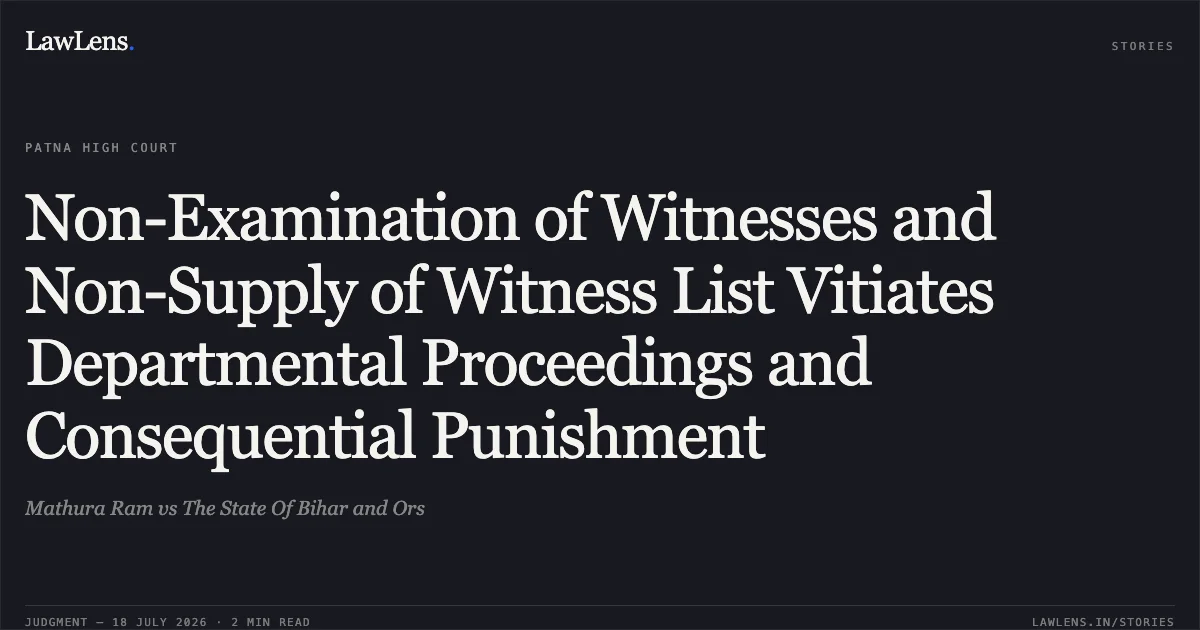
Rules 17(3), 17(4), and 17(14) of the Bihar Government Servants (Classification, Control and Appeal) Rules, 2005, which mandate providing a list of witnesses with the charge sheet and ensuring witnesses are examined to prove documents.
Source reference: para. 10Principles from Roop Singh Negi v. Punjab National Bank (2009), establishing that departmental proceedings are quasi-judicial and charges must be proved by evidence, not surmises.
Source reference: para. 6State of U.P. v. Saroj Kumar Sinha (2010), emphasizing that an Enquiry Officer must act as an independent adjudicator and not a prosecutor.
Source reference: para. 7Jai Prakash Saini v. U.P. Cooperative Federation Ltd. (2024), which held that unless a delinquent accepts guilt, the department must lead oral evidence to prove charges and documents.
Source reference: para. 8Reasoning
The Court found that the Department failed to provide a list of witnesses along with the memo of charges (and supplementary charges), violating Rule 17(3) and (4).
Source reference: para. 10During the inquiry, no witnesses were examined to prove the relied-upon documents; the Enquiry Officer arrived at findings solely based on the "comments/opinion" of the Presenting Officer.
Source reference: para. 10This denied the petitioner the mandatory opportunity for cross-examination under Rule 17(14).
Source reference: para. 10The disciplinary authority acted mechanically, rejecting the petitioner’s second show-cause reply without assigning sufficient reasons or considering the merits of his defense regarding the District Magistrate's orders.
Source reference: para. 10, 11Since there was no proof of "grave misconduct" or "pecuniary loss," the conversion into a Rule 43(B) proceeding was also questioned.
Source reference: para. 10Holding
The Court held that the entire departmental proceeding was conducted in complete violation of statutory provisions and principles of natural justice.
The Court quashed the impugned order (Memo No. 488 dated 25.07.2014) and directed the State to restore the petitioner's 100% pension and refund the 5% amount already deducted from the date of deduction until the date of payment.
Source reference: para. 11, 12Acts & Sections Cited
2 provisions across 2 statutes referred to in this judgment. Linked provisions open on LawLens.
Constitution of India1
Bihar Pension Rules, 19501
Original Court PDF
Mathura RamvsThe State Of Bihar and Ors
Click to open original judgment
Original judgment, available to read, download and summarize on LawLens.in