Facts
The petitioner, a senior clerk serving the respondent board since 1984, was served with a show-cause notice in 2006 and a charge-sheet in 2007
Source reference: para 3.1-3.2He was accused of negligence for failing to report "maneuvering" in the recorded number of water tanker trips in Voucher No. D-49
Source reference: para 5.1, 7The petitioner denied the charges, asserting that his superiors had initialed the changes
Source reference: para 7Following an inquiry where no witnesses were examined by the presenting officer, the inquiry officer found the charges proved
Source reference: para 3.2, 7The respondent imposed a penalty of reduction in pay scale, which the Appellate Authority reduced to a one-year duration
Source reference: para 3.3The petitioner challenged these orders under Article 226 of the Constitution, arguing that the inquiry was vitiated by procedural illegality
Source reference: para 2, 4.1Issues
1. Whether the departmental inquiry was vitiated because the presenting officer failed to examine any witnesses to prove the charges against the delinquent employee
Source reference: para 8, 102. Whether a penalty can be sustained when charges are denied and the department relies solely on documentary evidence without proving the same through oral testimony
Source reference: para 9, 11Law Applied
Rule 9(13) of the Gujarat Civil Services (Disciplinary and Appeal) Rules, 1971, which mandates that the presenting officer must produce oral and documentary evidence and examine witnesses to prove the charges
Source reference: para 8Supreme Court precedent in Jai Prakash Saini v. Managing Director, U.P. Cooperative Federation Ltd. (2026 SCC Online SC 505), which established that unless a delinquent employee accepts guilt in clear terms, the department must lead evidence and allow cross-examination; even in cases based on documents, a witness must be examined to prove those documents if they are not admitted
Source reference: para 9Reasoning
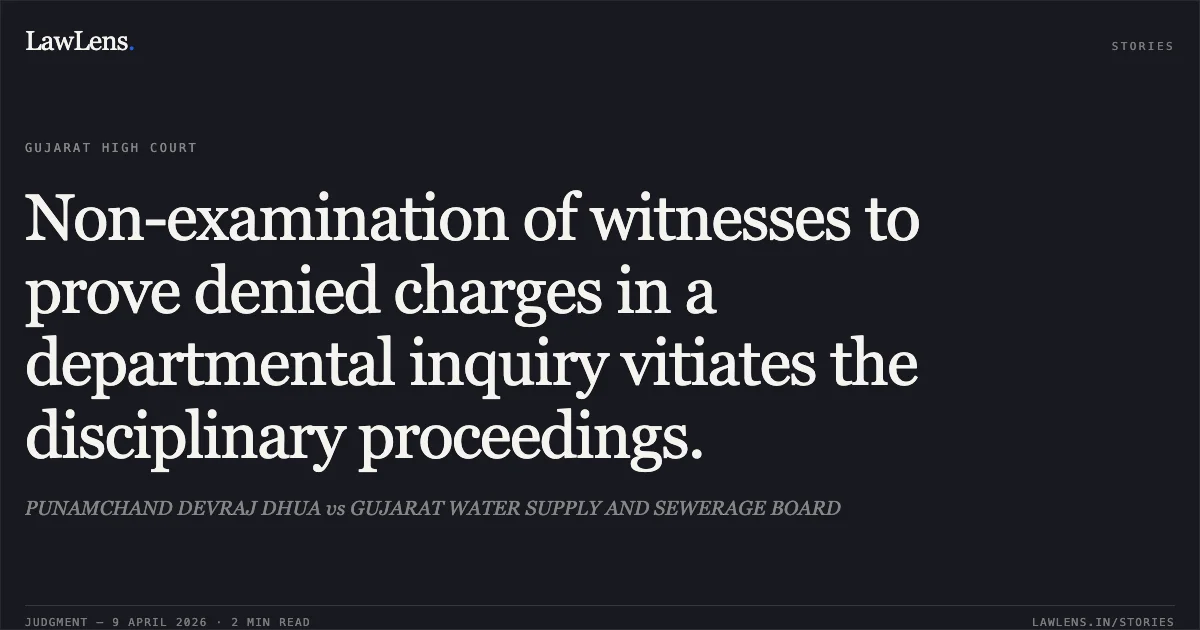
The court found it undisputed that the presenting officer examined no witnesses during the inquiry
Source reference: para 7, 10Although the petitioner denied the misconduct and argued that the receipts were initialed by superiors, the inquiry officer relied on inferences to conclude the charges were proved
Source reference: para 7The court observed that under Rule 9(13), it was incumbent upon the department to call witnesses to prove the charge, especially since the petitioner had not admitted guilt
Source reference: para 8, 10Applying the Jai Prakash Saini ratio, the court reasoned that the failure to lead oral evidence to prove the disputed documents meant the inquiry was fundamentally flawed
Source reference: para 9, 11Consequently, the court determined that the inquiry stood vitiated, rendering the consequential punishment orders unsustainable in law
Source reference: para 11Holding
The court held that the inquiry was vitiated due to the lack of oral evidence
The court partly allowed the writ petition, quashing and setting aside the penalty orders dated 28.11.2008 and 01.05.2009
Source reference: para 11, 16The court granted the respondent liberty to conduct a de novo inquiry to be completed within six months
Source reference: para 12-13The court directed that if a de novo inquiry is held and the charges are proven, the penalty imposed cannot exceed that which was previously set by the Appellate Authority
Source reference: para 13If no such inquiry is held, the respondent must consider the petitioner's claims for service benefits
Source reference: para 14Original Court PDF
PUNAMCHAND DEVRAJ DHUAvsGUJARAT WATER SUPPLY AND SEWERAGE BOARD
Click to open original judgment
Original judgment, available to read, download and summarize on LawLens.in