Facts
The State appealed against a judgment dated 30.08.2013 by the Additional Sessions Judge-I, Kangra, which overturned a Trial Court conviction of the respondents under Sections 323, 325, and 504 read with Section 34 of the IPC.
Source reference: para 1The prosecution alleged that on a field dispute, Raj Kumar assaulted Veena Devi (PW1) and inflicted a darat (sickle) blow on the arm of Parkash Chand (PW2), causing a fracture.
Source reference: para 2The Trial Court convicted the accused based on the victims' testimonies.
Source reference: para 6However, the Appellate Court acquitted them, noting material contradictions, the presence of a cross-case, and the failure of independent witnesses (PW3 and PW6) to support the prosecution.
Source reference: para 7Issues
1. Whether the High Court should interfere with a judgment of acquittal where the lower court has taken a "possible view" based on the evidence.
Source reference: para 13-152. Whether the medical evidence, which categorized the injury as caused by a "blunt" weapon, contradicts the ocular testimony alleging the use of a "sharp" darat.
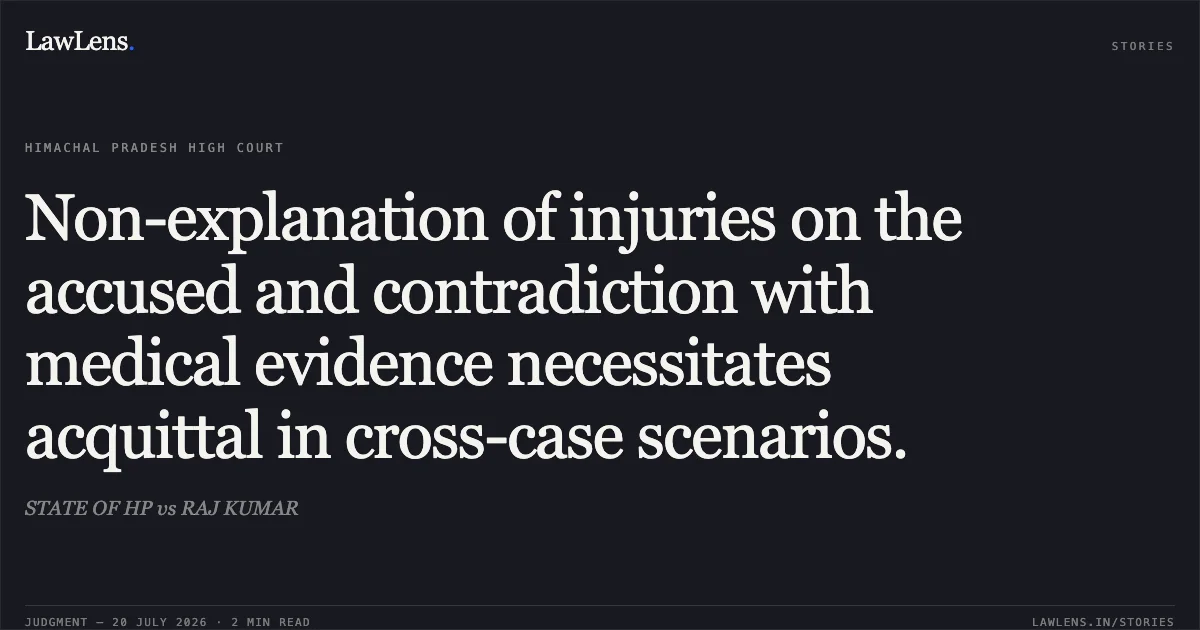
Source reference: para 17-203. Whether the non-explanation of injuries sustained by the accused during the same incident is fatal to the prosecution's case.
Source reference: para 21-23Law Applied
The Court applied the standard of appellate review in acquittals, holding that interference is warranted only in cases of "patent perversity" or misreading of material evidence, as established in Surendra Singh v. State of Uttarakhand and State of M.P. v. Ramveer Singh.
Source reference: para 13, 14It applied the principle from Amar Singh v. State of Punjab and Thaman Kumar v. State (UT of Chandigarh), which mandates that a fundamental inconsistency between ocular testimony (claiming sharp weapon use) and medical evidence (finding blunt force injuries) discredits the prosecution's case.
Source reference: para 17, 19Furthermore, it relied on Parshuram v. State of M.P., which holds that the non-explanation of injuries on the accused suggests the suppression of the true genesis of the incident.
Source reference: para 21Reasoning
The Court found that while PW2 claimed an injury from the sharp side of a darat, the medical officer (PW5) categorized the injury as caused by a blunt object and did not find any incised wounds.
Source reference: para 17, 20This contradiction categorized the case as one where the oral testimony regarding the weapon is "not truthful".
Source reference: para 19-20Additionally, despite evidence that the accused Raj Kumar sustained a bleeding head injury, the prosecution witnesses denied this, leaving the injuries unexplained.
Source reference: para 21The Court observed that the presence of a cross-case and pending civil litigation between the parties necessitated independent corroboration, which was absent as PW3 and PW6 turned hostile.
Source reference: para 24-27Consequently, the Appellate Court's view was deemed reasonable and not perverse.
Source reference: para 28Holding
The Court answered the issues by holding that the prosecution failed to prove the case beyond a reasonable doubt due to medical contradictions and the suppression of the incident's origin.
The High Court upheld the Appellate Court’s judgment of acquittal, finding no grounds to interfere with a plausible view.
Source reference: para 28The appeal was dismissed, and the respondents were directed to furnish bail bonds under Section 437-A of the CrPC to ensure appearance if further challenged.
Source reference: para 30-31Acts & Sections Cited
7 provisions across 3 statutes referred to in this judgment. Each provision opens on LawLens.
Indian Penal Code, 18604
Code of Criminal Procedure, 19732
Bharatiya Nagarik Suraksha Sanhita, 20231
Original Court PDF
STATE OF HPvsRAJ KUMAR
Click to open original judgment
Original judgment, available to read, download and summarize on LawLens.in