Facts
The petitioner-company appointed the respondent-workman as an Assistant Technical Trainee for an initial period of one year from 6 October 2016. The appointment letter provided that his learning and performance would be reviewed at the end of each six-month training phase, with the management having discretion to extend or discontinue the traineeship based on performance.
Source reference: para. 4, para. 29The respondent’s performance was periodically assessed, and the appraisal reports recorded deficiencies and the need for improvement. These reports bore the signatures of the respondent and the relevant managerial authorities.
Source reference: para. 5, para. 21His training was extended, but his performance allegedly remained unsatisfactory. By letter dated 3 November 2017, the company declined to renew his traineeship in accordance with the appointment terms.
Source reference: para. 11, para. 21The respondent raised an industrial dispute contending that the discontinuance amounted to retrenchment and that the termination was stigmatic and illegal for non-compliance with the Industrial Disputes Act, 1947.
Source reference: paras. 1–2The 7th Industrial Tribunal, Kolkata, held that the termination was stigmatic and unjustified, set aside the employer’s letter, and directed reinstatement with full back wages, continuity of service, consequential benefits and interest.
Source reference: paras. 1–2The company challenged the award under Article 226 of the Constitution.
Source reference: para. 1Issues
Whether discontinuance of the respondent’s traineeship for unsatisfactory performance amounted to a stigmatic and punitive termination requiring a prior disciplinary enquiry?
Source reference: paras. 1–2, 21–35Whether the discontinuance/non-renewal of the traineeship was protected by the contractual stipulation in the appointment letter and fell within Section 2(oo)(bb) of the Industrial Disputes Act, 1947?
Source reference: paras. 10–11, 16–20, 29–35Whether the Industrial Tribunal’s award directing reinstatement with full back wages and consequential benefits was legally sustainable?
Source reference: paras. 1–2, 35–37Law Applied
The Court applied Section 2(oo)(bb) of the Industrial Disputes Act, 1947, under which termination resulting from non-renewal of a contract on its expiry, or termination under a stipulation contained in the contract of employment, does not constitute retrenchment.
Source reference: para. 10It relied on M. Venugopal v. Divisional Manager, LIC of India, which holds that a probationer’s service may be discontinued for failure to meet performance requirements under the contractual terms and that such discontinuance is covered by Section 2(oo)(bb).
Source reference: para. 10Applying Samsher Singh v. State of Punjab, the Court held that the real substance of the order, rather than the mere existence of an enquiry, determines whether termination is punitive.
Source reference: para. 7, para. 29Relying on Chaitanya Prakash v. H. Omkarappa, Abhijit Gupta v. S.N.B. National Centre, Basic Sciences, and Pavanendra Narayan Verma v. Sanjay Gandhi PGI, the Court held that an order based on unsatisfactory performance or unsuitability during probation is ordinarily non-stigmatic unless it is founded on an unproved allegation of misconduct, moral turpitude or other blameworthy conduct.
Source reference: para. 31The Court also considered Utkal Machinery Ltd. v. Santi Patnaik, which requires the employer to establish the alleged unsatisfactory performance before the Labour Court or Tribunal.
Source reference: paras. 19, 22Reasoning
The Court found that the respondent was engaged as a trainee and had no vested right to confirmation or continuation beyond the contractual training period.
Source reference: paras. 6, 8–11, 21Clause 6 of the appointment letter expressly authorised periodic performance reviews, extensions of training, and release from traineeship where the respondent’s learning remained unsuitable.
Source reference: para. 29The respondent was repeatedly informed of his deficiencies through written appraisal reports, signed by him, and was given opportunities and extensions to improve.
Source reference: paras. 21–24, 35The Court held that the employer’s reliance on unsatisfactory performance was an administrative assessment of suitability and was not accompanied by allegations of misconduct, dishonesty, moral turpitude or character defects.
Source reference: paras. 30–34Accordingly, the decision was not punitive or stigmatic and did not require a disciplinary enquiry.
Source reference: paras. 30–34Since the respondent’s traineeship was discontinued pursuant to an express contractual stipulation, the action was also covered by Section 2(oo)(bb) and did not amount to retrenchment attracting the statutory safeguards relied upon by the respondent.
Source reference: paras. 10–11, 29, 35The Tribunal therefore erred in treating the discontinuance as an illegal, stigmatic termination.
Source reference: para. 35Holding
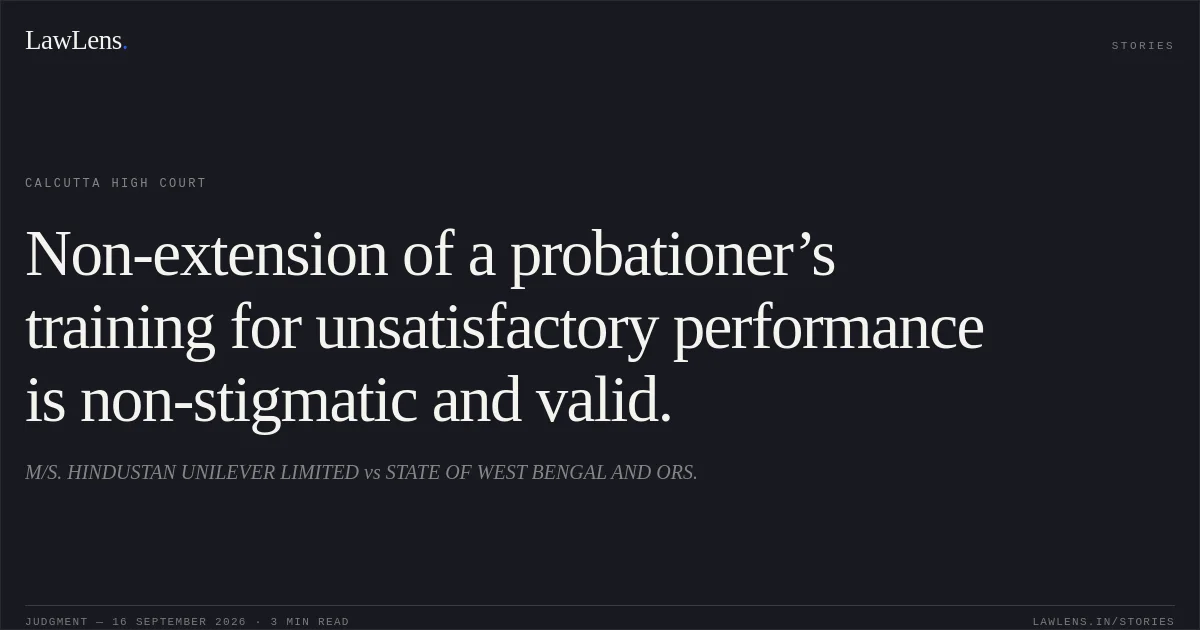
The High Court held that discontinuance of the respondent’s traineeship for consistently unsatisfactory performance was a non-stigmatic termination simpliciter, effected in accordance with the appointment letter and supported by documented performance assessments.
It further held that the action fell within Section 2(oo)(bb) of the Industrial Disputes Act, 1947, and did not constitute illegal retrenchment.
Source reference: paras. 10, 29, 35The Tribunal’s award dated 30 December 2025 was quashed and set aside as perverse and erroneous in law.
Source reference: paras. 36–39The writ petition was allowed, and all connected applications were disposed of; any interim order was vacated.
Source reference: paras. 36–39Acts & Sections Cited
4 provisions across 1 statute referred to in this judgment. Linked provisions open on LawLens.
Industrial Disputes Act, 19474
Original Court PDF
M/S. HINDUSTAN UNILEVER LIMITEDvsSTATE OF WEST BENGAL AND ORS.
Click to open original judgment
Original judgment, available to read, download and summarize on LawLens.in