Facts
The petitioner (defendant in the original suit) filed a petition under Article 227 of the Constitution of India challenging an order dated 16.06.2026 passed by the Additional Civil Judge, Botad
Source reference: p. 1The Trial Court had rejected the petitioner’s application (Exh. 107) in Regular Civil Suit No. 31 of 2016, which sought to frame three additional issues regarding the maintainability of the suit: limitation, valuation, and jurisdiction
Source reference: p. 2The Trial Court rejected the application on the grounds that it was filed at a belated stage and that such issues were unnecessary in a suit for declaration and injunction
Source reference: p. 3Issues
1. Whether the Trial Court committed a gross illegality in refusing to frame additional issues regarding limitation, valuation, and jurisdiction
Source reference: p. 4, para 62. Whether the issues of limitation and valuation must be specifically framed as separate issues when the court is already determining the overall entitlement to relief
Source reference: p. 4, para 5-6Law Applied
Article 227 of the Constitution of India regarding the High Court’s power of superintendence over subordinate courts, which is to be exercised only in cases of perverse or grossly erroneous orders
Source reference: p. 5, para 8Section 3 of the Limitation Act, which mandates that a court must examine the aspect of limitation irrespective of whether it is raised as a defense
Source reference: p. 4, para 6The court also considered the procedural standards for framing issues under the Code of Civil Procedure (implicitly), noting that issues already covered by existing frames do not require duplication
Source reference: p. 3-4, para 5Reasoning
The High Court observed that the Trial Court had already framed Issue No. 5 regarding jurisdiction, which sufficiently addressed the petitioner’s second proposed issue
Source reference: p. 3Regarding the proposed issues of limitation and valuation, the Court reasoned that these are primarily questions of law
Source reference: p. 4It clarified that even if not framed as specific issues at this late stage, the Trial Court is legally bound under Section 3 of the Limitation Act to adjudicate on the suit's timeliness during final disposal
Source reference: p. 4-5Furthermore, the original Issue No. 6 (concerning the plaintiff's entitlement to relief) allows for the consideration of these legal hurdles
Source reference: p. 4Consequently, the petitioner was not prejudiced as they remained free to raise these legal contentions during final arguments
Source reference: p. 5, para 7Holding
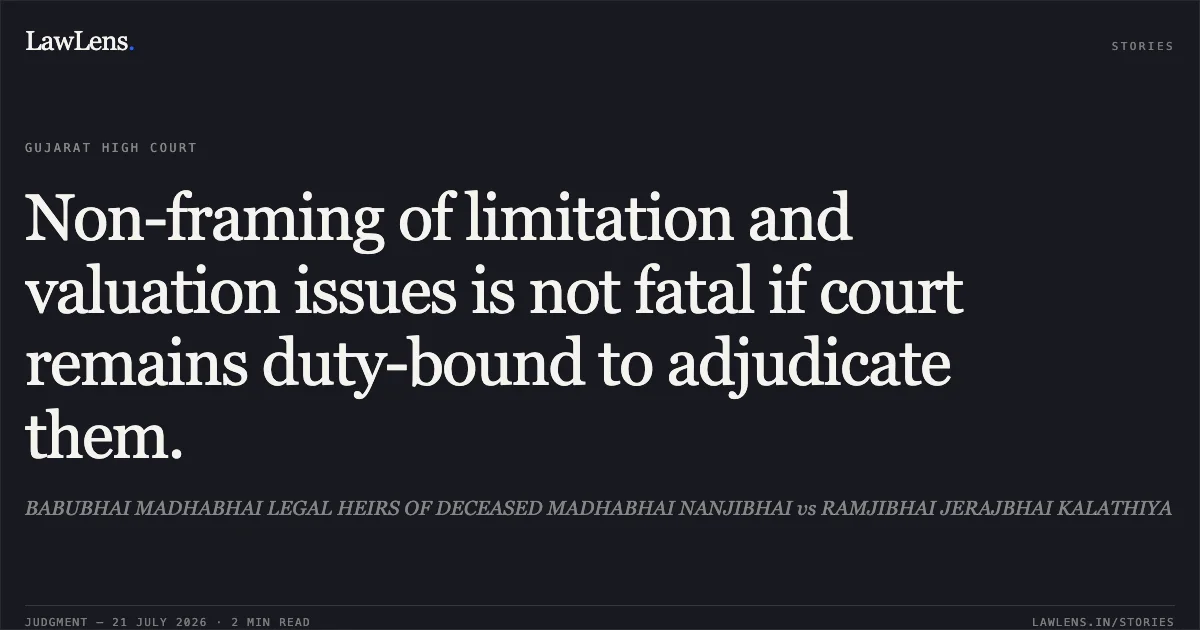
The Court answered that while additional issues need not be framed at a belated stage if they are inherently questions of law, the Trial Court maintains a "bounden duty" to examine limitation and valuation during final adjudication
The High Court dismissed the petition, holding that the Trial Court’s order was neither perverse nor grossly erroneous. The petitioner was granted liberty to raise these legal contentions during the final arguments of the suit
Source reference: p. 5, para 7-8Acts & Sections Cited
1 provisions across 1 statute referred to in this judgment. Each provision opens on LawLens.
Limitation Act, 19631
Original Court PDF
BABUBHAI MADHABHAI LEGAL HEIRS OF DECEASED MADHABHAI NANJIBHAIvsRAMJIBHAI JERAJBHAI KALATHIYA
Click to open original judgment
Original judgment, available to read, download and summarize on LawLens.in