Facts
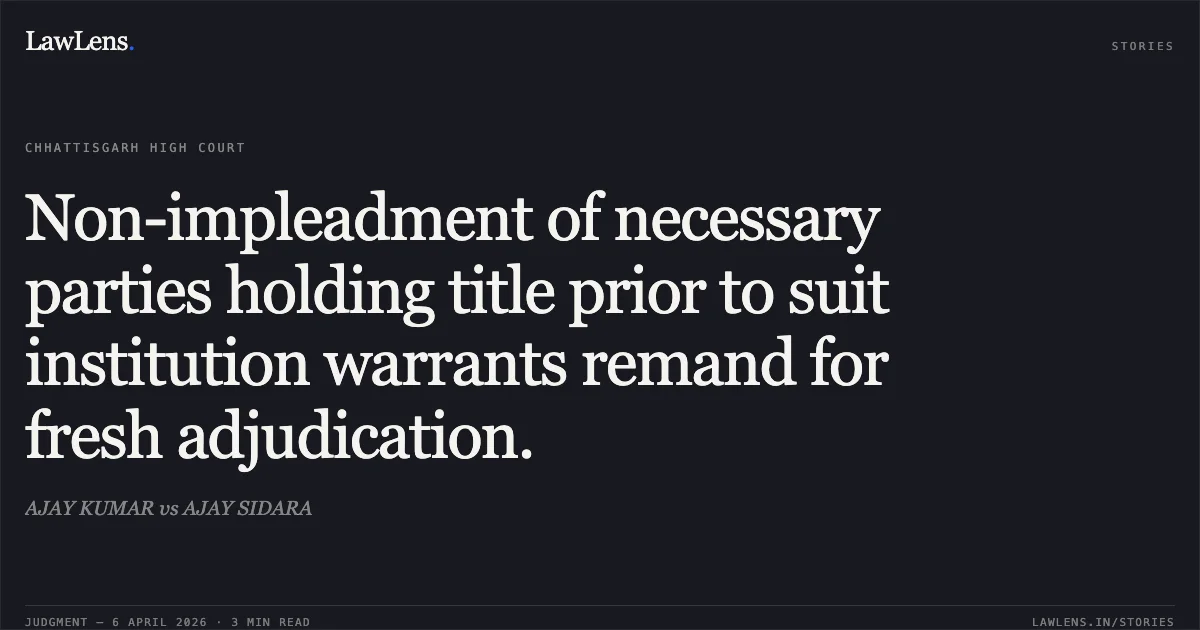
The appellants (original plaintiffs) filed a civil suit in 2010 seeking a declaration of title and permanent injunction regarding land in Village Tifra, Bilaspur, asserting they purchased the property in 2004
Source reference: para. 3The Trial Court proceeded ex-parte against the defendants and decreed the suit in favor of the plaintiffs on 19.08.2016
Source reference: para. 5Subsequently, Ajay Sidara (Respondent No. 1), a third party who purchased the land from Smt. Harsha Rana (Respondent No. 6) in 2020, challenged the decree before the First Appellate Court
Source reference: para. 2It was revealed that the original defendant, Khagendra Manhar, had already sold the suit property to Harsha Rana in 2009—prior to the institution of the suit—meaning Manhar held no title when the suit was filed
Source reference: para. 12The First Appellate Court set aside the Trial Court’s decree and remanded the matter for fresh adjudication, citing the non-joinder of necessary parties and suppression of facts
Source reference: para. 7Issues
Whether a third party not originally impleaded in a suit can maintain an appeal under Section 96 of the CPC as a "person aggrieved."
Source reference: para. 16-17Whether the non-joinder of a party who acquired title prior to the institution of the suit constitutes a fundamental defect justifying a remand under Order XLI Rule 23-A of the CPC.
Source reference: para. 13-15Law Applied
Order XLI Rule 23-A of the CPC, which empowers an appellate court to remand a case for fresh trial when the suit was decided on merits but the decree is reversed in appeal and a retrial is considered necessary
Source reference: para. 15, 21Supreme Court precedent in V.N. Krishna Murthy & Anr. v. Ravikumar & Ors. (2020), which establishes that a non-party may maintain an appeal with leave if they are a "person aggrieved" by the judgment
Source reference: para. 17Principle from S.P. Chengalvaraya Naidu v. Jagannath (1994), holding that a decree obtained by suppressing material facts or playing fraud upon the court is a nullity
Source reference: para. 19Doctrine of "necessary parties," asserting that the absence of a person whose interest is directly affected by the litigation renders the adjudication ineffective
Source reference: para. 14Reasoning
The Court reasoned that Smt. Harsha Rana was a necessary party because she held registered title to the property before the suit was even instituted in 2010; the plaintiffs' failure to implead her, while suing a predecessor who no longer held interest, resulted in a "one-sided adjudication"
Source reference: para. 12, 20The Court found that Ajay Sidara, as a subsequent purchaser from Rana, was "prejudicially affected" by the 2016 decree, thus qualifying as an aggrieved person entitled to appeal
Source reference: para. 16-17Regarding the remand, the Court determined that the Trial Court's failure to examine whether the actual title-holders were before it struck at the root of the proceedings
Source reference: para. 11, 14The High Court held that the First Appellate Court correctly exercised its jurisdiction under Order XLI Rule 23-A, as the defect of non-joinder and the resulting violation of natural justice could not be cured without a fresh trial involving all necessary parties
Source reference: para. 21-24Holding
The High Court dismissed the appeal and upheld the First Appellate Court's judgment to set aside the original decree
The Court held that the non-joinder of necessary parties (Harsha Rana and Ajay Sidara) was a fundamental defect that necessitated a remand for fresh adjudication
Source reference: para. 23The Trial Court was directed to restore the civil suit, allow for the impleadment of the necessary parties, permit them to file pleadings and lead evidence, and decide the case afresh on its merits; the parties were ordered to appear before the Trial Court on 06.05.2026
Source reference: para. 27Acts & Sections Cited
6 provisions across 1 statute referred to in this judgment. Each provision opens on LawLens.
Code of Civil Procedure, 19086
Original Court PDF
AJAY KUMARvsAJAY SIDARA
Click to open original judgment
Original judgment, available to read, download and summarize on LawLens.in