Facts
The Appellants, Nanak Chand (husband) and Veermati (mother-in-law), were convicted by the Trial Court for offences under Sections 498-A/304-B IPC following the death of Arti (the deceased) due to 100% burn injuries on October 4, 2002.
Source reference: p. 1-2Married in April 2000, the deceased had lived with her parents from February to September 2002 due to alleged dowry harassment (demands for ₹50,000 or a plot) and returned to her matrimonial home only 12 days before the incident.
Source reference: p. 4, 19A dying declaration was recorded by an SDM wherein the deceased specifically accused Veermati of pouring kerosene and setting her on fire.
Source reference: p. 3The Appellants challenged the conviction on grounds of vague allegations, non-examination of material witnesses, and the failure of the Trial Court to put the incriminating contents of the dying declaration to them during their Section 313 CrPC examination.
Source reference: p. 7-9Issues
1. Whether the failure to specifically put the contents of a dying declaration to the accused during examination under Section 313 CrPC renders that evidence inadmissible.
Source reference: p. 152. Whether the conviction under Sections 498-A and 304-B IPC can be sustained based on circumstantial evidence and oral testimonies independent of the dying declaration.
Source reference: p. 18Law Applied
The court applied Section 304-B IPC regarding dowry death, which requires proof of unnatural death within seven years of marriage linked to dowry-related cruelty "soon before death".
Source reference: p. 14It relied on the procedural mandate of Section 313 CrPC, which requires the court to put every material incriminating circumstance to the accused to ensure a fair trial.
Source reference: p. 15Precedents including Raj Kumar v. State (NCT of Delhi) and Aejaz Ahmad Sheikh v. State of U.P. established that circumstances not put to the accused under Section 313 CrPC must be excluded from consideration if prejudice is caused.
Source reference: p. 16, 18The court applied the standard for proving dowry harassment through the testimonies of related witnesses as per Karan Singh v. State of Haryana.
Source reference: p. 14Reasoning
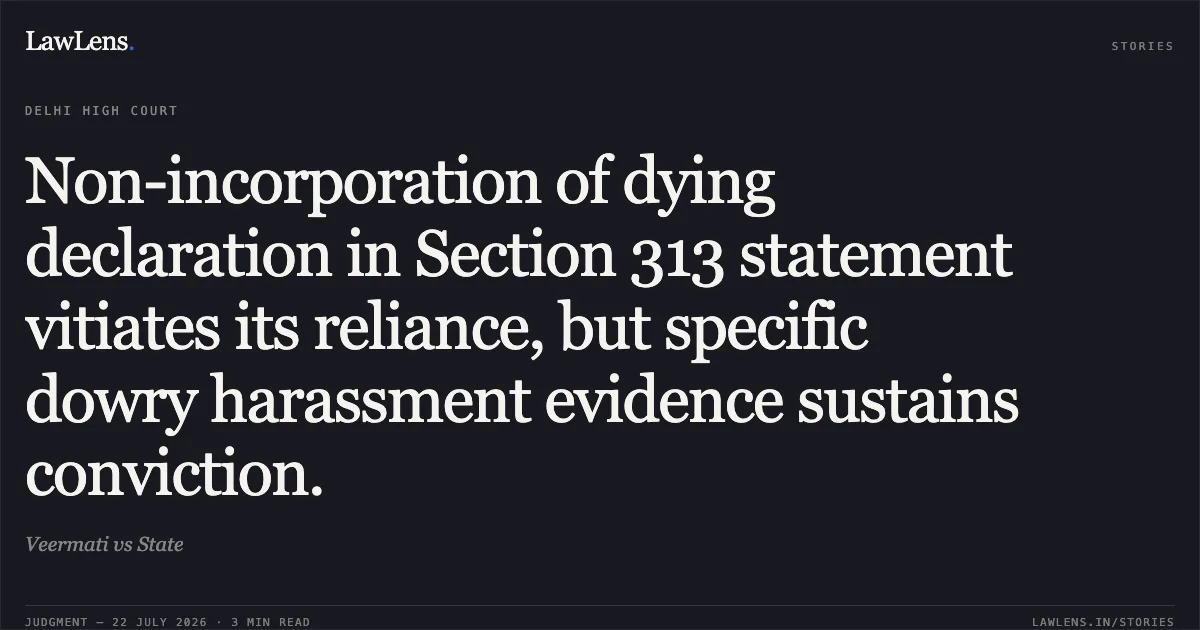
The High Court found a significant procedural lapse: the Trial Court failed to confront the Appellants with the specific allegation in the dying declaration—that Veermati poured kerosene and lit the fire—during their Section 313 CrPC statements.
Source reference: p. 15Given Veermati’s illiteracy, this omission caused material prejudice; consequently, the dying declaration was excluded from evidence.
Source reference: p. 16, 18The testimonies of PW-1 (father) and PW-2 (uncle) provided specific, non-vague accounts of persistent demands for a plot or cash and established that the deceased was only sent back to her in-laws 12 days prior after a mediated settlement.
Source reference: p. 19-22Medical evidence (100% flame burns) and the recovery of kerosene-soaked rubber gloves and a plastic can from the kitchen corroborated a non-accidental death.
Source reference: p. 23The Appellants’ conduct—being absent from the home/hospital and their apprehension at the Badarpur border—further pointed toward guilt.
Source reference: p. 29Holding
The Court answered the first issue in the affirmative, excluding the dying declaration due to the Section 313 CrPC lapse.
The court held that the foundational facts for "dowry death" and "cruelty" were proved beyond reasonable doubt through oral and circumstantial evidence.
Source reference: p. 30The High Court upheld the conviction and sentences (3 years for 498-A and life imprisonment for Veermati under 304-B). The appeals were dismissed, and the Appellants were directed to surrender within two weeks.
Source reference: p. 6, 31Acts & Sections Cited
5 provisions across 3 statutes referred to in this judgment. Each provision opens on LawLens.
Indian Penal Code, 18603
Code of Criminal Procedure, 19731
Bharatiya Nyaya Sanhita, 20231
Original Court PDF
VeermativsState
Click to open original judgment
Original judgment, available to read, download and summarize on LawLens.in