Facts
The Petitioner (decree-holder) obtained a decree for specific performance in OS No. 138/2018 on 06.04.2021.
Source reference: para. 2Upon the judgment-debtors’ failure to comply, the Executing Court in Ex. No. 81/2021 appointed a Court Commissioner to execute the sale deed.
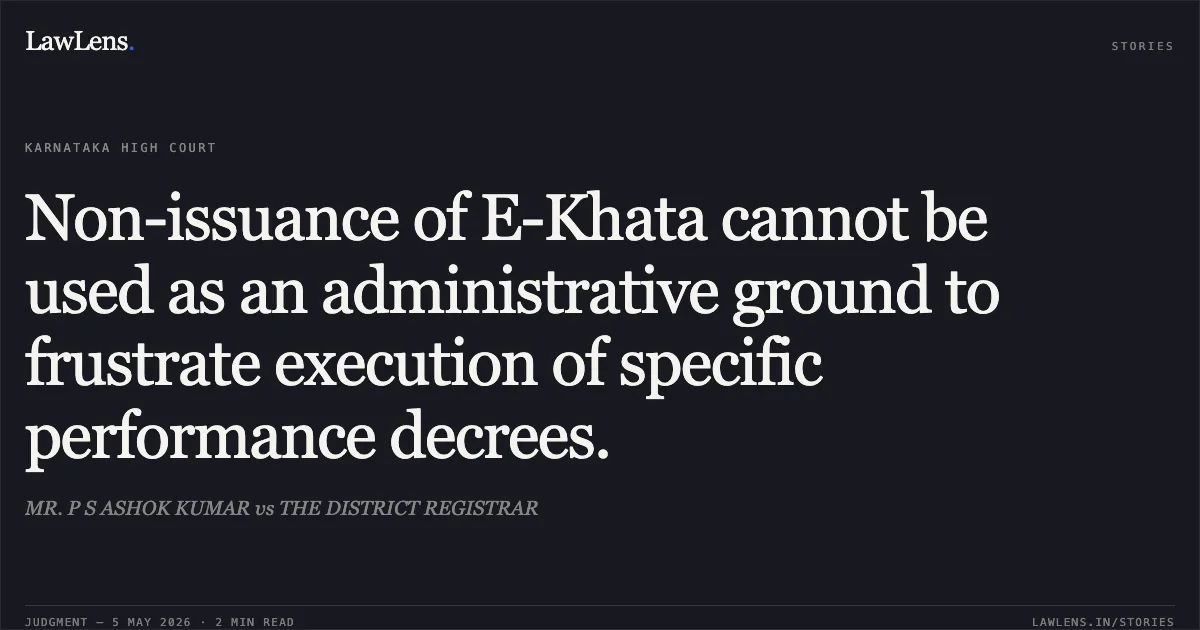
Source reference: para. 2The District Registrar (Respondent No. 1) issued an endorsement dated 28.08.2025 refusing to register the sale deed because of the absence of an "E-khata" (electronic property record).
Source reference: para. 2The Petitioner challenged this endorsement, arguing that the administrative requirement of an E-khata was being used to frustrate a judicial decree.
Source reference: para. 3Issues
1. Whether the registering authorities can decline the registration of a sale deed executed via a Court Commissioner on the grounds of non-production of an E-khata.
Source reference: para. 32. Whether the local municipal authorities are obligated to facilitate the issuance of an E-khata to give effect to a court decree for specific performance.
Source reference: para. 4Law Applied
The Court applied the fundamental principle that a decree for specific performance is a command enforceable in law and not a mere declaration of rights.
Source reference: para. 4It emphasized the duty of executive authorities to act in aid of judicial orders under the "Rule of Law".
Source reference: para. 5-6The court derived its authority from Articles 226 and 227 of the Constitution of India to bridge administrative "grey areas" and ensure the enforceability of civil decrees.
Source reference: para. 6-7It further clarified that procedural requirements under the Registration Act, 1908, must be interpreted facilitatively when the execution involves a Court Commissioner.
Source reference: para. 7(vii)Reasoning
The Court observed that judgment-debtors often deliberately abstain from obtaining E-khatas to frustrate decrees, leaving successful litigants remediless.
Source reference: para. 5It held that the executive machinery’s "hyper-technical or pedantic approach" in insisting on an E-khata—while refusing to issue one to anyone but the original owner—created a procedural deadlock that rendered judicial decrees "mere paper decrees".
Source reference: para. 5-6To resolve this, the Court reasoned that municipal bodies have a facilitative obligation to issue E-khatas either in the name of the judgment-debtor or the Court Commissioner for the limited purpose of registration.
Source reference: para. 7Furthermore, the Court determined that decree-holders must be permitted to pay outstanding property taxes to satisfy E-khata prerequisites, with the right to recover such sums from the judgment-debtor later.
Source reference: para. 7(iv)-(vi)Holding
The Court held that the Sub-Registrar cannot insist on the personal presence or consent of the judgment-debtor for deeds executed by a Court Commissioner.
The Court allowed the writ petition and quashed the impugned endorsement.
Source reference: para. 8(i)-(ii)It issued a writ of mandamus directing Respondent No. 2 to issue the E-khata within two weeks upon application by the Petitioner or Court Commissioner.
Source reference: para. 8(iii)-(v)Detailed guidelines were formulated to ensure that in all such cases, local authorities must quantify dues, accept payment from decree-holders, and process E-khatas to ensure the valid conveyance of property as ordered by the civil court.
Source reference: para. 7 & 8Acts & Sections Cited
2 provisions across 2 statutes referred to in this judgment. Linked provisions open on LawLens.
Registration Act, 19081
Code of Civil Procedure, 19081
Original Court PDF
MR. P S ASHOK KUMARvsTHE DISTRICT REGISTRAR
Click to open original judgment
Original judgment, available to read, download and summarize on LawLens.in