Facts
The plaintiffs (respondents) filed a civil suit for a permanent prohibitory injunction to restrain the defendants (appellants) from interfering with their possession of land measuring 33-15 bighas.
Source reference: para 2The plaintiffs claimed ownership as successors of Bhagi Rath, who was conferred proprietary rights under the H.P. Abolition of Big Landed Estates and Land Reforms Act.
Source reference: para 4The defendants contested the suit, asserting that the land was originally held by Keshav Ram (grandfather of the parties) as a non-occupancy tenant.
Source reference: para 3Defendant No. 1, Tulsi Ram (son of Sadhu Ram, another son of Keshav Ram), claimed he inherited the tenancy rights equally with Bhagi Rath upon Keshav Ram’s death.
Source reference: para 3The Trial Court and the First Appellate Court decreed the suit in favor of the plaintiffs, holding that non-occupancy tenancy was not heritable and that Bhagi Rath alone became the owner.
Source reference: para 7, 8Issues
1. Whether an unregistered family settlement (Ex. DX) purportedly executed in 1971 could be considered by the court.
Source reference: para 9, 142. Whether non-occupancy tenancy is heritable under the law of succession.
Source reference: para 9, 173. Whether the clubbing of material issues by the lower courts violated Order 20 of the CPC.
Source reference: para 9, 244. Whether the Civil Court has jurisdiction to determine controversy regarding tenancy rights and proprietary conferment.
Source reference: para 9, 275. Whether a suit for a mere injunction is maintainable without seeking a declaration of ownership.
Source reference: para 9, 32Law Applied
Section 17(1)(b) of the Registration Act, 1908, which mandates the registration of instruments that extinguish or create rights in immovable property, as established in Roshan Singh v. Zile Singh.
Source reference: para 14The court relied on the principle that non-occupancy tenancy is heritable under the general law of succession, specifically Section 8 of the Hindu Succession Act, 1956, as held in Charno Devi v. Dali Mal and Smt. Nathi v. Ned Chand.
Source reference: para 19, 20The court followed the doctrine from Anathula Sudhakar v. P. Buchi Reddy regarding the maintainability of injunction suits.
Source reference: para 32Order 41 Rule 22 of the CPC, which allows a respondent to support a decree by challenging adverse findings without filing cross-objections.
Source reference: para 36Reasoning
The High Court found that the family settlement (Ex. DX) was inadmissible as it was unregistered and purported to sever ownership, thus violating the Registration Act.
Source reference: para 15However, the court determined that the lower courts committed a significant legal error by holding that non-occupancy tenancy is not heritable.
Source reference: para 22Applying the Hindu Succession Act, the court noted that since Keshav Ram was the original tenant, his rights devolved upon his heirs; Tulsi Ram (as the son of a predeceased son) was a Class I heir entitled to an equal share with Bhagi Rath.
Source reference: para 23Consequently, the conferment of proprietary rights on Bhagi Rath alone by the Compensation Officer was a corrigible error over which the Civil Court maintained jurisdiction.
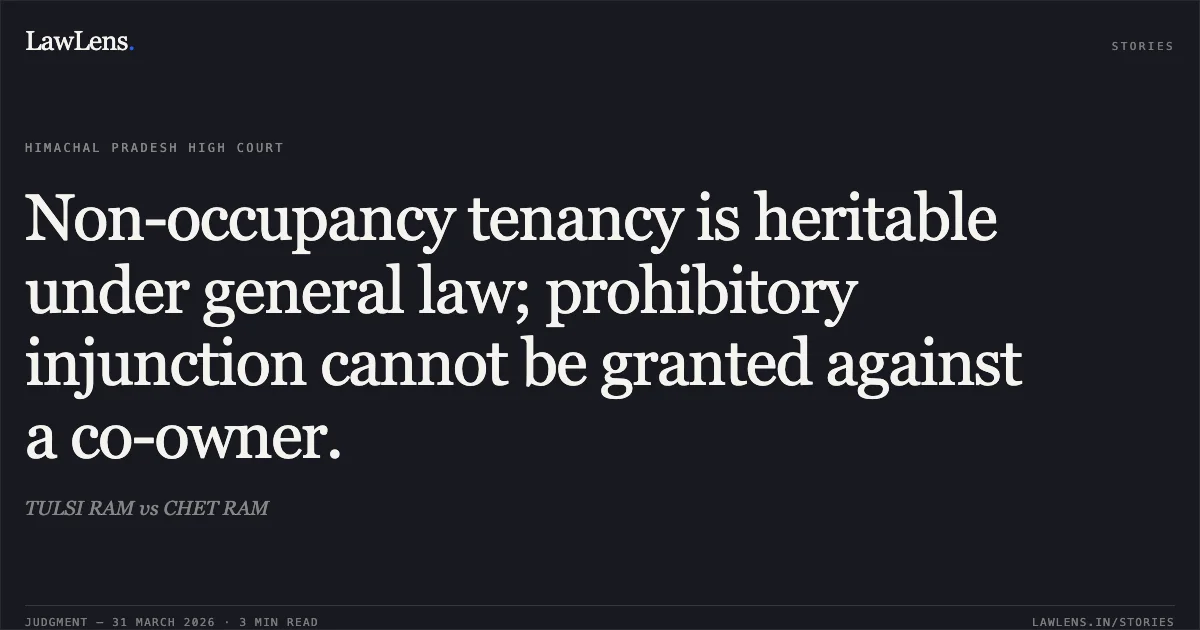
Source reference: para 29Under Indian law, a permanent injunction cannot be granted to restrain one co-owner at the instance of another.
Source reference: para 38Holding
The High Court answered the core legal questions in favor of the appellants, holding that non-occupancy tenancy is indeed heritable and that Tulsi Ram became a co-owner by succession.
The court concluded that the lower courts misinterpreted the evidence and the law of succession.
Source reference: para 31Consequently, the High Court allowed the appeal, set aside the judgments and decrees of the Trial Court and the First Appellate Court, and dismissed the plaintiffs' suit.
Source reference: para 39Acts & Sections Cited
7 provisions across 4 statutes referred to in this judgment. Each provision opens on LawLens.
Code of Civil Procedure, 19083
Registration Act, 19082
Punjab Tenancy Act, 1887.1
Hindu Succession Act, 19561
Original Court PDF
TULSI RAMvsCHET RAM
Click to open original judgment
Original judgment, available to read, download and summarize on LawLens.in