01Facts
Nagaraju obtained probate of an alleged Will dated 5 January 1976 executed by Puttaswamy, in a proceeding in which no respondents were named.
pp. 3–6, 11–12Manjula and the other appellants, who were not parties to the probate proceeding, claimed to be Puttaswamy’s children and legal heirs.
pp. 3–6, 11–12They alleged that Puttaswamy was not a bachelor, that they had obtained a partition decree concerning the properties, and that Nagaraju had suppressed material facts and obtained probate fraudulently.
pp. 3–6, 11–12They appealed under Section 299 of the Indian Succession Act, 1925, seeking to set aside the probate order.
pp. 6–802Issues
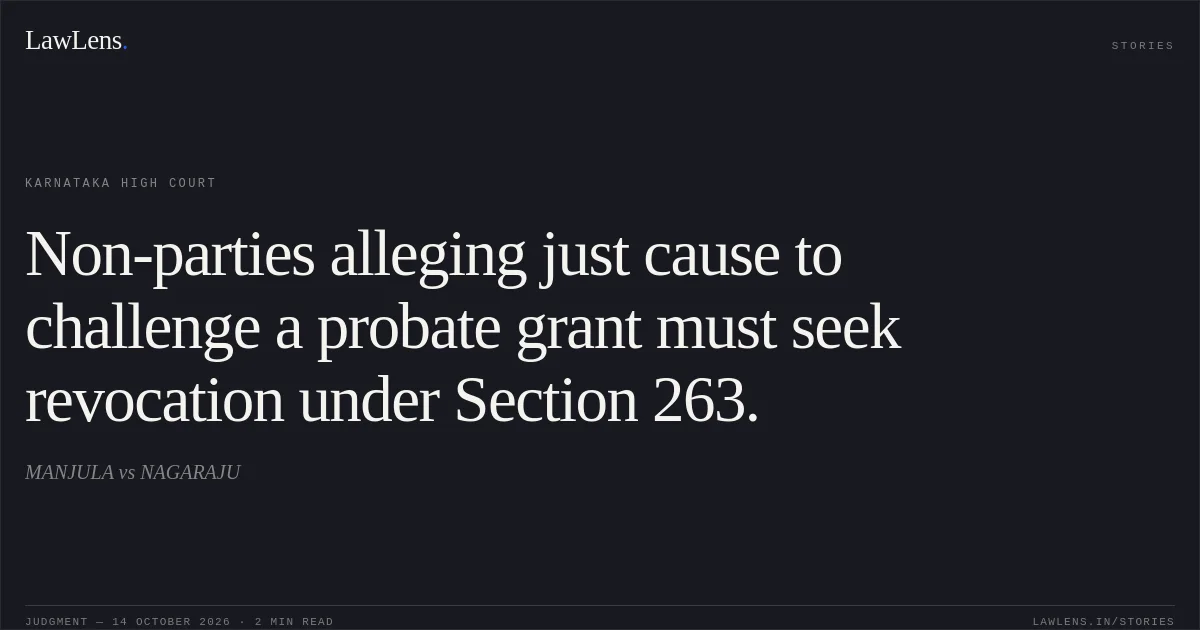
i.1. Whether the appellants, who were not parties to the probate proceeding, could pursue their challenge to the grant by appeal under Section 299, or should seek revocation under Section 263 of the Indian Succession Act.
pp. 7–8, 10–13ii.2. Whether the appellants’ allegations of non-citation, suppression and fraud should be determined on their merits in this appeal.
pp. 11–1403Law Applied
Section 299 of the Indian Succession Act provides for an appeal to the High Court from an order made by a District Judge under the Act, in accordance with the applicable provisions of the Code of Civil Procedure.
p. 9Section 263 permits revocation or annulment of probate or letters of administration for “just cause,” including where the proceedings were defective in substance, the grant was obtained fraudulently or by concealing material facts, or parties who ought to have been cited were not cited.
pp. 9–11Relying on Swaminathan v. Alankamony and Sri Sheshappa v. Sri Praveen, the Court held that persons seeking revocation on such grounds, where they were not parties to the probate proceeding, may apply under Section 263 before the probate court.
pp. 8–11Provisions in the judgment · 4 · Linked ones open on LawLens
Indian Succession Act, 1925 Section 299Section 276Section 263Section 300
04Reasoning
The appellants’ grievance was that they were omitted from the probate proceeding and that material facts concerning Puttaswamy’s family and the properties were suppressed.
pp. 10–13Those allegations, if established, could fall within the “just cause” grounds under Section 263, including defective proceedings and failure to cite persons who ought to have been cited.
pp. 10–13Because the appellants were not parties before the probate court, the High Court considered it appropriate for them to seek revocation there, rather than determine the disputed allegations in the appeal.
pp. 12–14The Court expressly declined to examine the merits.
pp. 12–1405Holding
The appeal was disposed of, with liberty to the appellants to apply to the VI Additional District Court and Sessions Judge, Mysuru, for revocation of the probate order under Section 263.
pp. 14–15The probate court was directed to entertain the application and decide it in accordance with law after providing the parties an opportunity to be heard.
pp. 14–15The appellants were also permitted to seek interim protection against alienation; if an application was filed, the trial court was directed to consider it within fifteen days.
pp. 14–15The High Court expressed no opinion on the merits.
pp. 14–15Original Court PDF
MANJULAvsNAGARAJU
Click to open original judgment
Original judgment, available to read, download and summarize on LawLens.in