Facts
The Petitioner and the Complainant (Patel Wine and Fruit Processing Industries) entered into a Franchise Agreement on March 12, 2015, for the supply of wine.
Source reference: para. 2The business relationship continued from 2014-15, with the Petitioner making periodic payments until 2022-23, when an outstanding balance of ₹19,27,596/- accrued.
Source reference: para. 2The Complainant alleged that the Petitioner’s refusal to pay the outstanding amount constituted cheating and criminal breach of trust, leading to the registration of FIR Crime No. 353/2024 at P.S. Manak Chowk, Ratlam, under Sections 420 and 406 of the IPC.
Source reference: para. 1, 2The Petitioner moved the High Court under Section 528 of the Bharatiya Nagarik Suraksha Sanhita (BNSS), 2023, seeking to quash the FIR on the grounds that the dispute was purely civil and lacked criminal intent.
Source reference: para. 3Issues
1. Whether the non-payment of dues in a commercial transaction for the sale of goods constitutes the offence of criminal breach of trust under Section 406 of the IPC?
Source reference: para. 4, 82. Whether the Petitioner possessed the requisite fraudulent or dishonest intention at the inception of the transaction to sustain a charge of cheating under Section 420 of the IPC?
Source reference: para. 9, 113. Whether the High Court should exercise its inherent jurisdiction to quash proceedings that are essentially civil disputes given a criminal color?
Source reference: para. 12Law Applied
Sections 420 (cheating) and 406 (criminal breach of trust) of the IPC.
Source reference: no citationSections 20 and 24 of the Sale of Goods Act, 1930, to establish that in a sale of movable property, ownership passes to the buyer upon delivery, thereby negating "entrustment".
Source reference: para. 8The guidelines for quashing FIRs established in State of Haryana v. Bhajan Lal (1992).
Source reference: para. 7Delhi Race Club (1940) v. State of U.P. (2024) to distinguish between civil debt and criminal breach of trust.
Source reference: para. 8Hridaya Ranjan Prasad Verma v. State of Bihar (2000) regarding the necessity of proving dishonest intention at the inception of a contract to establish cheating.
Source reference: para. 10Reasoning
The Court observed that the transaction was part of a long-standing commercial relationship governed by a Franchise Agreement containing an Arbitration Clause.
Source reference: para. 4, 11Regarding Section 406 IPC, the Court reasoned that because the wine was "sold," ownership transferred to the Petitioner upon delivery under the Sale of Goods Act; therefore, there was no "entrustment" of property, which is a prerequisite for criminal breach of trust.
Source reference: para. 8, 11Regarding Section 420 IPC, the Court found that the Petitioner had been making payments since 2014, and the recent default did not imply a dishonest intention existing at the time the contract was formed.
Source reference: para. 2, 11The Court determined that a mere breach of contract or failure to pay deferred bills does not amount to cheating unless fraudulent intent is shown at the start.
Source reference: para. 9, 10It concluded that the investigative agency was improperly influenced by the magnitude of the debt rather than the legal ingredients of the alleged crimes.
Source reference: para. 12Holding
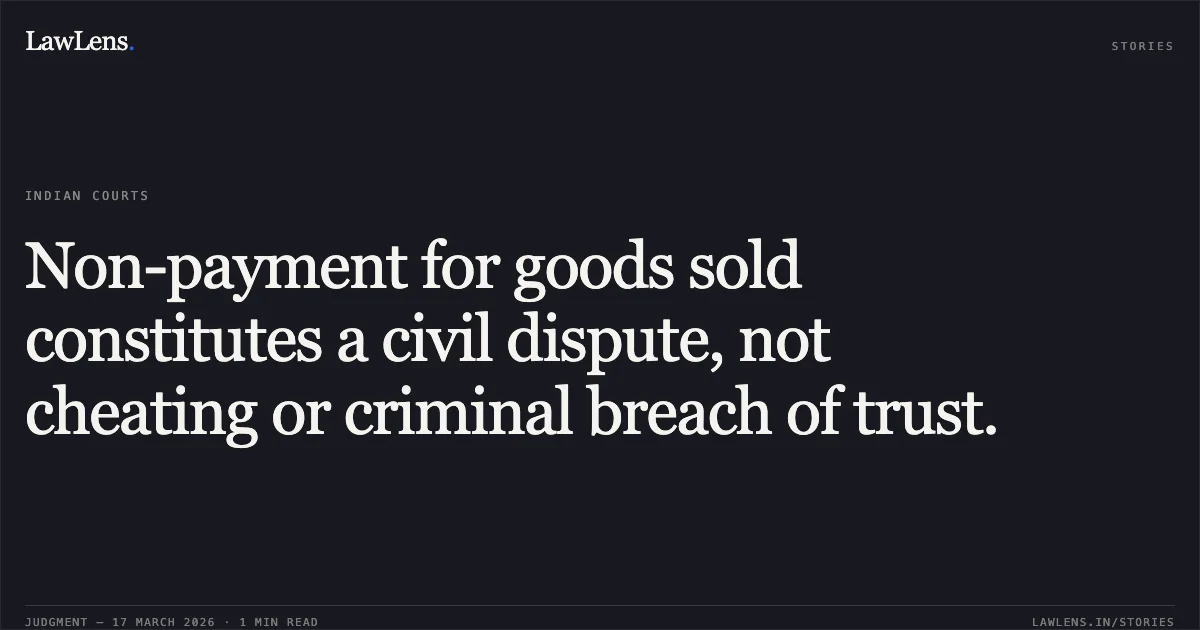
The Court held that the allegations, even if accepted in their entirety, did not prima facie constitute the offences of cheating or criminal breach of trust as the dispute was essentially civil for the recovery of money.
The Court found the FIR to be an attempt to "cloak" a civil dispute with criminal prosecution.
Source reference: para. 12Consequently, the Court allowed the petition under Section 528 of the BNSS and quashed FIR Crime No. 353/2024 and all subsequent proceedings arising therefrom.
Source reference: para. 13Acts & Sections Cited
10 provisions across 4 statutes referred to in this judgment. Each provision opens on LawLens.
Bharatiya Nagarik Suraksha Sanhita, 20231
Indian Penal Code, 18604
Code of Criminal Procedure, 19733
Sale of Goods Act, 19302
Original Court PDF
Bhupendra DixitvsThe State Of Madhya Pradesh
Click to open original judgment
Original judgment, available to read, download and summarize on LawLens.in