Facts
The petitioner, Shubham Bhardwaj, entered into a Memorandum of Understanding (MOU) with the informant for the supply of materials.
Source reference: para. 4The petitioner issued four cheques totaling a significant amount, but a sum of ₹2,68,55,829/- remained outstanding.
Source reference: para. 4When the informant demanded payment, it was alleged that co-accused persons abused and threatened him.
Source reference: para. 4Based on a written report, Chira Chas P.S. Case No. 14 of 2025 was registered under Sections 316(2) (Criminal Breach of Trust), 318(4) (Cheating), 352 (Insult), 351(2) (Criminal Intimidation), and 3(5) of the Bharatiya Nyaya Sanhita (BNS), 2023.
Source reference: para. 2Procedural orders for a non-bailable warrant and process under Section 82 Cr.P.C. were subsequently issued against the petitioner.
Source reference: para. 2The petitioner moved the High Court to quash the FIR and the entire criminal proceeding, arguing the matter was purely civil/contractual.
Source reference: para. 5Issues
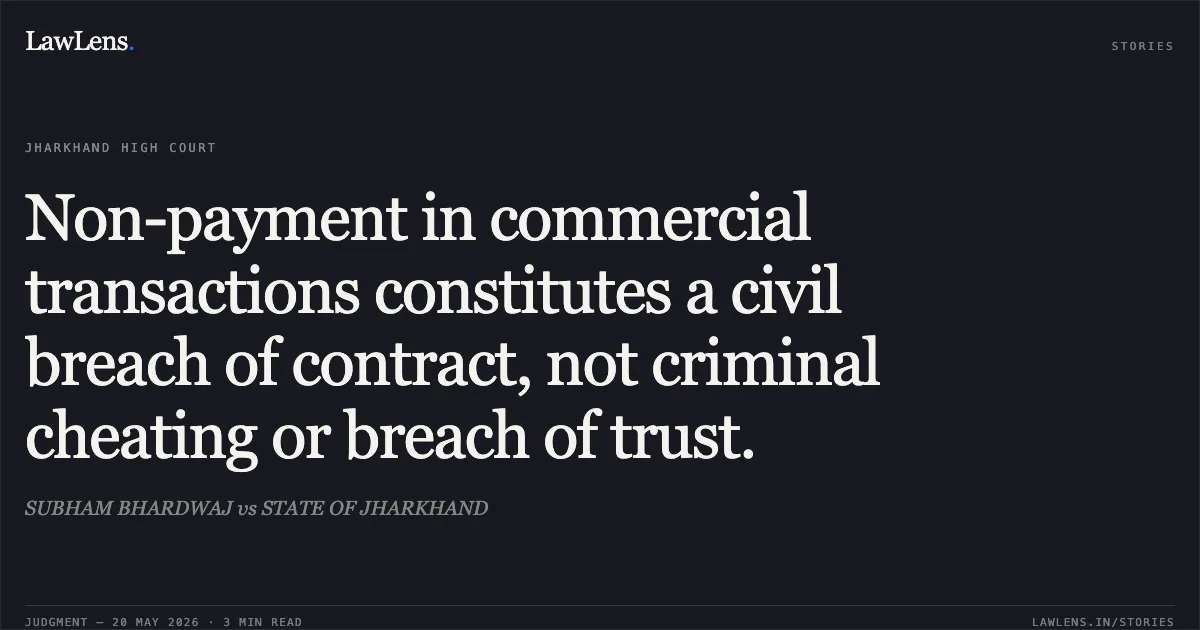
1. Whether a mere breach of contract or non-payment of dues in a commercial transaction amount to the criminal offences of cheating or criminal breach of trust under the BNS?
Source reference: para. 8-102. Whether the offences of criminal breach of trust and cheating can co-exist simultaneously for the same act?
Source reference: para. 113. Whether the allegations regarding verbal abuse and threats over the phone satisfy the legal ingredients of Sections 351(2) and 352 of the BNS?
Source reference: para. 13Law Applied
Section 528 of the BNSS, 2023 (inherent powers).
Source reference: para. 2Vir Prakash Sharma v. Anil Kumar Agarwal: non-payment for goods does not per se constitute cheating or criminal breach of trust.
Source reference: para. 8Uma Shankar Gopalika v. State of Bihar: for cheating, fraudulent intention must exist at the inception of the contract.
Source reference: para. 9Binod Kumar v. State of Bihar: mere retention of money without dishonest misappropriation is not criminal breach of trust.
Source reference: para. 10Delhi Race Club (1940) Ltd. v. State of U.P.: criminal breach of trust (entrustment) and cheating (inducement) cannot co-exist simultaneously.
Source reference: para. 11Fiona Shrikhande v. State of Maharashtra: intentional insult must be of a degree likely to provoke a breach of public peace.
Source reference: para. 5, 13Reasoning
The Court observed that the dispute was a quintessentially commercial transaction involving under-payment for goods.
Source reference: para. 12Regarding Section 318(4) (Cheating), the Court found no allegation that the petitioner possessed a deceptive intention at the very beginning of the transaction.
Source reference: para. 12Regarding Section 316(2) (Criminal Breach of Trust), the Court ruled that "entrustment" was absent because, in a sale of goods, ownership transfers to the buyer; thus, the buyer cannot "misappropriate" property they own.
Source reference: para. 12The Court further noted the legal impossibility of cheating and breach of trust co-existing for the same transaction.
Source reference: para. 12For the offences of insult and intimidation (Sections 351 and 352), the Court deemed the allegations "ornamental," finding that simple verbal abuse over the phone does not meet the threshold of provoking a breach of peace or causing alarm as required by statute.
Source reference: para. 13Holding
The Court held that the ingredients for the alleged offences were not made out even if the allegations were taken at face value, and the continuation of the proceeding would constitute an abuse of the process of law.
The Court allowed the petition and quashed FIR Chira Chas P.S. Case No. 14 of 2025 and the entire criminal proceeding, including the orders for non-bailable warrants and Section 82 process.
Source reference: para. 13-14Acts & Sections Cited
12 provisions across 4 statutes referred to in this judgment. Each provision opens on LawLens.
Bharatiya Nagarik Suraksha Sanhita, 20231
Bharatiya Nyaya Sanhita, 20235
Indian Penal Code, 18605
Code of Criminal Procedure, 19731
Original Court PDF
SUBHAM BHARDWAJvsSTATE OF JHARKHAND
Click to open original judgment
Original judgment, available to read, download and summarize on LawLens.in


