Facts
The petitioner-husband had instituted a divorce proceeding under Section 13 of the Hindu Marriage Act, 1955.
Source reference: no citationAt the wife’s request, the Family Court directed that the proceeding remain stayed until the husband paid arrears of interim maintenance of ₹1,20,000.
Source reference: p. 2The husband challenged that order, contending that an earlier application for the same relief had been rejected by the Family Court on 18 September 2025 and that the rejection had been affirmed by the High Court.
Source reference: pp. 2–5, 7The earlier order had declined to stay the divorce proceeding, reasoning that the case should proceed to a speedy conclusion and that the maintenance arrears could be addressed separately.
Source reference: pp. 6–7The High Court heard the writ petition at the admission stage without notice to the wife.
Source reference: p. 2Issues
Whether the Family Court could, without identifying changed circumstances or giving cogent reasons, allow a subsequent application for the same relief and stay the divorce proceeding for non-payment of maintenance arrears.
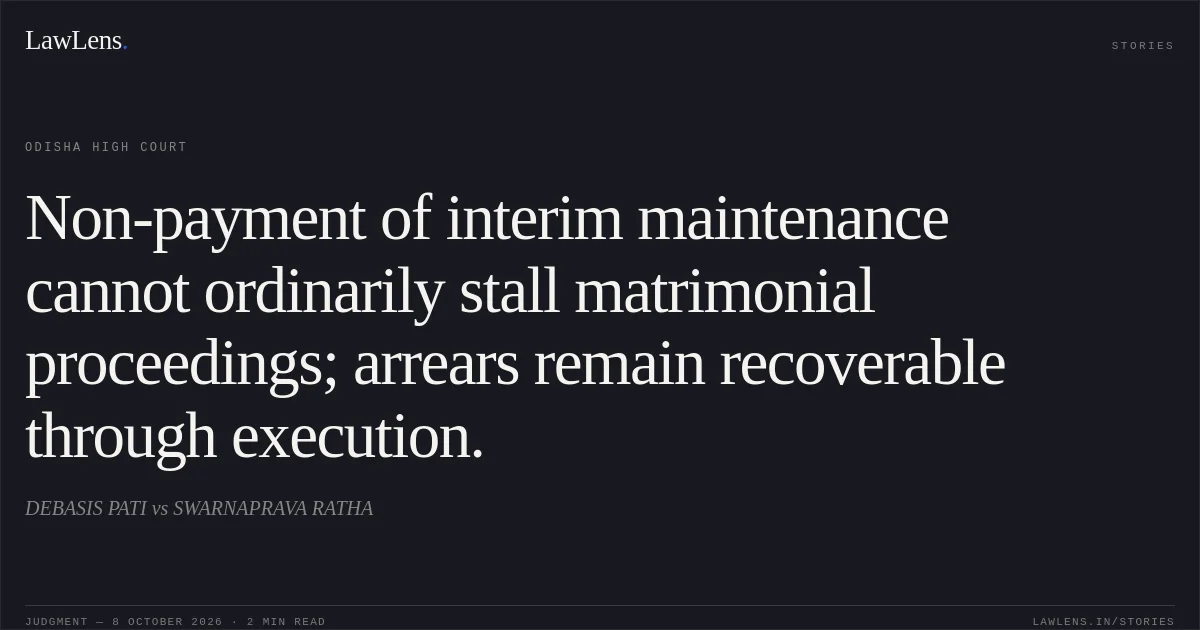
Source reference: pp. 7–8Whether non-payment of interim maintenance warrants staying a matrimonial proceeding, or whether the arrears should instead be recovered through execution or other appropriate proceedings.
Source reference: pp. 8–9Law Applied
Under Section 24 of the Hindu Marriage Act, 1955, interim maintenance is payable during the matrimonial proceeding.
Source reference: pp. 8–9The Court held that non-payment of maintenance ordinarily should not, by itself, result in the matrimonial proceeding being stayed or dismissed; unpaid arrears remain recoverable after disposal of that proceeding.
Source reference: pp. 8–9Relying on Rajnesh v. Neha, (2021) 2 SCC 324, the Court identified statutory routes for enforcement, including Section 28-A of the Hindu Marriage Act read with Section 18 of the Family Courts Act, 1984 and the relevant provisions of the Code of Civil Procedure, as applicable.
Source reference: pp. 8–9It also referred to Kaushalya v. Mukesh Jain, (2020) 17 SCC 822, concerning the striking off of a respondent’s defence for non-payment of maintenance in appropriate circumstances.
Source reference: p. 9Reasoning
The subsequent application sought relief identical to that refused in the Family Court’s order of 18 September 2025. The High Court found no changed circumstances or cogent reason justifying the Family Court’s departure from its earlier decision.
Source reference: p. 8It also considered that staying the divorce proceeding would impede its disposal, while leaving the wife’s maintenance claim without a remedy was unnecessary because the arrears could be recovered through execution or other proceedings recognised in Rajnesh.
Source reference: pp. 8–9The stay was therefore unsustainable, but setting it aside did not extinguish the husband’s liability to pay either accrued or ongoing maintenance.
Source reference: pp. 9–10Holding
The High Court set aside the Family Court’s order staying the divorce proceeding.
It permitted the husband to pay the accrued arrears—stated to be ₹1,50,000 at the hearing—in instalments within six months, in addition to paying current maintenance as directed by the Family Court.
Source reference: p. 10The wife remained at liberty to initiate execution or recovery proceedings in accordance with law if payment was not made.
Source reference: pp. 9–11Acts & Sections Cited
12 provisions across 5 statutes referred to in this judgment. Each provision opens on LawLens.
Hindu Marriage Act, 19553
Code of Criminal Procedure, 19732
Family Courts Act, 19841
Protection of Women from Domestic Violence Act, 20051
Code of Civil Procedure, 19085
Original Court PDF
DEBASIS PATIvsSWARNAPRAVA RATHA
Click to open original judgment
Original judgment, available to read, download and summarize on LawLens.in